Somalia: The Specter of Detrimental Trusteeship
by Abukar Arman
"The arrangement places Somalia at the mercy of its occupier, Ethiopia."
As America and indeed the rest of the world were counting down the last few days before a historic election, Somalia was hard-pressed to face another less promising replay of an old history; one destined to take it where no other sovereign state has ever gone before - into oblivion!
Though it is not officially being called that, Somalia has in effect become the first country in the 21st Century to be placed under trusteeship.
The trusteeship system was established to help United Nations Trust Territories (former colonies) attain the capacity for self-determination and self-governance. This is good so long as there is a trustee willing to help in capacity-building and a trustee council providing the necessary supervision and scrutiny.
The irony in this case is that it is not the United Nations imposing this decision; rather, it is the Horn of Africa regional authority IGAD (Inter-Governmental Authority on Development). The UN has suspended the trusteeship mandate in 1994. And contemplating what impact this precedent might have on the sanctity of the state sovereignty enshrined in the UN Charter requires a whole different discussion. This article, needless to say, deals with the imminent ramifications of IGAD's decision, and how that might further complicate the already volatile situation in Somalia.
Some are already convinced that the "Declaration of the 13th Extraordinary Session of the IGAD Assembly of Heads of states and Governments" is a better alternative to the current state of chaos and relentless violence in Somalia. Others feel they heard this all too familiar argument when the Ethiopian tanks roared into Mogadishu in December 2006 after crushing the Islamists who established relative peace and order in a number of Somali towns and regions. The horrific result of that ill-advised invasion is Africa's worst humanitarian crisis.
True, when the options are limited, choosing the lesser of two evils is the logical approach to problem solving. However, what is in reality a "lesser evil" is open for debate.
"The IGAD declaration as a manipulative charade to lend a façade of legitimacy to the Ethiopian occupation of Somalia."
The supporters of this controversial declaration base their argument on the premise that expedient, selective power-sharing is the solution. And since the declaration, among other things, compels the TFG (Transitional Federal Government) to form a new coalition government in two weeks, they are counting on a high profile Islamist accepting the Prime Minister position. And the name often mentioned is that of Sheikh Sharif Sheikh Ahmed - the ousted chairman of the ARS ( Alliance for Re-liberation of Somalia). However, it is important to note that, in his current status, after breaking up with ARS, this charismatic leader is widely believed to have little or no direct influence on the steadily growing insurgency determined to drive the Ethiopian forces out of Somalia.
Others, on the other hand, consider the IGAD declaration as a manipulative charade to lend a façade of legitimacy to the Ethiopian occupation of Somalia.
Adding insult to an injury,
Prime Minister Meles Zenawi of Ethiopia, who engineered the meeting, is the current IGAD Chairman who presided over the meeting.
And while there are indeed other questionable provisions in the declaration, number 16 and 17 clearly stick out. The former states in no uncertain terms that "the anchor of all the efforts in relation to Somalia must be IGAD." And, the latter, in an extrajudicial overreach devoid of any diplomatic refinement, asserts that "in default of the above, the IGAD Assembly shall meet and review its options, as it will not be business as usual."
Wittingly or otherwise, the TFG and IGAD agreed to sign onto a scheme mimicking the UN Trusteeship only to place Somalia at the mercy of its occupier, Ethiopia. This is a case of putting the fox in charge of the barn so that he may teach the chicken how to function in an orderly manner!
Part of Ethiopia 's strategic plan is to keep Somalis at war with one another. This is articulated in its National Security Policy and Strategy posted on the Federal Democratic Republic of Ethiopia Foreign Affairs website. And, candidly speaking, that is why for the last 17 years no other country but Ethiopia has armed Somali factions against one another, and tried to micromanage the Somali political affairs. And IGAD has been the enabler.
IGAD has long been accused of being subservient to the wishes of Washington 's loyal partner in the region in its failed foreign policy driven by GWT (Global War on Terrorism). Despite the expressed protestations by some of its members such as Eritrea and Djibouti, IGAD had opted to remain silent on Ethiopia 's invasion of Somalia - an act that would ultimately compel Eritrea to withdraw its IGAD membership. This left Ethiopia, Djibouti, Kenya, Sudan, Uganda, and Somalia as the current members of IGAD.
The situation in Somalia is more desperate today than it has ever been. Among other things, Ethiopia is set to discredit any vestige of nationalist leadership and to spread violence and hate. Imagine this scenario: Sheikh Sharif becomes a Prime Minister and takes his position as one of the Ethiopia-dependent cardboard figures. Insurgents fire at the Ethiopian troops, and the latter respond with indiscriminate shelling in a scale comparable to the " Mogadishu massacre" of early 2007.
Meanwhile, piracy and kidnapping of international aid workers, and the reckless actions of various criminals and extremist outfits in Somalia continue to overshadow the suffering of over 1 million internally displaced persons and over 3 million on the verge of starvation.
Abukar Arman is a writer who lives in Ohio. His work has appeared on the pages of International Herald Tribune, Al-Jazeera Magazine, and Tikkun Magazine.

 Gerald Perreira is chairperson of the Organization for the Victory of the People in Guyana. He discusses the America’s Counter-Cartel Coalition (ACCC) known as Shield of the Americas, the latest…
 The Democratic Party will recalibrate its messaging after its well-funded senate candidate in a Michigan primary lost to Abdul El-Sayed, who by his own admission is a capitalist, not a socialist, and…
 “Conflicts over colonies constitute the major source of war in the modern world.”
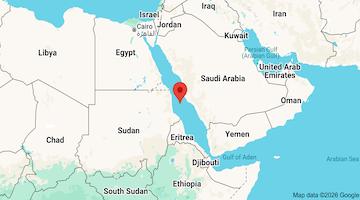 Saudi Arabia has formed a 14-state coalition to stop Ansar Allah, which has threatened to blockade its oil tankers in the Red Sea.
 “...when I talk about our political institutions, there is no reason for any American to continue to be victimized by what we still refer to as the Republican and Democratic parties…We don’t have to…


