On April 6, 1994, soldiers assassinated Rwandan President Juvenal Habyarimana and Burundian President Cyprien Ntaryamira by firing surface-to-air missiles at the plane carrying them back to Kigali from Dar es Salaam.
The records of the International Criminal Tribunal on Rwanda should not be surrendered to the Rwandan regime led by President Paul Kagame.
Rwandan President Paul Kagame and his ethnic Tutsi regime have renewed their demand to have the archives of the International Criminal Tribunal on Rwanda moved to Kigali, Rwanda’s capital. As they have demonstrated time and time again, they want to completely control the history of the infamous 100 days known as the Rwandan Genocide, between the first week in April and the last in July, 1994. They want to erase all evidence of their own responsibility for the horrific bloodshed between ethnic Tutsis and ethnic Hutus.
Rwanda suffered three years of war beginning on October 1, 1990, when an army of Rwandan Tutsi exiles led by then General Paul Kagame invaded Rwanda from Uganda and waged war to reclaim power from the Hutu government that had emerged from the Rwandan Revolution, also known as the Hutu Revolution, that had overthrown centuries of Tutsi rule. On August 4, 1993, the two sides signed the Arusha Accords, a negotiated settlement to end the war.
According to the Accords, there was to be a ceasefire and a transitional government until elections could be held, but they were never held. Instead, soldiers fired surface-to–air missiles that shot down the plane carrying Rwandan President Juvenal Habyarimana and Burundian President Cyprien Ntaryamira while they were returning to Kigali from Dar-es-Salaam. The population panicked, chaos ensued, and General Kagame’s Rwandan Patriotic Front launched a military assault that led to their victory in July, 1994, when Kagame seized power that he has held ever since.
Ethnic massacres of epic scale were committed during the hundred days after the plane was shot down, with estimates of the victims ranging from 300,000 to two million, but for some reason the press has in recent years settled on the figure 800,000 and stuck to it, for no ascertainable reason. It was widely reported that all the victims were Tutsis or “moderate Hutus” who tried to protect them, and this has been reinforced by “Hotel Rwanda” and countless other Hollywood movies, but abundant evidence has since emerged that hundreds of thousands of Hutus were also massacred. The International Criminal Tribunal on Rwanda was created to prosecute crimes of genocide and crimes against humanity committed during the 100 days, but only Hutus were indicted and prosecuted. Famed international criminal prosecutor Carla Del Ponte served as the court’s Chief Prosecutor for some time, but she was dismissed by the US, which controlled the court, after letting them know that she intended to prosecute Kagame and his officers for the assassination of the two presidents that triggered the bloodshed and for other crimes.
Defense attorney Tiphaine Dixon reported further evidence that the court’s mandate was to ignore the assassinations that triggered the ensuing catastrophe when speaking to Phil Taylor, host of The Taylor Report on radio station CIUT-Toronto. A judge, she said, had responded to her in court by saying, “We don’t investigate plane crashes.”
On April 22, 1995, Kagame’s army massacred between 4,000 and 8,000 Hutu men, women, and children at the Kibeho Camp for internal refugees in southern Rwanda. UN human rights monitors, photojournalists, and UN peacekeepers all witnessed the massacre but neither Kagame nor any of his officers have ever been indicted for the crime in international courts, including the International Criminal Tribunal on Rwanda.
One can agree or disagree with the way I have just told this history as well as I’ve been able to understand it in what is now 18 years of study, but with regard to the International Criminal Tribunal on Rwanda, the point is that the court adamantly refused to investigate the greatest crime.
Who had reason to assassinate the Rwandan president? Kagame was ultimately facing an election that he could not win. With a majority population, he could not defeat a Hutu candidate for the presidency, though he and other Tutsis would be rightly expected to win a share of power.
Their counter-argument is that the Hutu government wanted to create a
false flag that would give them an excuse to massacre Tutsis, in what they absolutely insist on naming, and require the world to name, the “genocide against the Tutsi.”
Fine then. If the Rwandan government’s explanation is plausible, why not investigate? The court did not.
However, this has never been enough for Kagame, not nearly enough. He has absolute power in Rwanda and he wants absolute control of its history. He is determined to have the archives placed under his control in Kigali, which is obviously not a neutral country, as noted in a UN report on the deliberations.
The UN representative of the United Republic of Tanzania—whose country hosted the Tribunal for Rwanda for 20 years in Arusha— pointed out that the archives have been kept safe in a neutral country with access for researchers, lawyers and historians in “state-of-the-art infrastructure”. Keeping these records in Arusha would be a stress-and cost-free solution. “We are ready, we are willing and we are reliable,” he argued.
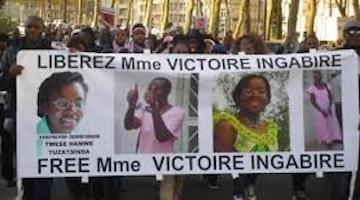
Many researchers, lawyers, and historians are unable even to enter Rwanda without fear of being arrested like the late Peter Erlinder, a lawyer who traveled there to try to defend political prisoner Victoire Ingabire, who served eight years in prison and is now in custody and facing sentencing again. Her principal crime? Alleged “genocide denial,” stating her conviction that Rwandan Hutus were also victims of crimes against humanity “before, during, and after the genocide.” She was arrested for saying that and Peter Erlinder was arrested for traveling to Rwanda to defend her, and for making similar statements in his own writing.
How could Rwanda possibly be even considered a safe place to store the archives? It’s outlandish that the UN is even discussing this, but they are. It has been on the Security Council agenda, though it wasn’t brought to the floor, but with Rwanda applying pressure, it may come up again soon.
Ninety-three people were indicted by the Court, and proceedings were completed for 82. Fourteen were acquitted and two had their indictments withdrawn, so, despite the obvious and extreme bias of the court, evidence demanded at least fourteen acquittals, and not all defendants were convicted of all charges brought against them. Twenty-three have served their sentences. Quite a few have died and several were referred to their home country for prosecution.
However, the Kagame regime actually dares to demand that all 14 of those acquitted be returned to Rwanda, quite likely for prosecution once again, in hopes of a different outcome. He also demands the repatriation of those who have served out their sentences, quite possibly for more trials. How could the UN even consider such demands? How could they rationally consider returning either the archives or the former defendants to Rwanda?
Judi Rever is the author of In Praise of Blood: Crimes of the Rwandan Patriotic Front and Rwanda’s 30-Year Assault on Congo: the Crimes, the the Criminals, and the Coverup. While she was writing her first book, Kagame’s agents threatened her and her pre-school age daughters. Belgian secret service agents appeared at her side in a hotel in Belgium to warn her that Kagame had agents in the country to kill her and said that they would be at her side as long as she was in the country. She obviously cannot travel to Rwanda; transfer of the archives would end her use of them in ongoing research.
“The move,” she said, “would deliver a death blow to a court that has already officially tried to erase history, for failing to prosecute Paul Kagame and his Tutsi forces for mass crimes committed in 1994.”
She also says, “There is no doubt that if the ICTR had prosecuted Kagame and his senior commanders, it could have stopped Kagame’s dark crusade in Congo. Congo’s war might have ended in 1997, or at the latest in 2003, when the indictments were prepared but then withdrawn. Millions of Congolese lives could have been saved. The ICTR only prosecuted one side of the conflict—Hutu perpetrators—and failed to hold Kagame and his army, the victors of Rwanda’s conflict, accountable for their crimes. The court ensured Kagame’s moral invincibility in the eyes of the international community; it emboldened him and allowed him to pour gallons of blood onto central Africa.
The judicial malfeasance denied Kagame’s victims the dignity of telling their stories and preserving memory for a future generation. Courts do not simply interpret and apply laws; they create history. Lawyers and judges select and frame evidence and create historical narratives. For many victims in Congo and Rwanda, the international courts have been little more than propaganda tools that have served US hegemonic interests in a unipolar world.”
Nevertheless, there are records and voices to be drawn from the archives for future researchers. There are statements of protected witnesses who would be endangered if the archives were moved to Rwanda. There is evidence, including that presented in defense of the 14 acquitted and in defense of those who were convicted of lesser crimes than they were charged with. There are defense attorney’s pleadings that tell a different story than that the Kagame regime has so successfully shaped and promoted since seizing power with the help of the US, which controlled the court. There is even a judge’s conclusion that there was no evidence of conspiracy to commit genocide.
Rwanda’s human catastrophe was among the worst of the 20th century. We are often told that the world must prevent “another Rwanda,” often in argument for so-called humanitarian intervention. Future generations deserve the chance to evaluate the evidence of what really happened, why it happened, and who was responsible.
Ann Garrison is a Black Agenda Report Contributing Editor based in the San Francisco Bay Area. In 2014, she received the Victoire Ingabire Umuhoza Democracy and Peace Prize for her reporting on conflict in the African Great Lakes region. She can be reached at ann@anngarrison.com. You can help support her work on Patreon.


 In this week’s segment, we discuss organizers in Washington, D.C. who developed a transit solidarity program to oppose transit fare crackdowns that criminalize poverty. But we begin with a discussion…
 Dr. Shireen Al-Adeimi provides historical background and analysis of events in Yemen as Ansar Allah advances against Saudi-backed mercenaries.
 Pan-African Community Action (PACA) released a Transit Solidarity Plan for Washington, DC that challenges DC fare evasion crackdowns by collecting and redistributing fare cards to residents in the…
 The United States got its hands on Alex Saab a second time in order to use him in its case against Nicolás Maduro. The U.S. succeeded in getting a guilty plea from Saab, but the current Venezuelan…
 “The Iraq invasion greatly accelerated the process of U.S. imperialism’s decline.”


