Jack Johnson in a boxing match with James J. Jeffries on July 4, 1910
Earlier this month, Donald Trump's White House hosted the UFC for a day-long event known as “Freedom 250” — fights the media compared to gladiatorial spectacles, infamous for overtly right-wing statements from fighters and commentators alike. To discuss its meaning and the broader problem of right-wing fighting culture, Joshua Reaves-Charmelus spoke with Ben Passmore, a cartoonist, author, amateur Muay Thai fighter, and self-defense instructor in Philadelphia. His works — including Sports Is Hell and Black Arms to Hold You Up — explore physical culture, race, and violence in modern American society.
Joshua Reaves-Charmelus: You came to martial arts through politics. Tell me about that path.
Ben Passmore: I got into anarchism more or less in college, and over the course of the time I was involved in anarchism, there was this strong intersection with anti-fascism. I would find myself going to Tennessee because there was a big Klan rally, or going to Stone Mountain where there were Nazis. People my age who engaged with fascism were sort of the anti-racist action generation, which included a lot of street violence — even if you weren't going to a demonstration for that, it would have that feature. So I got into boxing in my 20s, purely because I wanted it for self-defense.
As a Black radical, I was conscious of the Black Panthers' history of training karate, and as I studied Black Power history, I got to know groups like the Revolutionary Action Movement (RAM), who did Kung Fu in the Park. I was excited as a younger political person to do martial arts for the practical reasons and for the historical reasons.
I got into Muay Thai through an ex-partner who was an anarchist from the Bay — around the 2010s, when Bay Area radicals were deeply involved in anti-police violence movements after Oscar Grant was killed at Fruitvale Station. A lot of radicals in that area were dealing with police violence and with Nazis like the Golden State Skinheads, so they would train Muay Thai and Brazillian Jiu Jitsu. After I moved to Philadelphia, I went out to Mexico City, to an anarchist kickboxing gym called Centeno Colectiva — that gym had strong connections to Bay Area anarchists — and that's where I learned how to really train in a gym setting. It basically set me off training really, really obsessively, and made martial arts and self-defense central to my organizing and to what I share with people through mutual aid.
JRC: In Black Arms to Hold You Up and Sports is Hell, you speak about street violence and community self-defense as part of a culture. What's the relationship between the physical practice of martial arts and the political and social world around it?
BP:Things like boxing, football, and basketball have always been owned by right-wing billionaires, with varying levels of support for conservatism and, more recently, Trump. But the thing that's always been inconvenient to white nationalists — in the White House and not — is that these sports produce Black millionaires who sometimes will not parrot, and actually speak against, white supremacy.
One of the most prominent examples in fighting sports is Muhammad Ali. We can't underestimate the discomfort that the white people who make the most off of fighting sports have with the fact that Muhammad Ali — a prominent Muslim, member of the Nation of Islam, friend of Malcolm X, Black nationalist — that his name rings out. The fact that Dana White is using Muhammad Ali's name in the Ali Act to try and gut the few benefits there are in boxing, I think speaks to that discomfort. The most reputable fighters are, more or less, pro-Black.
We shouldn't underestimate how frustrated people like Trump were with Colin Kaepernick using his position to kneel during the national anthem, or with basketball players wearing pro-Black t-shirts. The UFC is sort of ideal in that even while Dana White goes in and out of pretending to be a moderate, you will have prominent stars expressing overtly white supremacist talking points. Even in the UFC, if you remember the first Colby Covington and Kamaru Usman fight, Covington generated legitimate heat just for being a Trump supporter. At the time it was still a provocation to be an overt Trump supporter. It isn't anymore.
JRC: Going as far back as Jack Johnson in the 1910s — criminalized under the Mann Act, forced into exile, his fights banned in entire states — how much of that racial anxiety is still operating in how we talk about Black athletes today?
BP: I think we underestimate how much white people politicize Black excellence. It is enough for a Black person to just be unapologetically Black, and that gets read as deeply threatening. Allen Iverson is a really good example — someone who just was unapologetically Black, wearing wave caps and has tattoos and chains, and that was seen as deeply shocking to white people. The act of being unapologetically Black is implicitly left-wing to them — by them, I mean white people, particularly white supremacists.
Jack Johnson — I don't think there's anything inherently radical about being Black, rich, and dating white women. There's a way in which that's playing into very white values. If I'm going to look to someone for pro-Blackness, I'm obviously going to look to someone like Ali. But thinking about Blackness and the white gaze: even if you're racist, the most prominent, most venerated athletes are Black. If you just talk to a random white person about who their favorite white boxer is, nine times out of ten it's gonna be someone who didn't exist — it's gonna be Rocky from the Rocky movies. So I think the UFC is creating this opportunity for someone like Sean Strickland — where they're finally able to have the “Great White Hope,” not even be the hope, just the great white champion.
JRC: That same week as Freedom 250, there was a pogrom in Belfast, Northern Ireland targeting migrant businesses and homes. Do you see a direct connection between far-right street violence and right-wing fight sports promotion?
BP: There's a direct line. Active Clubs — explicitly fascist youth fighting groups — were busing members to Belfast to participate in those pogroms and white race riots. Active Clubs were founded by Robert Rundo, who's a prominent neo-Nazi. This is a national organization backed by a huge amount of money. There's a recent article about Australian neo-Nazis living in million-dollar mansions owned by billionaires in that country.
There is a connection between Active Clubs and underground fighting organizations like King of the Streets, which itself has connections to European MMA organizations and also the UFC. Neo-Nazis, both in the US and globally, have been using BJJ specifically as a way to recruit young people and to have legitimate standing within the martial arts community. They've seen MMA as a way to participate in cultural white nationalism.
And this shouldn't surprise us. Most martial arts — Kung Fu, Karate, Muay Thai, Judo — have always more or less been a tool for nationalists. When people get together to train, to practice, to test themselves, they build really strong cultural bonds and really potent cultural and physical capacity. The UFC understands that. What worries me is that Americans might develop a backlash against practicing martial arts in general. That would be a mistake. One should think of low kicks and guillotine chokes the same way you think of a Kalashnikov — it's something you want to be excellent at if you want to be able to advocate for your freedom and liberation.
JRC: You teach self-defense courses with the Neighborhood Martial Arts Project. Who are your students, and what are you trying to give them beyond technique?
BP: Who I end up training with tends to be wide and reflects the communities I'm a part of. I've been an anarchist for a long time. American anarchism has comprised, among other people, a lot of queer and trans people. I'm a Black man — my main contradiction is that I am a Black anarchist who also has aspirations towards nationalism. But I'm in common cause and in community with other Black men and other Black radicals. That's the wide range of people who come to me.
I came to martial arts as an adult through insurrectionary anarchism — a kind of anarchism that believes in not waiting to confront white supremacist capitalism and authoritarianism. I learned in that community to build up tools and excellence. If you want to be able to do, you have to be excellent about it. That's generally how martial arts work.
When trying to train people, I want to confront some of the historical hierarchies that exist in a gym or dojo. I may be a coach, but my goal is to teach people enough so that I'm unnecessary — so they can, as soon as possible, pursue their own training for their own goals. In the last few years we've seen more and more left-wing gyms — mostly anarchist, but also different kinds of socialists — developed in the spirit of what we would have seen on the East Coast with Black kung fu gyms: people training and then meeting up to fight and test themselves, left-wing fighting events, smokers, exhibition matches.
Other than teaching people how to defend themselves — or how to kick a Nazi out of his situation — it's also about building fight culture with each other. It's an excellent way to organize with people. It's an amazing way to build trust. And it's more exciting than sitting in a meeting, which often alienates a lot of people. Radical third spaces have always been really, really important. I don't like capitalism, but I love a Black bookstore. The UFC and fascist fighting culture seeks to attract disaffected and isolated and bitter young men. Martial arts gives us an opportunity to teach those same people healthy habits, consent, and a commitment to your body that has nothing to do with technology.
The gym is also how I learned what mutual aid actually means — it's not transactional. It's not deciding who needs what more. It's: we're getting together to make each other excellent.
JRC: Do you see Freedom 250 as a peak moment in right-wing convergence or an accelerating trend of open fascism in American sports?
BP: The run-up was sort of interesting, because Dana White did the media circuit and, unlike the raging support he gave Trump during the inauguration, he was trying to position himself more like a Joe Rogan type — well, I'm a moderate, I have liberal friends, this is just about loving America. You're seeing him and the wider manosphere podcast industry that relies on faux hypermasculinity trying to hedge their bets, since the bipartisan alarm over the Epstein files and Trump's botched war with Iran. They're reverting to semi-quote-unquote politically neutral positioning.
But Freedom 250 hit us with a big tell. These statements about Michelle Obama, the general tone — they should be seen as acts of desperation, in the same way that the state sentencing the Prairieland defendants with 50 to 70 years is an act of desperation. This Trump era — what we call the MAGA movement, but is itself just the fascist third position — is deeply terrified of losing legitimacy, because it is. They hitched their wagons to Trump so much that they're losing anyone who watched the UFC and just chose to ignore the politics. It's a massive act of insecurity.
JRC: Between left-wing gyms and right-wing fight promotions, where does martial arts culture go from here?
BP: The thing to always remember is that neo-Nazis thrive on the margins. We're just in this rare time where these kinds of fascists can just be in government. Even if Trump fails, this kind of fascism has taken over so many governments around the world. One of the byproducts is that fascists in gyms, fascists in smaller promotions, Active Clubs — they can operate very publicly without being embarrassed. There was a time where if you were a neo-Nazi, even other racists would be embarrassed of you. We're not in that time anymore.
What's likely is that a more effective politician — whether it's Tucker Carlson or someone who is, in fact, more fascist — will get into power. So that's maybe pessimism. But I'm encouraged to see more decentralized culture-building around fighting, more fighters being really open about their politics and really antagonistic to fascists. I just think it's too small. People need to recognize that we don't have an equivalent to Elon Musk. They have all this funding. Just like every other left movement in the United States, we have to understand something our ancestors understood: it's gonna take twice the effort to reach our goals. We're running uphill, we're swimming against the river. But we're braver and smarter, and we're correct.
You gotta do the road work. You gotta get those hours in.
Ben Passmore is the author of Black Arms to Hold You Up (Penguin Random House) and Sports Is Hell. He can be found at @daygloayhole on Instagram and Bluesky.
Joshua Reaves Charmelus is a husband, writer, and grassroots internationalist. He uses political and historical analysis, photography, and speculative fiction to practice the unity of study and struggle that his political ancestors modeled.



 In this week’s segment, we hear about the ongoing uprising in France against neo-liberal austerity, colonialism, and white supremacy. But first, we discuss a new report that reveals a 25% decline in…
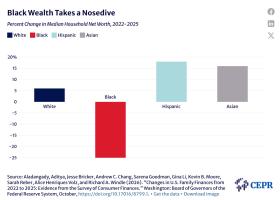 The Center for Economic and Policy Research (CEPR) recently reported on Federal Reserve data indicating that Black people in the U.S. have lost 25% of their wealth between 2022 and 2025. Whites,…
 Bouna Mbaye is an activist, writer, and a member of the Pan-African League-Umoja, the Pan-African Brigade for Palestine, and the US Out of Africa Network. He joins us from Paris to discuss the…
 As Black Agenda Report is poised to celebrate its 20th anniversary, we reprint Glen Ford's commentary on the killing of Trayvon Martin and the impunity provided to his killer in a criminal justice…
 The Democratic Party is terrified of even small liberal reforms and will not abide left leaning democrats thwarting their plans for austerity and neoliberal orthodoxy.


