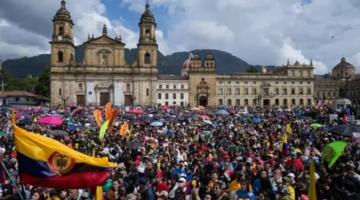
Colombia's presidential election will be held on June 21st as Historic Pact candidate Ivan Cepeda runs against the Trump endorsed right wing candidate Abelardo de la Espriella. This analysis written before the May 31 runoff provides context for the importance of this election for Colombia and all of the Americas.
Originally published in Alliance for Global Justice.
Versión en español abajo
Colombia is approaching the most important election on the continent—and possibly on the planet. Not because Bogotá will decide merely the administrative fate of a peripheral state, but because something far more profound is at stake in Colombia: the possibility that Latin America will continue and deepen the historic rupture that began with Gustavo Petro’s government in the face of the old order of the armed oligarchic estate as a form of government.
While Europe is consumed by its liberal exhaustion and the United States is once again flirting with mass fascism, the Latin American continent is once again becoming the decisive laboratory of global politics. Honduras was the warning. Argentina is the experiment. Peru, the dress rehearsal for the hollowing out of democracy. And Colombia—precisely Colombia—is the tipping point.
The Continental Oligarchic Restoration or the Return of the Monroe Doctrine
The revelations known as “Honduras-Gate” —a series of leaked conversations involving political, media, and security actors linked to governments and far-right sectors in the region, including the United States, Argentina, and Honduras, discussing strategies of pressure, destabilization, and cognitive warfare against popular democratic processes in countries such as Colombia and Mexico— finally brought to light something that for years many preferred to dismiss as Latin American paranoia: the existence of coordinated mechanisms linking far-right sectors, intelligence agencies, military structures, media conglomerates, and governments aligned with Washington to contain or destabilize popular democratic processes in the region. The disclosed discussions regarding Colombia, Mexico, and other Latin American countries revealed the extent to which the old hemispheric logic of the Monroe Doctrine continues to operate in contemporary forms, combining diplomatic pressure, media and cognitive warfare, lawfare, regional intelligence, and political destabilization operations, thereby reviving the old hemispheric technologies of regime change against governments and popular movements.
For an American reader, the parallels should be impossible to ignore. The same political, media, and corporate constellation aligned with Trumpism that intervened in recent Latin American processes—including the political pressure campaigns and cognitive warfare observed in Argentina and Honduras—is now openly involved in attempts to manipulate and influence the U.S. midterm elections. The classic distinction between domestic and foreign policy is beginning to blur under a new reactionary international order centered on authoritarian nationalism, disinformation, and the permanent destabilization of democracy.
In this context, the Colombian elections go far beyond the national framework. Colombia could become the first major hemispheric rejection of the international rise of contemporary fascism, or a new strategic victory for the authoritarian forces seeking to restore the old continental order through social fear, cognitive warfare, and oligarchic discipline. For U.S. voters, interference in Colombia reflects processes already unfolding within the United States, where Trump’s Republican Party is increasingly attempting to subvert democratic procedures through institutional pressure, disinformation, voter suppression, attacks on electoral legitimacy, and increasingly open efforts to undermine and potentially overturn democratic electoral processes.
That is why there are profound reasons to closely observe what happens in Colombia on May 31: to denounce U.S. intervention, to understand the international dimension of this dispute, and to recognize that the continent’s democratic future is no longer played out solely within national borders.
What is happening in Colombia is not simply a dispute between the left and the right. That interpretation is too narrow to grasp the historical moment. What is at stake is the continuation of a process of radical and ethical democratization of the Colombian state, or the triumphant return of oligarchic necropolitics: recycled paramilitarism, land dispossession, a narco-economy integrated into regional power, structural corruption, reactionary evangelism, and violence administered as social pedagogy.
The oligarchy and the fear of the people
The Colombian elite knows this. Perhaps better than anyone else. That is why they react with such disproportionate paranoia toward figures like Iván Cepeda or toward the Historic Pact itself. Because when Cepeda speaks of an “ethical revolution,” the Colombian oligarchy does not hear a democratic transformation: it hears an insurgent threat. Not because Cepeda is a guerrilla in disguise—that caricature belongs to the outdated paranoid delusions of the landowning castes—but because Colombia’s ruling classes have spent decades confusing social justice with terrorism.
After two centuries of running the country like a plantation surrounded by private armies, the local oligarchy has lost the ability to imagine a real democracy. Any redistribution of symbolic, economic, or racial power strikes them as illegitimate violence, if not terrorism. Any popular uprising strikes them as war. Any commoner with intellectual authority is unbearable to them due to their deep class contempt, to that oligarchic conviction that knowledge, elegance, and political authority are the exclusive and monopolistic heritage of the upper castes.
Part of the tragedy in Colombia is that this mindset ultimately sabotaged even the historic possibility of a relatively stable democratic transition. The systematic obstruction of the peace process during the administration of Juan Manuel Santos—with figures such as then-Attorney General Néstor Humberto Martínez playing a decisive role in the legal and political blocking of the agreements—helped create exactly the scenario the far right needed: State noncompliance, the persecution of sectors linked to implementation, and the deliberate failure to dismantle regional war economies allowed residual armed groups to survive, whose existence ultimately serves as the perfect fuel for the politics of fear.
Every episode of sporadic violence, every act of residual terrorism, reactivates the favorite emotional mechanism of Latin America’s authoritarian right-wing: militarization, permanent exceptionalism, and the restoration of the internal enemy. The Colombian paradox is brutal: sectors that for decades blocked a democratic resolution to the conflict ended up using the consequences of that very sabotage as an argument to prevent further democratic transformations.
The dispute over the horizon of meaning.
Herein lies precisely the historical nature of the moment. Because the Historic Pact does not emerge merely as an electoral coalition. It also emerges as a rupture against decades of neoliberal domestication of political language and stigmatization under the doctrine of the internal enemy. Neoliberalism not only privatized public enterprises and dismantled social gains: it also attempted to privatize the collective imagination. It sought to render words like “class,” “exploitation,” “oligarchy,” or “social justice” obscene—or to expel them from language altogether. All were meant to appear as uncomfortable archaisms from another era, ideological remnants of the Cold War and the long Latin American counterinsurgency. That logic was historically organized under the so-called “internal enemy doctrine,” a political and military concept—fueled as much by American McCarthyist anti-communism as by European traditions of fascist persecution against the “infiltrated enemy”—that transformed social conflict into a permanent war against the population itself. In Latin America, that doctrine made it possible to label any project of social justice as suspected subversion. The problem was never solely armed insurgencies: the true enemy was the possibility of a popular democratization of power. The same counterinsurgency doctrine that was refined in Colombia has been applied far beyond its borders. What happens in Colombia does not stay in Colombia: the tactics once used to undermine popular movements, manipulate public opinion, criminalize dissent, and contain democratic transformation are increasingly visible in the United States and elsewhere, including in attempts to shape electoral outcomes and repress pro-democracy and anti-fascist movements ahead of the November elections.”
Under this logic, any demand for social justice could be interpreted as a subversive threat. Trade unionists, students, peasants, journalists, indigenous movements, social leaders, human rights defenders, or even moderate reformists were turned into potential enemies of the state, with the aim of preventing the emergence of democratic majorities capable of challenging the oligarchic monopoly on power.
It is not surprising, then, that for years even a significant portion of Latin American progressivism ended up speaking the sanitized language of governance, entrepreneurship, and global technocracy, as if social conflict had been overcome by cultural decree.
That is why the Historic Pact is shaking up the Latin American political landscape so much. It brings back to the center of the discourse something that the local elites believed had been definitively neutralized: the material existence of the contradiction between social classes. Suddenly, urban youth, trade unionists, grassroots feminists, Afro and Indigenous movements, and university sectors are once again talking about redistribution, dignity, and popular power without making ideological apologies. There is something magnetic about this phenomenon. After decades of aspirational neoliberalism and empty technocracy, politics once again has substance, desire, historical memory, and collective ambition. The left, for the first time in a long while, has ceased to appear as a melancholic administration of defeats with no alternative and has begun to look like the future.
That is what truly terrifies the ruling classes.
It is not merely the figure of Iván Cepeda as an individual. Nor is it, strictly speaking, a specific economic program that produces such a level of panic among the ruling classes. What truly terrifies them is the emergence of an unashamed popular subjectivity with a drive for power. Young people from the neighborhoods speaking the language of power without seeking cultural permission. Women politicizing everyday life. Indigenous and Afro-descendant communities occupying the symbolic center of the country. Proletarian university students discussing hegemony, historical debt, and redistribution as if Colombia finally belonged to them as well.
The Colombian oligarchy knew how to respond militarily and paramilitarily to the armed insurgency. What it does not know how to manage is a cultural democratization of power, an ethical and democratic revolution capable of challenging the country’s common sense without resorting to violence. And it is precisely this political impotence that is beginning to show through in the campaign speeches of its own candidates, increasingly permeated by fear, oligarchic class resentment, and the veiled threat of authoritarian restoration.
Because an ethical, aesthetic, and democratic revolution threatens something much deeper: the aristocratic monopoly on the very idea of the nation. That is, over the production of social consensus and, ultimately, over hegemony.
Democracy Under Siege
For the reasons outlined here, the Colombian elections extend far beyond national borders. In Colombia, it is not merely the fate of a progressive government that is at stake, but the very possibility that a profound democratic transformation might survive the coordinated advance of the continent’s new authoritarian right-wing movements.
Colombia could become the first major hemispheric democratic bulwark against the international advance of contemporary fascism. Or it could prove that the old Latin American elites, in league with global Trumpism and the hemispheric machinery of U.S. intervention, are still capable of blocking any profound democratization of the American continent.
What is at stake in Colombia no longer belongs solely to Colombia. The outcome of these elections could determine whether Latin America succeeds in deepening the historic rupture opened by the continent’s new popular democratic processes, or whether the Monroe Doctrine, the war against the working classes under the logic of the “internal enemy,” and oligarchic restoration manage to reorganize themselves under the contemporary forms of global fascism.
Colombia: Una revolución ética (con acento popular)
Colombia se aproxima a las elecciones más importantes del continente, y posiblemente del planeta. No porque en Bogotá vaya a decidirse únicamente el destino administrativo de un Estado periférico, sino porque en Colombia se está jugando algo mucho más profundo: la posibilidad de que América Latina continúe y profundice la ruptura histórica que comenzó con el gobierno de Gustavo Petro frente al viejo orden de la hacienda oligárquica armada como forma de gobierno.
Mientras Europa se consume en su agotamiento liberal y Estados Unidos coquetea otra vez con el fascismo de masas, el continente latinoamericano vuelve a convertirse en el laboratorio decisivo de la política global. Honduras fue el aviso. Argentina es el experimento. Perú, el ensayo general del vaciamiento democrático. Y Colombia —precisamente Colombia— es el punto de quiebre.
La restauración oligárquica continental o el retorno de la Doctrina Monroe
Las revelaciones conocidas como “Honduras-Gate” terminaron de hacer explícito algo que durante años muchos prefirieron descartar como paranoia latinoamericana: la existencia de mecanismos coordinados de articulación entre sectores de extrema derecha, aparatos de inteligencia, estructuras militares, conglomerados mediáticos y gobiernos alineados con Washington para contener o desestabilizar procesos democráticos populares en la región. Las discusiones reveladas en torno a Colombia, México y otros países latinoamericanos mostraron hasta qué punto la vieja lógica hemisférica de la doctrina Monroe sigue operando bajo formas contemporáneas, combinando presión diplomática, guerra mediática y cognitiva, lawfare, inteligencia regional y operaciones de desestabilización política, reactivando las viejas tecnologías hemisféricas de cambio de régimen contra gobiernos y procesos populares.
Para un lector estadounidense, el paralelismo debería resultar imposible de ignorar. La misma constelación política, mediática y empresarial alineada con el trumpismo que intervino en procesos latinoamericanos recientes —incluyendo las operaciones de presión política y guerra cognitiva observadas en Argentina y Honduras— participa hoy abiertamente en los intentos de manipular y condicionar las elecciones de mitad de mandato en Estados Unidos. La distinción clásica entre política doméstica y política exterior empieza a desdibujarse bajo una nueva internacional reaccionaria articulada alrededor del nacionalismo autoritario, la desinformación y la desestabilización democrática permanente.
En ese contexto, las elecciones colombianas exceden completamente el marco nacional. Colombia podría convertirse en el primer gran rechazo hemisférico al ascenso internacional del fascismo contemporáneo, o en una nueva victoria estratégica para las fuerzas autoritarias que buscan restaurar, mediante miedo social, guerra cognitiva y disciplinamiento oligárquico, el viejo orden continental. Para los votantes estadounidenses, la injerencia sobre Colombia refleja procesos que ya están ocurriendo dentro de Estados Unidos. Por eso hay razones profundas para observar atentamente lo que ocurra el 31 de mayo: denunciar la intervención estadounidense, comprender la dimensión internacional de esta disputa y reconocer que el futuro democrático del continente ya no se juega únicamente dentro de las fronteras nacionales.
Lo que está ocurriendo en Colombia no es simplemente una disputa entre izquierda y derecha. Esa lectura es demasiado reducida para entender el momento histórico. Lo que está en juego es la continuidad de un proceso de democratización radical y ética del Estado colombiano, o el retorno triunfal de la necropolítica oligárquica: paramilitarismo reciclado, despojo de tierras, narcoeconomía integrada al poder regional, corrupción estructural, evangelismo reaccionario y violencia administrada como pedagogía social.
La oligarquía y el miedo al pueblo
La élite colombiana lo sabe. Tal vez mejor que nadie. Por eso reaccionan con un nivel de paranoia tan desproporcionado frente a figuras como Iván Cepeda o frente al propio Pacto Histórico. Porque cuando Cepeda habla de una “revolución ética”, la oligarquía colombiana no escucha una transformación democrática: escucha una amenaza insurgente. No porque Cepeda sea un guerrillero encubierto —esa caricatura pertenece al delirio paranoico trasnochado de las castas terratenientes— sino porque las clases dominantes colombianas llevan décadas confundiendo justicia social con terrorismo.
Después de dos siglos administrando el país como una finca cercada por ejércitos privados, la oligarquía criolla perdió la capacidad de imaginar una democracia real. Cualquier redistribución del poder simbólico, económico o racial les parece violencia ilegítima, cuando no terrorismo. Cualquier emergencia popular les parece guerra. Cualquier plebeyo con autoridad intelectual les resulta insoportable debido a su profundo desprecio de clase, a esa convicción oligárquica de que el conocimiento, la elegancia y la autoridad política son patrimonio exclusivo y monopolístico de las castas altas.
Parte de la tragedia colombiana es que esa mentalidad terminó saboteando incluso la posibilidad histórica de una transición democrática relativamente estable. El entrampamiento sistemático del Proceso de Paz durante el gobierno de Juan Manuel Santos —con figuras como el entonces fiscal general Néstor Humberto Martínez desempeñando un papel decisivo en el bloqueo jurídico y político de los acuerdos— ayudó a producir exactamente el escenario que la ultraderecha necesitaba. El incumplimiento estatal, la persecución contra sectores vinculados a la implementación y la incapacidad deliberada de desmontar las economías regionales de la guerra permitieron la supervivencia de grupos armados residuales, cuya existencia termina funcionando como combustible perfecto para la política del miedo.
Cada episodio de violencia fragmentaria, cada acto de terrorismo residual, reactiva el dispositivo emocional favorito de las derechas autoritarias latinoamericanas: militarización, excepcionalidad permanente y restauración del enemigo interno. La paradoja colombiana es brutal: sectores que durante décadas bloquearon una salida democrática al conflicto terminaron utilizando las consecuencias de ese mismo sabotaje como argumento para impedir nuevas transformaciones democráticas.
La disputa por el horizonte de sentido.
Aquí reside precisamente el carácter histórico del momento. Porque el Pacto Histórico no irrumpe únicamente como una coalición electoral. Irrumpe también como una ruptura frente a décadas de domesticación neoliberal del lenguaje político y estigmatización bajo la doctrina del enemigo interno. El neoliberalismo no sólo privatizó empresas públicas y desmanteló conquistas sociales: también intentó privatizar el imaginario colectivo. Quiso volver obscenas -o expulsar del lenguaje- palabras como “clase”, “explotación”, “oligarquía” o “justicia social”. Todas debían parecer arcaísmos incómodos de otra época, residuos ideológicos de la guerra fría y de la larga guerra contrainsurgente latinoamericana. Esa lógica fue organizada históricamente bajo la llamada doctrina del enemigo interno, una concepción política y militar -alimentada tanto por el anticomunismo maccarthista estadounidense como por las tradiciones europeas de persecución fascista contra el “enemigo infiltrado”- que transformó el conflicto social en una guerra permanente contra la propia población. En América Latina, esa doctrina permitió convertir cualquier proyecto de justicia social en sospecha de subversión. El problema nunca fueron únicamente las insurgencias armadas: el verdadero enemigo era la posibilidad de una democratización popular del poder.
Bajo dicha lógica, cualquier demanda de justicia social podía interpretarse como amenaza subversiva. Sindicalistas, estudiantes, campesinos, periodistas, movimientos indígenas, líderes sociales, defensores de Derechos Humanos, o incluso reformistas moderados fueron convertidos en enemigos potenciales del Estado, con el objetivo de impedir la aparición de mayorías democráticas capaces de disputar el monopolio oligárquico del poder.
No resulta extraño, entonces, que durante años incluso buena parte del progresismo latinoamericano terminara hablando el dialecto higienizado de la gobernanza, el emprendimiento y la tecnocracia global, como si el conflicto social hubiera sido superado por decreto cultural.
Por eso el Pacto Histórico desordena tanto el paisaje político latinoamericano. Porque devuelve al centro del discurso algo que las élites criollas creían definitivamente neutralizado: la existencia material de la contradicción de clases sociales. De pronto, jóvenes urbanos, sindicalistas, feministas populares, movimientos afro e indígenas y sectores universitarios vuelven a hablar de redistribución, dignidad y poder popular sin pedir disculpas ideológicas. Hay algo magnético en ese fenómeno. Después de décadas de neoliberalismo aspiracional y tecnocracia vacía, la política vuelve a tener cuerpo, deseo, memoria histórica y ambición colectiva. La izquierda, por primera vez en mucho tiempo, dejó de parecer una administración melancólica de derrotas sin alternativa y empezó a parecer futuro.
Eso es lo que aterra realmente a las clases dirigentes.
No es solamente la figura de Iván Cepeda como individuo. Tampoco es, estrictamente, un programa económico específico lo que produce semejante nivel de pánico en las clases dirigentes. Lo que verdaderamente aterra es la aparición de una subjetividad popular sin vergüenza y con vocación de poder. Jóvenes de barrio hablando el lenguaje del poder sin pedir permiso cultural. Mujeres politizando la vida cotidiana. Comunidades indígenas y afrodescendientes ocupando el centro simbólico del país. Universitarios proletarios discutiendo hegemonía, deuda histórica y redistribución como si Colombia finalmente les perteneciera también a ellos.
La oligarquía colombiana sabía cómo responder militar y paramilitarmente a la insurgencia armada. Lo que no sabe administrar es una democratización cultural del poder, una revolución ética y democrática capaz de disputar el sentido común del país sin recurrir a la violencia. Y precisamente esa impotencia política empieza a transparentarse en los discursos de campaña de sus propios candidatos, cada vez más atravesados por el miedo, el resentimiento oligárquico de clase y la amenaza velada de restauración autoritaria.
Porque una revolución ética, estética y democrática amenaza algo mucho más profundo: el monopolio aristocrático sobre la idea misma de nación. Es decir, sobre la producción del consenso social y, en última instancia, sobre la hegemonía.
La democracia bajo asedio
Por las razones aquí expuestas, las elecciones colombianas exceden ampliamente las fronteras nacionales. En Colombia no se decide únicamente el destino de un gobierno progresista, sino la posibilidad misma de que una transformación democrática profunda sobreviva al avance coordinado de las nuevas derechas autoritarias del continente. Colombia podría convertirse en el primer gran dique democrático hemisférico frente al avance internacional del fascismo contemporáneo. O en la prueba de que las viejas élites latinoamericanas, articuladas con el trumpismo global y la maquinaria hemisférica de intervención estadounidense, todavía son capaces de bloquear cualquier democratización profunda del continente americano.
Lo que se juega en Colombia ya no pertenece únicamente a Colombia. El resultado de estas elecciones podría definir si América Latina logra profundizar la ruptura histórica abierta por los nuevos procesos democráticos populares del continente, o si la doctrina Monroe, la guerra contra las clases populares bajo la lógica del “enemigo interno” y la restauración oligárquica consiguen reorganizarse bajo las formas contemporáneas del fascismo global.






 “I believe that the Movement of Nonaligned Countries…can buttress the united will of the Arab nation and help it to prevail against intervention and aggression.”
 There is no evidence that Eritrea has surrendered its Red Sea Coast in exchange for relief from US sanctions.
 The liberal news media treat U.S. violence and oppression as aberrations from the country's founding ideals rather than expressions of its fundamental character as a settler colony, empire,…
 The U.S. relocation of MQ-9 Reaper drones from Africa to Latin America is not a drawdown of imperial aggression but a strategic reallocation, with the drones likely to be used against Cuba, Venezuela…
 Race is a sociopolitical construct, not a biological truth. The real determinants of health are structural factors such as zip code, environmental pollution, and access to resources.


