Teheran, Iran. Ayatollah Khomeini's son, Syed Ahmad (R), is shown with five of the ten hostages released from the U.S. Embassy at Mehrabad Airport on November 20, 1979.
Iran's 1979 revolution was a victory for national sovereignty which also forged solidarity with African people.
On February 28, 2026, the United States and Israel launched a war on Iran, which had been in the making for decades. As a faithful cheerleader for America’s wars, the legacy media narrativized the war in the context of the supposed dangers Iran’s nuclear program posed to the “civilized” world. In reality, the nuclear issue was always secondary and subsidiary to the larger problem: Iranian sovereignty, which the United States, as the Middle East’s imperialist broker, cannot tolerate. From the US’s perspective, Iran’s sovereignty is contagious: it could spread to other Global South countries as far as Africa, which Iran has viewed, since its 1979 revolution, as a strategic partner in the fight against imperialism.
The origins of Iran’s sovereignty goes back to 1979. In that year, Iranians had a popular revolution, which replaced the US-backed Shah with an Islamic Republic. The revolution was made in political idealism: combining spiritual conviction, political organization, and street demonstrations, the Iranian masses were able to overthrow an unpopular king who had a powerful army, a dreaded secret police, and the backing of the United States and Britain. Their idealism extended from the domestic arena to Iran’s relationship with the world. The revolution opposed Western imperialism and Zionism; conversely, it made an effort to connect with the world’s dispossessed, whether they lived within the core countries of the capitalist economy, i.e., the “First World,” or on the periphery of the world economy, i.e., the “Third World.” Iranians therefore extended their solidarity to both demographics: 1) African-American communities living in the First World, whom nonetheless, White-led colonialism had dispossessed; and 2) people and states in the continent of Africa at large, who, like Iranians, had contended for their political and economic independence.
Iranian revolutionaries showed solidarity with African-Americans early on in the revolution. When the US hosted the Shah, refusing to send him back to Iran to stand trial, Iranian activists stormed the U.S. embassy in Tehran and held the American staff hostage. In solidarity with the historical oppression African-Americans faced in the United States, the African-American hostages were freed. Since the revolution, Iranians have commemorated African-American political and social icons, such as Malcolm X and Tupac Shakur, featuring the former on postage stamps and the latter on drones shot at U.S. and Israeli positions in retaliation to their attacks. African-Americans have also been inspired by the Iranian revolution, relocating to Iran or traveling to the country. This included a recent trip by former NBA player, Mahmoud Abdul-Rauf, who had refused to stand up for the Star-Spangler banner before Colin Kaepernick did the same. These are not simple leisurely visits; they are acts of defiant solidarity made in conscious opposition to imperialist propaganda, which “advises” U.S. citizens against travel to Iran for its supposed fanaticism and dangers! These advisories refuse to articulate the context: Iran, as a sovereign country, might be “dangerous” for imperialist actors to roam unconstrained. However, it is safe and welcoming for the likes of Mahmoud Abdul-Rauf who respect Iran’s sovereignty.
After the revolution, Iran also looked towards Africa. At home, this was reflected in urban politics, renaming streets in order to commemorate Africa’s anti-colonial leaders. Iranian authorities renamed a major street in the bustling cultural center of Tehran to Patrice Lumumba, Congo’s anti-colonial leader brutally murdered by the West through local collaborators. Before the revolution, the Shah had named the same street after his son, heir apparent to the throne; he went into exile after 1979 and is now funded and supported by the US and Israel, calling for the January 8-9 riots, which prepared the stage for the US-Israeli bombing campaign a month later.
One of Tehran’s longest streets was renamed “Africa,” which after Nelson Mandela’s death, is also referred to as “Mandela.” After the revolution, Iranians on their daily commute, saw the names of African icons over empire-aligned Iranian personalities, and wrote African names on address lines, instead of the name of former US presidents—before the revolution, a major street had been named after President Dwight Eisenhower who authorized the 1953 coup, bringing the Shah into power over nationalist premier, Mohammad Mosaddeq!
Internationally too, the revolution rested on solidarity with Africa. However, in practice, this was not easy to implement. Since the late nineteenth century, Iranians had looked Westwards, traveling to Europe and the United States for their education. As with other modernizing colonial and semi-colonial nations, Iran’s political and intellectual capital were invested heavily in the West; little existed in terms of a human network between Iran and Africa. Executing the anti-colonial principle of the revolution, the Islamic Republic attempted to create bridges between Iran and the continent, targeting their common struggle against Western neo-colonialism. For example, after 1979, Iran halted the supply of oil to apartheid South Africa, instead imposing a trade embargo and making financial contributions to the African National Congress. In the 1980s, Iran’s Africa “outreach” was hampered because it had to focus on state consolidation and fighting the Western-backed army of Saddam Hussein. After the war ended in 1988, more ideological, diplomatic, and economic outreach occurred, with Iran’s President, Akbar Hashemi Rafsanjani, visiting Sudan in 1991 and establishing ties with the country. To this day, Iran supports the Sudanese Armed Forces against the UAE-backed Rapid Support Forces.
Among Iran’s presidents, President Mahmoud Ahmadinejad (2005-2013) had the biggest African pivot; many Africans I meet associate Iran with his name. He once famously referred to the geography of England in an African-centric way, calling it a “small island to the west [sic] of Africa.” He visited over a dozen African countries, including trips to Ghana, Niger, Benin, Senegal, and a historic visit to Egypt in 2013, which was the first by an Iranian president since 1979. Iran also expanded trade and cultural ties, opening a car production plant in Senegal and a health clinic in Ghana. During Ahmadinejad’s presidency, Iran became an influential regional player, especially since it had filled the political vacuum caused by the US invasion of Iraq. This increased influence coincided with the Obama administration applying further economic sanctions on Iran, and Iran looking to Global South partners, including Africa, for trade opportunities. The more liberal Hassan Rouhani Administration (2013-2021) abandoned this strategy, prioritizing negotiations with the West. After successful negotiations, leading to a 2015 “joint comprehensive” agreement with the United States, the Westwards strategy proved a failure. The Obama Administration stalled on meaningful sanctions relief and the Trump administration left the agreement altogether. The Raisi Administration (2021-2024) revived the trade ties and diplomatic visits of the Ahmadinejad era, including tours of Kenya, Uganda, and Zimbabwe. After Raisi’s suspicious death in a helicopter crash, President Masoud Pezeshkian (2024-) has continued to develop ties with Africa. This includes plans for more formal security ties with anti-colonial Sahel states of Burkina Faso, Niger, and Mali.
Iran’s economic cooperation with Africa remains relatively small. Its share of Africa’s total trade is roughly $1.2 billion out of the continent’s total annual trade of about $1.2 trillion. Approximately 3% of Iran’s total exports go to Africa, while Iran receives 1% of its imports from Africa. The expansion of economic and security ties have been planned, but without becoming operational yet. U.S. sanctions, the absence of a human and logistical network between the two places, and the lingering impact of colonialism, including self-colonized outlooks on both sides of the relationship, have all slowed progress. The most visible progress has been made in the religious sphere, with Iran and Africa building ties over their shared Muslim identity, in particular as Shias. This is not necessarily sectarian in nature; the Iranian revolutionaries, in particular those with leadership roles, have been in favor of Muslim unity, without regard for sect. Iran became more invested in Africa’s Shias because they have existing social ties through common pilgrimage sites and shared sacred memory. Iran is a major center for the study of Shia law, bringing many African Shias to the country for extended residence and study.
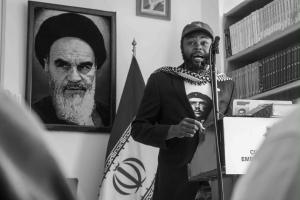
Some Africans also come here due to their conviction in the political principles of the Iranian revolution. I spoke to Zainab Zakariyah, a Nigerian journalist and revolutionary, who like Mahmoud Abdul-Rauf visited Iran, but chose to stay long term. Coming from the Zakariyah family, who had fought against British rule in Nigeria, Iran’s anti-imperialist politics had inspired Zainab since she was young. She told me that nowadays you have “watered down what a revolutionary is supposed to be [it is someone] in a suit having an argument on TV. But [then you see Iranian generals actually] fight [as revolutionaries]!” Zainab has lived out her political principles, staying behind in Iran and reporting from the ground, during the most intense days of the US-Israeli bombing campaign in March and April.
There is a strong argument that we are transitioning away from the post-Cold War unipolar world order, with the US being the sole superpower, to a multipolar world order where a number of countries will compete with the US. The Iran War, which even according to the US legacy media, resulted in an Iranian victory (at least for now) has further demonstrated that the old days of US unipolar domination are over. As we move towards multipolarity and thus greater political and economic sovereignty, there is great potential for Iranian and African ties to develop and decolonize the world. It remains to be seen whether this potential will be actualized, and whether new imperialist configurations would emerge that would block their development.
Navid Zarrinnal is a historian and journalist. He holds a PhD in Middle East Studies and has taught in the United States, Iran, and Pakistan. He is currently documenting the impact of the US-Israeli war on life in Iran from Tehran.


 In this week’s segment, we discuss U.S. control over Venezuela and its resources, and the Venezuelan people's response to their loss of sovereignty. But we begin with a report on the police killing…
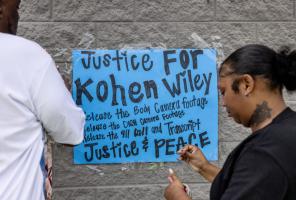 Our guest is attorney Jaribu Hill, executive director of the Mississippi Workers Center for Human Rights. She reports on the police killing of 1-year old Kohen Wiley in Senatobia, Mississippi and on…
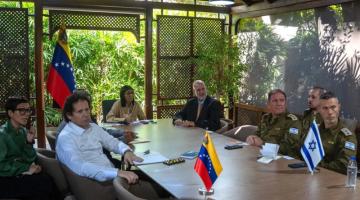 On January 3, 2026, the U.S. conducted a military attack against Venezuela and kidnapped president Nicolas Maduro and his wife, First Combatant Cilia Flores. Since that time interim president Delcy…
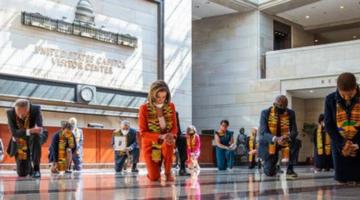 The democrats’ backtracking on what they dismissively refer to as “wokeness” is the newest iteration of their political trickery as once again they give the appearance of supporting what they…
 “The Burnham dictatorship crept up upon Guyanese people like a thief in the night.”


