The U.S. military claims it is “green,” but what the Pentagon is really trying to prove is the planetary sustainability of war.
“How we can foster care, accountability, and the right to self-determination through means other than such forms of militarized sovereignty?”
In this series, we ask acclaimed authors to answer five questions about their book. This week’s featured author is Shiloh Krupar. Krupar is a Geographer and Provost's Distinguished Associate Professor at Georgetown University. Her book is Hot Spotter’s Report: Military Fables of Toxic Waste.
Roberto Sirvent: How can your book help BAR readers understand the current political and social climate?
Shiloh Krupar: My book Hot Spotter’s Report: Military Fables of Toxic Waste reflects on the toxic legacies of the 20th century. We live in a world marked by WWII and Cold War military production and US mobilization for war. Toxicity and exposure are not the exception but the rule. Massive contamination remains within the continental US and beyond from the production, maintenance, and disposal of weapons systems; decades of improper and unsafe handling, storing, and discarding of hazardous materials; privileging production goals over ecological concerns; and the extension of American nuclear bombing and testing, from Japan to the Western Shoshone nation, from the Marshall Islands to Puerto Rico to the Nevada Test Site.
“Toxicity and exposure are not the exception but the rule.”
The subtle but widespread impacts generated by the social organization of war—economically redundant nuclear workers, contaminated land and communities, nuclear wastes, abandoned facilities, repudiated industrial culture—belie any sense that the Cold War is over. Yet contemporary military-industrial restructuring claims “closure” on the Cold War. The domestic remains of war are often hard to see, and there are active efforts to decommission former military sites and erase knowledge surrounding them. The book endeavors to show readers how this has been accomplished under the aegis of the “greening” of the military. Hot Spotter’s Report examines the disavowal of war’s ongoing and residual domestic impacts, which I refer to as “green war”—methods of governing that allow for displacement and abandonment of defunct facilities, redundant workers, cancer-ridden communities, and hazardous wastes. I argue, however, that such sanitation is refuted by general domestic conditions of exposure related to US Cold War military productions. My analysis demonstrates the dangerous limitations of the kind of legacy that is green war and encourages readers to discover and enact other legacies and ethical-environmental practices that do not support state efforts to claim the planetary sustainability of war. Although Hot Spotter’s Report was published in 2013, the book’s intervention gains a sense of urgency in 2020 when no part of the current administration is interested in environment sustainability—except the Pentagon.
What do you hope activists and community organizers will take away from reading your book?
The current “greening” of the military poses new challenges to organizing effective responses to toxicity and war. One of my goals with this project is to inform and inspire readers to challenge dominant ways of knowing—and of ignoring—domestic remains of war, by experimenting with cultural forms and practices that use or activate the residual to challenge the status quo. I hope the book reads like a critical field guide to creatively documenting material geographies of exposure and figuring out ways to respond to and care for such exposures. Toxicity can be difficult to detect; a history of secrecy and misinformation makes it difficult to substantiate claims; military sites are scattered across the country largely in rural areas that do not command public attention; and the burden of inhabiting the risks and attritional hazards of such sites falls largely on marginalized communities. In response, the project foregrounds a series of irreverent figures that inhabit the US nuclear complex. These figures challenge the ongoing secrecy, control, and abandonment of the remains of war. They also rework environmental and bodily norms, regulatory procedures, and disciplinary conventions involving nuclear arts and sciences. The use of comical, whimsical, ridiculous, and/or even completely failed figures, as well as performance- and arts-based methods, from allegory to institutional parody, can serve as important tactical means of drawing people in, interrupting routinized responses and thoughtlessness, compelling action and community renewal, and encouraging creative coalitions. Finally, the figures raise questions about the ethical dimensions of post-Cold War environments, posing a “transnatural” approach (see #5) to the domestic remains of war. This framework critiques investments in certain forms of sovereignty that maintain the US’s toxic open door and asks how we can foster care, accountability, and the right to self-determination through means other than such forms of militarized sovereignty.
We know readers will learn a lot from your book, but what do you hope readers will un-learn? In other words, is there a particular ideology you’re hoping to dismantle?
Hot Spotter’s Report seeks to dismantle and explore alternatives to dominant American ideologies of purity and sovereignty linked to the idea of a “pristine nature.” The chapters examine the role of nature spectacle in reframing military practices as compatible with environmental protection. Hypervisible forms of environmental stewardship can serve to maintain war as a basis of the nation by facilitating disposal of the negative legacies. Specifically, state productions of nature and conservation efforts can tactically obscure death and suffering, inoculating responsibility for ongoing harm from transnational geographies of war. For example, one of the preferred ways to dispose of contaminated military facilities in the US is to convert them to wildlife refuges. Designating a contaminated military site a wildlife refuge allows the Department of Defense or Department of Energy and their contractors to save money on actual cleanup by harnessing cultural tropes that hold visibly natural spaces to be uncontaminated. The categorization obscures the prior conditions and remains of the site, and works against compensation claims made by sickened/contaminated former site workers or neighboring communities. The rhetoric of stewardship casts the military into the role of environmental protector—a stunning reversal for branches of government that have historically sought exemption from environmental laws. Ethical-environmental practices are needed that do not collaborate with state efforts to produce “a return to nature.” Ideas about the natural and pure are too often used to avoid care and accountability for toxicity. The celebration of “nature’s survival” across military and nuclear landscapes in particular marginalizes former workers, downwinders, native nations—all those that are now living with the legacies of industrial exposures or the drift of waste in their bodies.
Who are the intellectual heroes that inspire your work?
This work is indebted to a number of intellectual heroes whom I would broadly categorize as sharing a geographical political imagination and concern with the politics of form and scholar-activism. The late Allan Pred—and his intellectual kinship with Walter Benjamin—inspired my understanding that there is nowhere outside the political and the pedagogical; activism is not just a matter of transforming the status quo through the insertion of new politicized content or subject matter, but intervenes on the level of forms themselves, and opens up alternative ways of thinking and doing—even within the most monolithic and toxic institutions. Ruth Wilson Gilmore’s transformative teaching and scholarship showed me that “a geographic imperative lies at the heart of social justice struggles,” that “form does not mean blueprint, but rather the lived relations and imaginative possibilities emanating from those relationships. . . . form is a resolutely geographical concept, because it is about making pathways and places rather than searching endlessly for the perfect method and mode.”[i]
“A geographic imperative lies at the heart of social justice struggles.”
Gilmore compellingly demonstrates how geographies of differentiation, displacement, and oppression are the very sites where the imagination and undertaking of abolition takes place. Michel Foucault has offered invaluable conceptual tools to think through dominant forms of governance and ways to pursue alternative world-making. Frantz Fanon’s commitment to a new humanity and future through searing critique of racial capitalism and development continually reminds me that anger can sustain hope for new worlds and ways of being. I am also motivated by the former Activist Geographers Group (AGG) and its scholar-activist project of “Living Beyond the Warfare-Welfare Complex.” This collective envisioned the ongoing necessity of exploring/unraveling “the connections and contradictions between warfare and welfare; illuminating the life and death connections between militarism, racism, sexism, the economy/capitalism, the state and politics; and in doing so, creating activist research that honors struggles for survival and dignity and helps create a better world.”[ii]
In what way does your book help us imagine new worlds?
The book considers what kind of environmental ethics would challenge green war and guide how we live with nuclear waste. It argues that we need an environmental ethics capable of responding to the complex environments we have inherited from the Cold War: a post-sublime and post-ecocidal understanding of nature—as neither “purity” nor “ruined and unnatural.” Too often nature is understood to be some kind of pure realm, with waste/contamination as something that pollutes that purity. Hot Spotter’s Report instead insists that waste is already with us—in our bodies, in our environments—so there’s no point in trying to recover the idea of the pure because it is used to obscure and stigmatize war’s remains. Instead, the book examines the messy combinations of nature and waste and seeks ways of conceptualizing and doing justice to the lives most affected by nuclear waste, by exploring new kinds of political coalitions to attend to these lives. The book frames this as transnatural ethics. Drawing on queer ecofeminist and environmental justice perspectives, this ethics speculatively and practically rethinks “rights” premised on individual autonomy/sovereignty/recognition, for a political model and practice that creatively engages with the changing materialities of land, humans, and nonhumans tied to geographies of war. The transnatural orientation that I advocate opens up a broader suite of possibilities for addressing war’s legacies and moving toward more openly just and sustainable futures.
Roberto Sirvent is Professor of Political and Social Ethics at Hope International University in Fullerton, CA, and an Affiliate Scholar at Yale University’s Interdisciplinary Center for Bioethics, where he directs the Race, Bioethics, and Public Health Project. He is co-author, with fellow BAR contributor Danny Haiphong, of the book, American Exceptionalism and American Innocence: A People’s History of Fake News—From the Revolutionary War to the War on Terror.
Please join the conversation on Black Agenda Report's Facebook page at http://facebook.com/blackagendareport
Or, you can comment by emailing us at comments@blackagendareport.com
[i] Ruth Wilson Gilmore, “In the Shadow of the Shadow State,” in INCITE! Women of Color Against Violence, ed., The Revolution Will Not Be Funded: Beyond the Nonprofit Industrial Complex (Cambridge, MA: South End Press, 2009), 41-52, 51.
[ii] AGG flier, 2005, “Living Beyond the Warfare-Welfare Complex,” annual meeting of the American Association of Geographers, Denver, Colorado.


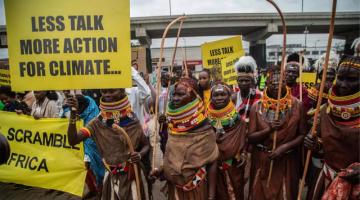 Carbon and biodiversity offsets are the latest imperialist weapons used against African people and their nations. Self-determination is the key to ecological health for the continent.
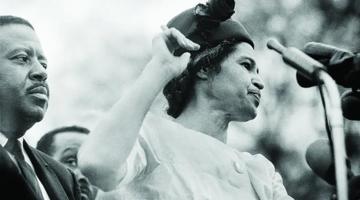 Internationalism is the path toward Black liberation. Black people must resist the push to silo our movements and move in this spirit of Rosa Parks - with fearless integrity.
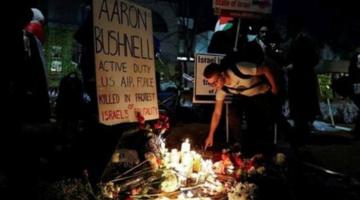 Aaron Bushnell's act of self-immolation is a symbol and a call for people around the world to break their silence and fight for a free Palestine.
 In the time between the two imperialist wars, the spirit and politics of Pan-Africanism grew. African Americans continued to organize and built movements to resist rising fascism.
 The West African trade bloc has lifted a majority of the sweeping sanctions it had imposed on Niger, including border closures and a freezing of state assets. The move followed soon after Niger, Mali…


