Slavery was created by violence and the path to freedom in the US is never nonviolent.
“I want readers to see black abolitionists as the founders and foot soldiers of their own movement.”
In this series, we ask acclaimed authors to answer five questions about their book. This week’s featured author is Kellie Carter Jackson.Jackson teaches in the Africana Studies Department at Wellesley College. Her book is Force and Freedom: Black Abolitionists and the Politics of Violence.
Roberto Sirvent: How can your book help BAR readers understand the current political and social climate?
Kellie Jackson: Martin Luther King Jr. once said, “Change does not roll in on the wheels of inevitability, but comes from continuous struggle.” When I think about the end of slavery, nothing about it was inevitable. In many cases slavery could have easily persisted for another 100 years and in many cases, the consequences of slavery are still with us. What I would want BAR readers to know is that reform requires activism. Change does not happen on its own. There are many examples in today’s political and social climate that need to change. I value how black abolitionists provide us with a model for activism.They used their voices, printing presses, networks, collectivism, and their very bodies to advance the causes of freedom. I think we can all gain something from the boldness of Maria Stewart and Harriet Tubman, the courage of William Parker and Lewis Hayden, the tenacity of Frederick Douglass and Charles Remond, and the brilliance of James McCune Smith. These were just a few black leaders in the nineteenth century that were willing to speak truth to power and act on their convictions. I hope readers will see the title of my book as a set of ingredients. Force is almost always the number one component for freedom. Every major piece of legislative and social change in this country has come about by the forceful demands of those in and out of power.
What do you hope activists and community organizers will take away from reading your book?
I contend that black abolitionists were the FIRST abolitionists. No one needed to tell them that slavery was wrong. I want readers to see black abolitionists as the founders and foot soldiers of their own movement. It's so important that the beliefs and efforts of black abolitionists be placed at the center of our understanding and telling of history. Too much of the abolitionist movement is told through the lens of sympathetic white allies or limited to the narratives of Frederick Douglass and Harriet Tubman. When I teach any of my classes, my goal is always two-fold: to teach something new and to affirm the knowledge my students already have. I hope in reading Force and Freedom, activists and community organizers can be introduced to new people in history that they may not know. There are so many black leaders who accomplished incredible feats in the face of insurmountable odds. But equally important, I want readers to be affirmed in what they may already know: that black abolitionists’ efforts were central to the abolition of slavery. I hope readers can connect their activism to a long tradition of resistance to oppression in American history.
We know readers will learn a lot from your book, but what do you hope readers will un-learn? In other words, is there a particular ideology you’re hoping to dismantle?
I think too often historians minimize or neglect altogether the role that violence played in the coming of the Civil War. Scholars and educators have largely examined the abolitionist movement as a nonviolent endeavor based on morality. I think there is also a propensity to privilege the performance of nonviolence as godly. It’s an endearing bedtime story. We discuss the Underground Railroad solely in terms of heroic acts of escape, but fleeing often required fighting. Slavery was created in violence. Slavery was sustained through violence. It seemed logical that slavery might only be overthrown through violence. Not talking about the embrace of force by black abolitionists can feel dishonest. It can make it seem like the Civil War was a spontaneous and unfortunate outcome. But human bondage is warfare. The enslaved have been at war ever since they were placed in bondage.
“Human bondage is warfare.”
The American Civil War was the deadliest event to ever take place in our country’s history. One of the perennial questions in political thought asks: Is violence a valid means of producing social change? My study addresses how black abolitionists answered this question. A retreat from engaging in a complex understanding of the political purposes of violence limits both how we see and make use of the past. Accordingly, the ways in which black abolitionists utilized violence deserves a more sustained and nuanced analysis. Frederick Douglass once said, “The American public…discovered and accepted more truth in our four years of Civil War than they learned in forty years of peace.” The truth held in violence is an invaluable lesson. The path to freedom in this country is never nonviolent.
Who are the intellectual heroes that inspire your work?
When I was in the process of writing my acknowledgements I was reminded of one of Toni Morrison’s quote. She said, “I tell my students, ‘When you get these jobs that you have been so brilliantly trained for, just remember that your real job is that if you are free, you need to free somebody else. If you have some power, then your job is to empower somebody else. This is not just a grab-bag candy game.’” If I could add to Morrison’s wisdom, I would say it is not only our job to bring others along, but to thank those who helped us get where we are going. There are so many people that have freed me, empowered me, and shared their intellectual candy. The cop-out answer is to say my mom, that would also be the truth. She’s also a professor and an intellectual. She’s helped me to form just about every idea I’ve ever had.
But historically and intellectually speaking, I am always inspired by Ida. B. Wells, James Baldwin, W.E.B Du Bois, and Frederick Douglass. I remain in awe of enslaved women named and unnamed who fought to survive and protect their children and humanity in the face of an inhumane world. I value their courage, grit, wit, and ability to find laughter and joy. My absolute favorite class to teach is on the lives of enslaved women. Very little is accomplished in all of the nineteenth century without their contributions and convictions.
In what way does your book help us imagine new worlds?
I hope Force and Freedom will allow people to imagine what’s possible. No one, least of all the slaveholder, could have imagined a black American as president, but it happened. The history of black people in America is not all tragedy. We have triumphs. I think in some ways, the difficulty in imagining a new world is not the destination, but the journey.
The process of thinking and rethinking about the possible and most effective paths toward liberation is complicated. When black abolitionist and minister Joshua Easton spoke at a Massachusetts Anti-Slavery Society in 1837, he declared, “Abolitionists may attack slaveholding, but there is a danger still that the spirit of slavery will survive, in the form of prejudice, after the system is overturned. Our warfare ought not to be against slavery alone, but against the spirit which makes color a mark of degradation.”
I don’t want readers to imagine a world without slavery. I want them to imagine a world where color is not a mark of degradation. In other words, a world in which anti-blackness does not exist. For black reformers, emancipation was a starting point. Force is Freedom is about what is required to get where we all want to go.
Roberto Sirvent is Professor of Political and Social Ethics at Hope International University in Fullerton, CA. He also serves as the Outreach and Mentoring Coordinator for thePolitical Theology Network. He is co-author, with fellow BAR contributor Danny Haiphong, of the new book, American Exceptionalism and American Innocence: A People’s History of Fake News—From the Revolutionary War to the War on Terror.
COMMENTS?
Please join the conversation on Black Agenda Report's Facebook page at http://facebook.com/blackagendareport
Or, you can comment by emailing us at comments@blackagendareport.com

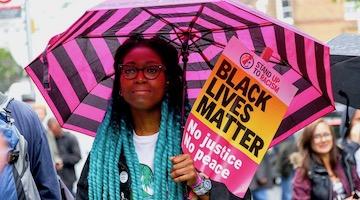 Although Britain never experienced a civil rights movement on its own soil, such movements did take place “in its colonies...in anti-colonial and anti-apartheid struggles,” said Adam E
 Donald Trump is guilty of many impeachable acts, but the Ukraine scandal “pales into insignificance compared to everything else Trump has done,” said University of Illinois professor of internation
 The Republicans and Democrats are united under the American imperial banner, and only differ on details of strategy to maintain Washington’s global domination.
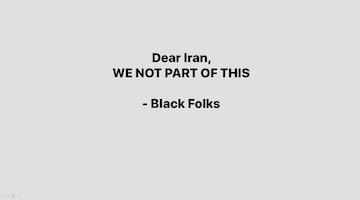 Black Americans, as perpetual targets of US lies and attacks, should be the first to reject Washington’s rationales for war with Iran.
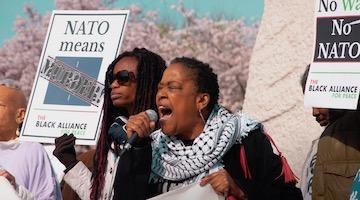 The rhetoric of the Democratic “progressives” only gives cover to the ongoing criminality of the U.S. state and its commitment to permanent war – with congressional approval.



