The focus on separate “identities” has led to numerous academic theories and non-profit career opportunities but no real power for oppressed and working-class people.
“Paul Robeson and Huey P. Newton made common cause with oppressed people around the world and defended revolutionary movements in Russia, Vietnam, and Cuba from US and Western aggression.”
Over the last four plus years, I have been able to contribute almost weekly to Black Agenda Report and engage with readers from all areas of life. However, the next seven months will mark a change due to the time that is being eaten away by graduate school. Over this period, my contributions will consist of shorter pieces that focus on revolutionary political theory. Analysis of revolutionary theory comes at a critical moment in history. The system of US imperialism is in marked decline and the class struggle is in a state of retreat.
Class struggle is a good place to begin. Marxist theory defines class as a social relationship to the means of production. Capitalism creates two classes: the bourgeoisie that owns the means of production and profits from the exploitation of the proletariat. The proletariat, the second class, is dispossessed of the means of production and must sell its labor to the bourgeoisie. US imperialism is a stage of capitalism where monopoly and finance capital have replaced the industrial ruling classes as the motive force of development in the United States and the West. For nearly two centuries, US imperialism has plundered the planet on behalf of finance capital and caused the death and immiseration for hundreds of millions in Latin America, Asia, and Africa.
“The system of US imperialism is in marked decline and the class struggle is in a state of retreat.”
The class struggle under US imperialism is a complex phenomenon. White supremacy has ensured that workers in the US and the Western orbit are divided along racial lines. The material and psychological wages of whiteness have left the class struggle in the US in an especially weak state, with labor unions fragmented even in their strongest years and Black Americans, indigenous people, and others deemed “nonwhite” subjected to the most extreme forms of state violence and terror. White supremacy has become a global phenomenon that has further eroded class consciousness by instilling a deep sense of American “nationalist” sentiment in the proletariat to build historic support for capitalist robbery.
Still, the class struggle under US imperialism has ebbed and flowed in the process of the proletariat working through these contradictions. Communists helped form industrial unions in during the 1930s and 40s while lending support to the Black struggle against racism. The Black left has been the historic leader of the class struggle in the United States. Black rebellion and revolution emerged from a constant struggle against a century and a half of captive bondage and became a vital part of the struggle against capital after the US capitalism became “officially” a wage slave society in the latter half of the 19thcentury. Black revolutionaries from W.E.B. Du Bois to Assata Shakur made the revolutionary organization of Black people the central focus of the broader war against the owners of capital at the top of the class structure, reminding the working class that the conditions of slavery had not ended but rather shifted in form.
“The Black left has been the historic leader of the class struggle in the United States.”
The reason the Black liberation struggle has always led the class struggle in the US is because the proletariat has been restrained by the ever-reforming forces of white supremacy and empire. Black revolutionaries such as Paul Robeson and Huey P. Newton recognized that the class structure had become an international system of global imperialism that plundered oppressed people the world over to enrich corporate oligarchs. They made common cause with oppressed people around the world and defended revolutionary movements in Russia, Vietnam, and Cuba from US and Western aggression.They elevated the struggle of women to the frontlines of the class struggle. They built upon prior clashes with the powers that be and paved a path for such clashes to end with the oppressed people of the world standing tall in victory.
A troubling pattern has emerged in this era of US imperial decline. Instead of a politics of solidarity and class struggle, much of what calls itself “progressive” or even “revolutionary” in the United States has adopted a politics of recognition often called “identity politics.” This term is insufficient as it does not describe the elitist character of the ideology. The focus on separate “identities” has led to numerous academic theories and non-profit career opportunities but no real power for oppressed and working-class people. Heated and often irreconcilable debates have emerged about which oppressed grouping, be it queer, Black, disabled, or women-identified people, is suffering more than the other. Sometimes these categories are combined to add some complexity to the analysis but hardly ever is history or class added to the equation. It is unsurprising that the rise of so-called “identity politics” has coincided with the increasingly destitute position of the poor, especially the Black poor, in the age of mass Black incarceration, endless war, and ruthless austerity.
“Black revolutionaries from W.E.B. Du Bois to Assata Shakur made the revolutionary organization of Black peoplethecentral focus of the broader war against the owners of capital.”
The politics of “liberalism,” non-profit careerism, and the dead-end discourse of identity must be replaced by a politics of class struggle. Class struggle does not emerge without class consciousness. Class consciousness is the recognition of the conflicting interests of workers and the oppressed and those of their capitalist masters. Such recognition is not about which Supreme Court Justice is nominated or whether the Republicans or Democrats win the Congress even if issues raised by these developments very much represent the interests of the ruling class or the oppressed. Class struggle occurs only when the oppressed classes are activated and in motion against the oppressor class and fighting for material gains that will not only improve the lives of the downtrodden right now but will also open the door to a completely new arrangement of power all together.
Feel free to send comments regarding this article and all others on Black Agenda Report. The discussion and analysis of left political theory and organization is in desperate need of enrichment. Tune in to Black Agenda Report and try to tune-out of the corporate media circus that centerson scandals, “likes,” clickbait headlines, and lies.
Danny Haiphong is an activist and journalist in the New York City area. He and Roberto Sirvent are co-authors of the forthcoming book entitled American Exceptionalism and American Innocence: A People’s History of Fake News- From the Revolutionary War to the War on Terror (Skyhorse Publishing). He can be reached at wakeupriseup1990@gmail.com
COMMENTS?
Please join the conversation on Black Agenda Report's Facebook page at http://facebook.com/blackagendareport
Or, you can comment by emailing us at comments@blackagendareport.com





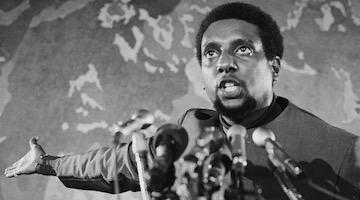 In the political hotbed that was Dar es Salaam, Tanzania, in 1967, US Black Power advocate Stokely Carmichael, who had not yet changed his name to Kwame Ture, made both friends and enemies among th
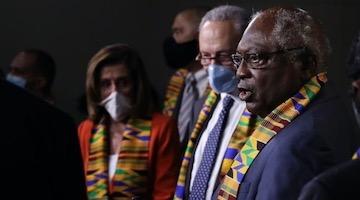 The Black misleaders have been busy selling out Black people for half a century, but are still only barely tolerated by the rich man’s Democratic Party and its racist figurehead, Joe Biden.
 The civil rights groups’ rather basic requests for voting rights protections and the need for federal intervention to address police brutality were minimized and dismissed by the president-ele
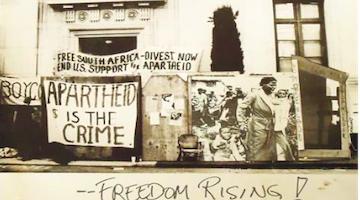 The phrase racial capitalism first emerged in the context of the anti-Apartheid and southern African liberation struggles in the 1970s.
 The theory of change that depicts the likes of Bernie Sanders and AOC as the leaders of the class struggle has failed to materialize in reality.



