“’Black capitalism’ was a crucial part of President Nixon’s ‘southern strategy’ and the rhetoric and administration of his program is still intact.”
In this series, we ask acclaimed authors to answer five questions about their book. This week’s featured author is Mehrsa Baradaran. Baradaran is J. Alton Hosch Associate Professor of Law at the University of Georgia School of Law. Her book is The Color of Money: Black Banks and the Racial Wealth Gap.
Roberto Sirvent: How can your book help BAR readers understand the current political and social climate?
Mehrsa Baradaran: When the Emancipation Proclamation was signed, the black community controlled about 1% of the nation’s wealth. Over 150 years later, that number hasn’t budged. The reason for this lack of economic progress despite the fact that racial progress has been made is the story I tell in my book.
I also uncover the way black banking and black business has been used by a few cynical politicians to avert the focus from real and meaningful reforms. Why did Donald Trump and Steve Bannon host a minority business summit and praise black businesses as the answer to the racial wealth gap? Because “black capitalism” was a crucial part of President Nixon’s “southern strategy” and the rhetoric and administration of his program is still intact.
What do you hope activists and community organizers will take away from reading your book?
I hope activists will understand that there is no such thing as economic justice that doesn’t focus on racial justice—we have had a system based on black exploitation and any remedy must include a means of addressing that through some form of a reparations program. Whether that’s a job or income guarantee, capital programs, community development, it must include capital and it must involve the federal government.
I also believe wholeheartedly that such a program will not be zero-sum. In other words, we all benefit from eliminating the legacy of racial injustice and not just in a moral sense, but actually in dollars and cents. The New Deal redistributive programs were actually profitable for capital markets, government programs, and the people that benefited from them. But those programs—all of which built the American middle class—were built on black exclusion.
We know readers will learn a lot from your book, but what do you hope readers will un-learn? In other words, is there a particular ideology you’re hoping to dismantle?
That fixing the wealth gap is the responsibility of the black community. White society created it and white society must help fix it. Black banks are useful and should be supported, but they are not the solution. They cannot “control the black dollar.” Banks operate in a network and cannot multiply and control money outside of it. This is one of the central points of the book and it may not be a popular one, but I have studied these banks collectively and through time so I hope I can convince the reader that community banks, micro-credit, etc are not the answer to macro injustice.
Who are the intellectual heroes that inspire your work?
Abram Harris and Andrew Brimmer are two of the most prominent black economists of the century and their work is brilliant and unfortunately largely forgotten. They delivered a strong, data-supported message and were both path-breaking thinkers, but because their message was nuanced, it was either maligned or forgotten. I try to highlight some of their thoughts in a few places in my work.
For the sheer pleasure of reading, I absolutely love the prose of W.E.B. Dubois and James Baldwin. I had so many of their quotes in the first few drafts of the book, that I was given a maximum quota and had to take a bunch out, but I give Dubois the first line of the book and the last.
In what way does your book help us imagine new worlds?
I would love to see more honesty and accountability in our national dialogue about race. I would like to see us all committed to understanding and addressing our history so we can move on instead of growing more angry, defensive, and divided. I think the way forward is through some slight discomfort. I believe the other side of that necessary process and restructuring will be much better than we can imagine. I think we need to think broadly in building coalitions and to try to resist creating ever narrower tribes. The silver lining in our current political tragedy is that it has helped crystalize our country’s racist legacy. It’s easy to feel hopeless and pessimistic about the state of our democracy, but I think ultimately, the divide will lead to some crucial conversations and seeds planted this will bear fruit in the future.
Roberto Sirvent is Professor of Political and Social Ethics at Hope International University in Fullerton, CA. He also serves as the Outreach and Mentoring Coordinator for thePolitical Theology Network. He’s currently writing a book with fellow BAR contributor Danny Haiphong called American Exceptionalism and American Innocence: The Fake News of U.S. Empire.





 Melanie Dominguez joins us to discuss the conditions in New York State jails and prisons and explain why new legislation to expand and strengthen the State Commission of Correction is needed.
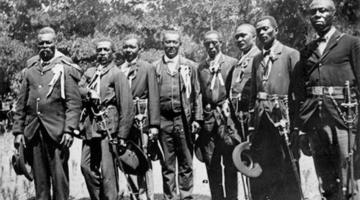 Giving Juneteenth the imprimatur of a state stamp of approval makes it problematic, and no longer the people’s holiday it has been for nearly 100 years.
 The Biden administration and congress work together in their efforts to secure what they think is U.S. domination. They are playing a dangerous game and now try to bring back a draft through sleight…
 Zora Neale Hurston’s sermon on the “Pet Negro” system provides devastating and timely insight into the psychology of Black folk working in the service of white power. Preach, Sister Zora!
 Dan Kovalik’s new book makes a case for Palestine.


