“The ideology I’d like to dismantle makes every black person the same as every other black person, assumed to be a man or woman under the age of sixty-five.”
In this series, we ask acclaimed authors to answer five questions about their book. This week’s featured author is Nell Painter. Painter is the Edwards Professor of American History, Emerita, at Princeton University. Her book is Old in Art School: A Memoir of Starting Over.
Roberto Sirvent: How can your book help BAR readers understand the current political and social climate?
Nell Painter: In the most direct fashion, my history books are far more efficient when “the current political and social climate” is understood in terms of race, class, and gender. As a historian I worked hard—and readers said I succeeded—to analyze events and people in the past in ways that illuminated our present times. My work as a historian was to speak clearly, so that readers would go along with the narratives I was building.
My art does not function in so coherent a way, because art leaves room for the viewer to make meaning. But even so, Old in Art School can help readers see something not ordinarily visible.
Old in Art School brings age and some of its meanings to the forefront, even though old people often feel invisible, even disrespected. Young and middle-aged people find it hard to focus on old people, and when they do, the temptation of euphemism is strong: “You’re not old, you’re older.” Old is the kind of dirty word black used to be before the age of black power. Black Agenda Report readers are sophisticated when it comes to race, class, and gender. Maybe my book can help them see age, which definitely affects how we see and act in the world. Age matters.
What do you hope activists and community organizers will take away from reading your book?
I’d like to encourage activists and organizers to see old people as people who count, as people with needs as well as abilities that aren’t the same as those of younger people with whom they share race and class and gender. Often old people come from different places—the South, the Caribbean islands, the nations of Africa—than young people coming of age elsewhere. Geographic origin matters.
I’d also like readers to look at my art as additional ways to regard the world, to slow down and really see what they’re looking at.
We know readers will learn a lot from your book, but what do you hope readers will un-learn? In other words, is there a particular ideology you’re hoping to dismantle?
The ideology I’d like to dismantle makes every black person the same as every other black person, assumed to be a man or woman under the age of sixty-five. That assumption often carries an implicit judgment as how to be truly and authentically black. How to be black culturally, as in religion and music, for instance, and how to be black politically, with regard, for instance, to the Democratic Party.
Old people are likely to have lived through and recall the complexities of the civil rights and black power eras and so remain less likely to fall for simple assessments and drastic solutions.
Who are the intellectual heroes that inspire your work?
I grew up with the modernists Elizabeth Catlett and Charles White, both superbly skilled draftsmen who thoughtfully embedded historical and political messages in their art. They provided a visual counterpart to the history I read at home by John Hope Franklin. These giants helped me envision ways to dispute the history I studied in school in Oakland.
More recently, as I focused on visual art, I found inspiration in the work of Deborah Willis, Robert Colescott (my patron saint of painting), Faith Ringgold, Maira Kalman, and R. B. Kitaj. As a photographer and historian of art, Willis showed me the iconographic history of blackness in the US. The other artists work figuratively in dialogue with art history and history-history. They work within the tension between image and meaning in very satisfying ways. Ringgold, Kalman, and Kitaj write books of various sorts that have shown me several different ways of pursuing my own vocation of art-book making.
In what way does your book help us imagine new worlds?
I think the great strength of American blackness and activism is the embrace of community. We tend to see ourselves as related to other black people across time and space. This is a very good thing, psychologically and ethically, and it serves as an essential counterweight to dog-eat-dog American individualism that devalues the public good.
An exclusive concentration on community does tempt us to devalue ordinary individuals and ordinary individuals’ differences, as though to see yourself as an individual means you’re denying your blackness. I would like us to hold both visions of ourselves in our eyes, to keep the enormous strength of community while respecting each other as individuals—even while listening to each other, even while learning from each other in the knowledge that we are not all the same.
Roberto Sirvent is Professor of Political and Social Ethics at Hope International University in Fullerton, CA. He also serves as the Outreach and Mentoring Coordinator for the Political Theology Network. He’s currently writing a book with fellow BAR contributor Danny Haiphong called American Exceptionalism and American Innocence: Essays on Race, Empire, and Historical Memory.





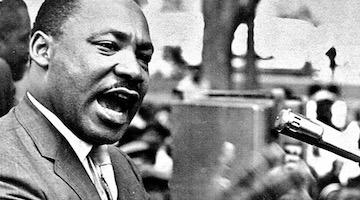 Both Newton and King sought to create a united front for peace and socialism.
 The convict labor system was once notorious in Mississippi – and it still is, under the guise of debt restitution.
 Black Self-Defense is Important, But Ideology is Paramount
 The US became deeply involved in global counterinsurgency after World War Two, said Stuart Schrader, a sociologist at Johns Hopkins University and author of “Badges Without Bo
 On January 31 activists plan to confront New York City cops in protests over high transit fares and police brutality, under the banner “F.T.P,” according to Shannon Jones, of


