VIDEO
JARED BALL, TRNN: Welcome, everyone, back to the Real News Network. I'm Jared Ball here in Baltimore.
As we continue to mark this week's 48th anniversary of the assassination of Dr. King there are lessons still to be learned from his example. To discuss this and more is the executive editor and founder of Black Agenda Report, Glen Ford, back for his weekly Ford Report.
Glen, welcome back to the Real News.
GLEN FORD: Thank you for having a space for me.
BALL: So, what are you suggesting we can learn about today's political moment from King's previous example?
FORD: Well, people of course talking about 48 years ago today, that's the day that King was assassinated. But it was 49 years ago, a year before his assassination, that he delivered that brilliant and historic speech at New York's Riverside Church in which he broke definitively with President Lyndon Johnson over the Vietnam war. He was killed, as I said, a year, exactly a year later, and it may have had something to do with that speech he made at Riverside Church in which he called the United States the greatest purveyor of violence in the world today.
So Dr. King's anti-war stance, and we have to be clear: This was an anti-imperialist position that he was taking back in 1967. This position was nothing new in Black America, even at that time. SNCC, the Student Nonviolent Coordinating Committee, came out against the draft years before Dr. King's speech. Muhammad Ali famously, in 1967, refused to be drafted, and he said that no Vietnamese never called me nigger. They never lynched me and they never set any dogs on me.
Ever since Black people have been tracked by the polls they have been shown to be the group that was most opposed to US military adventures abroad. Broadly speaking, there is a Black position on foreign policy and, broadly speaking, we would describe that as anti-imperialist. So when Dr. King made that speech at Riverside Church in 1967 he was not just speaking for himself. He was speaking from the Black radical tradition, and that tradition is broadly based and it is a popular tradition.
However, there was a Black misleadership class even then. It was a lot smaller than it is today, but it existed and it was very eager to get in the good graces and make its political fortunes in the Democratic Party. And it was appalled that the nation's premier civil rights leader would dare to challenge the war policies of the Democratic president and of Hubert Humphrey, the Democratic vice president. So they urged Dr. King to shut up, to keep his mouth shut unless he was just going to talk about civil rights, and to not challenge the Democrat in the White House.
The first Black president, the one we have in office today, is the president who has expanded even further than the scope of his predecessor, George Bush, the theaters of US wars. And under him, as his secretary of State, is Hillary Clinton, a person who was central, according to all accounts including her own, to the campaign, the bombing campaign against Libya. That is, a massive, US-led, European and American bombing campaign against Africa. It was this Hillary Clinton who cackled like a witch over the body of Muammar Gaddafi. And then she was key to sending these same jihadist terrorists into Syria, where now the United States is guilty in the death of a quarter million people.
So there's lots to be angry about if you come from a people whose broad foreign policy views are anti-imperialist and against the slaughter, by the United States, of people abroad. You know, it's really not just because of the presence of this Black misleadership class that the anti-war, anti-imperial opinions of most Black people are not represented in the Black political discourse. The real problem is this duopoly, two-party system in which one of those parties is the white man's party, and of course Black people are not going to be in that party, and so all of the Black electoral political takes place in the other party, the Democratic Party, and the effort there is entirely based around trying to beat the white man's party, to beat the Republicans, and this year to beat Donald Trump. [crosstalk] And
BALL: [interceding]But Glen, to that point, just very quickly.
Isn't there, to a certain extent, couldn't it be said, and some are saying it, that there has been a sort of Kingian advance in our national politics, in the sense that Bernie Sanders voted against the Iraq invasion, or re-invasion, in 2003, and Donald Trump is espousing a kind of drawback, sounds like a drawback, of US military empire from around the world. Isn't that some sort of, again, Kingian advance, politically?
FORD: That is a great irony, that Donald Trump's foreign policy, if you really read it, is actually far to the left of the Democrats, and that includes Bernie Sanders. Bernie Sanders is probably to the left of Bernie Sanders, but you don't hear the left foreign policy of Bernie Sanders in this campaign, because to run on a left foreign policy would be to challenge the foreign policy of the current president, the first Black president, and Hillary Clinton has, of course, wrapped herself in the robes of Barack Obama. I'm absolutely certain that many, if not most, of Bernie Sanders' supporters in the primary race, are anti-war people, but they don't demand that their candidate state, spell out a real anti-war position, because they are concerned about beating the Republicans, and about getting their candidate in the only position that they think can really challenge the Republicans.
So the fact that it's a duopoloy game, and it's the only game in town, actually creates a trap, not just for Black people, but for all progressives, and that's one of the reasons that the Black is Back Coalition for social justice and peace and reparations is holding, this weekend, on Saturday in Harlem, in New York, a national conference on the 2016 election with an emphasis on Black self-determination. We can't have a self-determinationist politics when all of our discourse has to be smothered in this Democratic Party, as part of this two-party duopoly trap.
BALL: Well Glen Ford, thanks again for joining us here at the Real News.
FORD: Thank you.
BALL: And thank you all for joining us, wherever you are. Again, I'm Jared Ball here in Baltimore saying, as always, as Fred Hampton used to say, to you we say peace if you're willing to fight for it, so peace everybody, and we'll catch you in the whirlwind.

 The legacy of colonialism and interference from the U.S. and other states keeps Djibouti's president in office after 25 years. Djibouti needs democracy and sovereignty for its people.
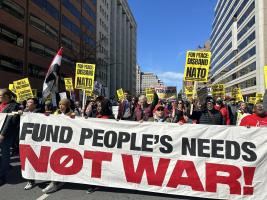 On March 18 thousands of people rallied in Washington DC to mark the 20th anniversary of the invasion of Iraq and to call for an end to the war in Ukraine.
 Being a white ally is a very serious matter. They can be "martyred on a shrine of white supremacy in an effort to discourage other whites from following their lead."
 The FBI raid on the Uhuru Movement has resulted in economic sanctions like those imposed on countries that dare to be sovereign despite being under U.S. attack.
 This week we will hear about efforts to mobilize New York progressives in support of the Green Party and how a proposal for new questions on ethnicity and race would improve accuracy and fairness in…


