by Ann Garrison
Scholar Horace Campbell warns that unaccountable leaders and foreign interests cannot bring justice to the people of war-torn South Sudan. The United States bear heavy responsibility. “People around Barack Obama himself, like Gayle Smith, people from the Enough Project, Susan Rice, have been involved in this disaster from the beginning.”
South Sudan Conflict Won't End Until Oil Wealth Benefits South Sudanese: An Interview with Horace Campbell
by Ann Garrison
“The $5 billion from the oil is not being used in South Sudan for the health, welfare, water supply and education of the people.”
Warring parties in South Sudan’s brutal 20-month civil war signed a peace agreement in Addis Ababa, Ethiopia, on August 26, 2015. The civil war, which began in December of 2013, has cost more lives than anyone can yet estimate with any certainty, and it has uprooted over two million South Sudanese people.
However, seven previous ceasefire agreements have already failed. I spoke to Dr. Horace Campbell, Syracuse University Professor of African American Studies and the author of many books and articles on Africa, including the 2014 Pambazuka News essay, “South Sudan: Peace, democracy and reconstruction instead of war.”
Ann Garrison: When President Obama sat down to talk about bringing peace to South Sudan with Ethiopian Prime Minister Hailemariam Desalegn, Ugandan President Yoweri Museven, Kenyan President Uhuru Kenyatta, Sudanese Foreign Minister Ibrahim Ghandour and Nkosazana Dlamini-Zuma, chairwoman of the African Union, you said, on Democracy Now!, that everyone at the table, except Mrs. Zuma, was compromised. Can you elaborate on what you meant by that?
Horace Campbell: What I meant by that is that the looting of South Sudan has gone on since independence, in the past four years. When the economy of South Sudan was part of the Sudan, the oil revenues were about $50-100 billion per year. The reporting we have from South Sudan is that the economy is now based on $5 billion. That $5 billion from the oil – and 90 percent of the economy is based on petroleum resources – is not being used in South Sudan for the health, welfare, water supply and education of the people.
“The leaders have no accountability to the people of the South Sudan.”
It is being looted in collaboration with the regional leaders of Ethiopia, Uganda, Kenya and members of the Sudanese elite. Ethiopia is heavily invested in hotels, Uganda in food, Kenya in banking and telecommunications.
And so the situation in South Sudan is one where the leaders have no accountability to the people of the South Sudan and they have money and property in Uganda, in Nairobi and in Addis Ababa. And the resources for the South Sudan should be used for the people of South Sudan so that they can have a better quality of life.
AG: In December 2013, shortly after the new conflict began, I spoke to Mabior Garang de Mabior, the son of Dr. John Garang de Mabior. He said then that the conflict had turned attention to the suffering of South Sudanese, but that they had been suffering like refugees before the conflict, in villages and cattle camps, because decades of war had destroyed indigenous agriculture and the new nation's oil revenue was not reaching them.
HC: And it will not reach them now, because the institutions in South Sudan are not organized for the well-being of the people. South Sudan is run by the military; it is run by international NGOs and a Parliament that does not have real power.
And that is why I am in agreement with the recommendations of the African Union Commission of Inquiry on South Sudan, which recommended a transitional period with three distinctive features:
* a high level oversight panel to guide the period of transition,
* a transitional government that excludes those politically accountable for the crisis, and
* a transitional government that addresses the questions of justice in different forms. And one of the key areas they spoke about in terms of justice in different forms was that oversight of the resources from the African Development Bank, so that the infrastructure, the health and the well-being of the people of South Sudan is taken care of.
AG: With regard to the international NGOs running South Sudan in a way that deprives the South Sudanese people, I imagine you’re speaking particularly of the ENOUGH Project to “End Genocide and Crimes Against Humanity” founded by security state professional John Prendergast and USAID chair nominee Gayle Smith. You’ve identified them as part of the problem in Pambazuka News and on Democracy Now!, where you said that, “One of the tragedies of the South Sudan situation has been the way in which the international organizations, NGOs and people around Barack Obama himself, like Gayle Smith, people from the Enough Project, Susan Rice, have been involved in this disaster from the beginning.”
HC: Yes, I said that and I think that the Enough Project should end its involvements in South Sudan.
Ann Garrison writes for the San Francisco Bay View, Black Agenda Report, Black Star News, Counterpunch and her own website, and produces news and features for Pacifica Radio’s WBAI-NYC and KPFA-Berkeley. She can be reached at @AnnGarrison.

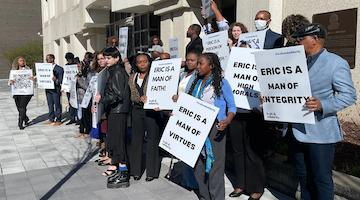 The Canton Repository published Ann Garrison’s op-ed in support of Eric Nshimiye on April 22. The US Attorney’s office has charged Eric with concealing genocide crimes on his asylum application.
 In this feature, we interview Syrian-born journalist Richard Medhurst about state propaganda, the mainstream media, and U.S. imperialism.
 In this time when Israel and Zionism have become the representation of Judaism, Jewish people, especially Black Jews, should reflect on what it means to observe Passover during an ongoing…
 On campuses across the country, students and faculty are finding various ways to take action against the unfolding genocide in Gaza. In response, colleges and universities operate in collusion with…
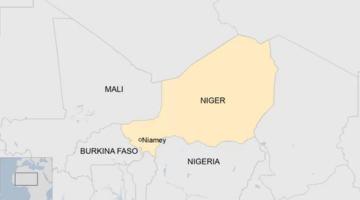 Thousands gathered in Niamey to call for the departure of United States drone stations and soldiers.


