by Theogene Rudasingwa
Under dictator Paul Kagame, Rwanda’s military is highly paid for peacekeeping duties in Darfur, South Sudan, the Central African Republic and Haiti – despite its role in the death of millions in the Democratic Republic of Congo. The West depends on Kagame as its man in Africa, and in return gives impunity to his criminal network.
Rwanda’s Peacekeeping Operations: A Poisoned Pill that Blackmails the West
by Theogene Rudasingwa
This article previously appeared in Pambazuka News.
“Kagame has built a global financial and criminal network to liquidate any of his opponents.”
President Paul Kagame has come to love United Nations peacekeeping operations. This is ironic since he hates the United Nations, and does not actually believe in peacekeeping. It is now an unwritten rule that the West (mostly the US and UK) will ask Rwanda to participate in UN peacekeeping missions, and Kagame will kindly oblige.
What is the deal?
First, the West will not shed the blood of their sons and daughters for Africans. They need their favorites like Kagame to do the job for them. Hence, Rwanda's troops can now be found in Darfur, South Sudan, Central African Republic, Haiti. Rwanda's officers, some of them notorious human rights abusers, are the most favored when it comes to leading United Nations peacekeeping missions. The unspoken thought from Washington and London seems to be ‘Africans are killing Africans, who cares even if African murderous dictators like Kagame pretend to keep an illusive peace?’
Second, Kagame needs these ‘gifts of love’ from the West. He needs something to occupy his increasingly restless Tutsi army. If they are not in the Democratic Republic of Congo, they should be somewhere else.
Third, Kagame has made a fortune out of peacekeeping. His family and clique pockets most of money that should otherwise go to the Rwandan officers and men in these UN missions. Through the Horizon Group (controlled by Rwanda's military and intelligence), alongside Crystal Ventures (Kagame's financial empire that controls most of Rwanda's economy), he gets money directly from the UN system, and indirectly from taxpayers in the West. With vast resources, Kagame has built a global financial and criminal network to liquidate any of his opponents, be they Rwandans or heads of states of other countries.
Kagame has come to believe that he is indispensable to the West.”
Fourth, by having his troops in these peacekeeping missions, Kagame can always blackmail the West into silence, inaction and protection when it comes to calls for accountability for his horrendous human rights abuses. All that Kagame has to do is to threaten to withdraw Rwandan troops from UN peacekeeping missions. In 2010, when the UN Mapping Report chronicled his war crimes, crimes against humanity and even possible “acts of genocide” in the DRC, Kagame threw a tantrum, and threatened to withdraw his troops from Darfur. The next day, UN Secretary General embarked on a pilgrimage to Kigali to pay homage to Kagame. The report was shelved, joining many others that tell the sad story of unaccounted crimes by Kagame and his clique before and since 1994.
Fifth, Kagame has come to believe that he is indispensable to the West, in war-prone and far-flung hot spots that are still viewed as the dark continent. Through Kagame's deployments in the Horn of Africa and the Great Lakes region, Western military and intelligence establishments have proxy eyes and ears on the ground. Occasionally, Washington and London will timidly voice their concerns as in the M23 saga in DRC, or the assassination of Patrick Karegeya in South Africa, but the hard-nosed analysts will insist Kagame is still their man.
As in 1994, it will take another civil war, more bloodshed, regional instability and the demise of the Kigali regime for Washington and London to wake up to the new national and geopolitical realities. When that happens, Washington and London, like Paris before them, will hopefully learn that even powerful nations can be wrong, be on the wrong side of history, and knowingly help inflict damage on poor nations.

 by Bryan K. Bullock To read the foreign policy pages of the New York Times is to enter a world of whiteness. “Whites are the only ones who are presumed to have an opinion on such issues that is worth…
 by Ann Garrison The just-concluded election revealed as much about the corporate media, which has broken every rule of journalism to support Hillary Clinton, and the fraudulence of much of the…
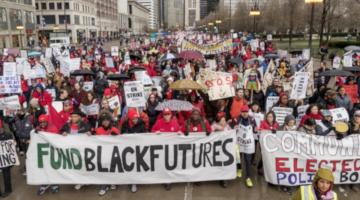 When the Chicago Teachers Union goes on strike, it doesn’t walk alone; Movement 4 Black Lives organizations have their back. And, when young Black activists campaign against police terror, the…
 by Timothy Shenk In order to downgrade the centrality of slavery to the development of the United States and global capitalism, mainstream historians attempt to depict the slaveholding classes as…
 by Yohannes Woldemariam The minority ethnic regime in Ethiopia now faces multiple rebellions. The regime’s foreign friends are part of the problem. “Faced with increased intrusion into their lands by…



