The Poor Die Quicker
A Black Agenda Radio commentary by Glen Ford
"An affluent white woman in the United States can expect
to live 14 years longer than a poor Black man."

There are lots of ways that governments can kill you. Public
policy can be deadly, in more ways than just drafting a person and sending him
off to war. And so, when we have political debates, even those that are purely
about domestic matters - not war and
peace - understand that people's lives are at stake.
New government research shows that the growing economic
disparities in the United States are accompanied by growing disparities in life
span, as well. In other words, economic policy has a direct effect on the
longevity of citizens. The politician
who encourages economic disparities is actually killing people, putting his
fellow Americans in early graves.
We're talking about older people and young babies - all of
whose life prospects are affected by the relative wealth of the families they
come from. And as the pace of change in
society increases, so does the gap in how long different Americans can expect
to walk around and breathe on this earth. A spokesperson for federal medical
officials reports that, back between 1980 and 1982, affluent Americans could
expect to live 2.8 years longer than people in the least economically well-off
group. By 1998 to 2000, the gap in life expectancy between the most affluent
and the poorest groups had grown to four-and-a-half years.
"Economic policy has a
direct effect on the longevity of citizens."
In other words, public policy that affects economic life has
a profound effect on how long one lives. Public policy is contributing years to
some people's lives, and subtracting years from others. Here's the most
dramatic statistic from the federal study: an affluent white woman in the
United States can expect to live 14 years longer than a poor Black man. The
affluent white woman's life expectancy is just a little over 81 years. The
Black man can expect to be around for just under 67 years.
There's lots of reasons that rich people are putting so much
life space between themselves and poor people, these days. Science is coming up
with more ways of dealing with cancer, but the rich have much more access to
this new knowledge. More educated people tend to smoke less. Lower income
people live in unsafe neighborhoods, and of course, tend not to have health
insurance.
What is interesting is, that in a country that claims to be
so morally centered, so concerned about the cause and effect of things,
differences in something as basic as life expectancy don't show up as moral
issues in major political campaigns. Could it be that many Americans continue
to believe that the poor deserve their fate -
including a lot shorter life? For Black Agenda Radio, I'm Glen Ford.
Glen Ford can be contacted at Glen.Ford@BlackAgendaReport.com.

 The United Nations occupation of Haiti under MINUSTAH and BINUH brought instability, violence and even cholera to that nation. Signatories of an open letter to Mexico's president Lopez Obrador remind…
 Djibo Sobukwe participated in a Canadian Foreign Policy Institute panel, "NATO and Global Empire" on June 30, 2022. These are his remarks on NATO and Africa.
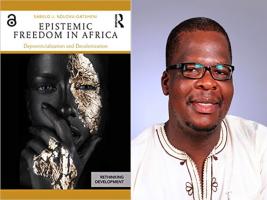 This week’s featured author is Sabelo J. Ndlovu-Gatsheni. Dr. Ndlovu-Gatsheni is Chair of Epistemologies of the Global South, Faculty of Humanities and Social Sciences and Vice-Dean: Research, Africa…
 This week, we interview Courtney Cox. Dr. Courtney M. Cox is an assistant professor in the Department of Indigenous, Race, and Ethnic Studies at the University of Oregon. Her research examines issues…
 The prison system links corporate interests, the military industrial complex, and policing into a web of oppression impacting more than 2 million people in this country. The Mapping Project reports…



