How Criminal Injustice System Impacts Blacks
 A Black Agenda Radio commentary by Glen Ford
Broadcasters and others desiring an MP3 copy of this commentary should visit the Black Agenda Radio archive page here.
"Race exerts an overwhelming influence on the judgments
and decisions of the mostly white-run criminal justice apparatus."
The State of Iowa leads the nation in the rate Blacks are
sent to prison, as compared to whites. It is, therefore, fitting and proper
that Iowa recently became the national legislative leader in documenting why
its little corner of the American prison gulag is so disproportionately Black
and brown. From now on, when state legislators consider bills that are related
to crime and punishment, they will have to produce a Minority Impact Statement,
explaining the effect the law will have on racial minorities and women. It is a
very tentative, but potentially significant step towards a full discussion of
the facts of the national African American Prison Gulag.
For a Black person seeking to avoid the prison experience,
Iowa is the worst place to be. African Americans in Iowa are more than 13 times
as likely to wind up behind bars as whites. Nationally, states on average
incarcerate Blacks six times more often than whites. Iowa is twice as harsh on
Blacks, who make up only two percent of the population. The process of singling
out Blacks for punishment begins early. Forty percent of Iowa's juvenile detention
inmates are Black. And, although Blacks make up only 5 percent of the public
school population, 22
percent of students suspended or expelled from school are Black.
The Iowa Minority Impact Statement bill is restricted to
criminal justice matters, and applies only to new legislation and
funding grants. It does not require a study of how and why the state got to be
so enthusiastic about locking up African Americans. It does appear, based on comparative
studies by Black Agenda Report, that police in states with small Black
populations centered in a few cities tend to bring great law enforcement
pressures on those isolated Black clusters. For example Milwaukee, Wisconsin
registers the highest Black incarceration rate of any big city in the country.
"Police in states with small Black populations
centered in a few cities tend to bring great law enforcement pressures on those
isolated Black clusters."
There is no
dearth of studies
of racist impacts in the American criminal justice system. Iowa's Minority
Impact Statement bill is the direct result of such a study performed by the Sentencing
Project, based in New York. Other studies over the decades show
disproportionate racial impacts at every stage of the criminal justice process,
from police deployment and behavior in Black neighborhoods, to arrest and
booking, through prosecution, trial, sentencing, terms and conditions of
confinement, and circumstances of parole. In other words, race exerts an
overwhelming influence on the judgments and decisions of the mostly white-run
criminal justice apparatus. As with racism in all arenas of society, the
problem is not so much what Blacks can do to avoid prison, but what whites are
doing and perceiving. If that were not so, then we would have to conclude that
Blacks behave six times as badly as whites, nationally, and that Black people
in Iowa are the worst behaved of all.
Nowadays, there's
lots of talk about the need for even more talk on the subject of race. Well, talk
should be based on facts, and the facts of race are nowhere more blatant and
cruel than in the criminal justice system. A meaningful national conversation
about race would begin with detailed discussion of the mechanisms by which
racism has created the internationally infamous Black American Prison Gulag. The
steps that have brought us to the current horrors of incarceration go back
generations. The clinking of chains and shuffling of fettered feet are the
sounds of Black people's past and present. The "impact" is the content of our
future. For Black Agenda Radio, I'm Glen Ford.
BAR executive editor
Glen Ford can be contacted at Glen.Ford@BlackAgendaReport.com.

 Every year, people around the world honor Malcolm X. Though he was taken from us prematurely, his memory and impact remain. With that memory, there is a mandate that we accept and carry on the legacy…
 Pat Parker warns us that cowardly acquiescence to fascism is deadly for us all.
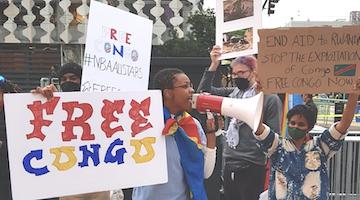 As Rwandan troops tightened their grip on the capitals of DRC’s Kivu Provinces, activists protested the National Basketball Association’s close collaboration with the Rwandan regime.
 The deal for a prisoner exchange proposed by the El Salvadoran president presents a dangerous threat to incarcerated people in the U.S. The continued outsourcing of the U.S. penal system…
 The economic stress on African American people shows itself in phenomena like marriage rates. What once was a benefit to Black communities and a path to the middle class, marriage is becoming…


