A Black Agenda Radio commentary by BAR columnist Jared A. Ball Ph.D.
Some folks are too dense even for cartoons – when they’re produced by Aaron McGruder. The Boondocks author’s political take on President Obama is too heavy for at least a portion of the audience, who tend to see the world as divided between those who are “hatin’” on Obama and those who are not. McGruder’s attempt to create Black political “space” for meaningful discussion confronts the empty spaces inside people’s heads.
The Boondocks as Black Public Sphere
A Black Agenda Radio commentary by BAR columnist Jared A. Ball Ph.D.
“If this is to be the last season of the Boondocks we need to be working to develop space for more public criticism of our horrific conditions.”
To all those who felt that Aaron McGruder had begun this season’s Boondocks with too much criticism of Obama you can rest easy, at least for now. Week two was quite a drop-off from the season-opener. After week one, where McGruder had set such a high-standard of criticism, less directly focused on Obama than on our reaction to the brand, some were actually calling him a replacement of Tavis Smiley as our “high profile… post-racial hater.” He was accused of airing our dirty laundry and was even asked why he had not felt it necessary to have Huey Freeman, his Black revolutionary “terrorist,” choose exile during the reign of Bush as opposed to only after the election of Obama. But what many seem to have missed was that Huey’s inability to pull off his escape of Obama being about having no ride was an allusion to our own political powerlessness and absence of a public sphere where these debates can actually take place. It was just as in Huey’s previous attempt at freeing political prisoner Shabazz K. Milton Burrow where he also couldn’t get a ride and where he also had no space to publicly debate or organize an end to the continued unjust imprisonment of a Black Panther Party revolutionary.
The “public sphere” has often been defined as space where a mostly bourgeois elite meet to openly discuss the politics of their time. The Black public sphere has been defined as one that challenges such class bias and which occurs in what are often considered alternative spaces but no less political or substantive in their exchanges. Churches, beauty and barbershops, street corners, parks and even – for a time – Black popular music all reflected the role of the public sphere. However, the impact on these spaces resulting from gentrification, to worsening economic crises and, most immediately relevant, to increased media consolidation among fewer owners has made these spaces harder to find. According to one scholar, if the public sphere is to be defined as that which allows for public critique of, and an offer of remedy to, the horrific conditions faced by African America, then, “A Black public sphere does not exist in contemporary America.” And it is this absence which has so many either angry at McGruder’s public airing of our dirty laundry or others of us so frustrated that this is as good as it ever gets.
“According to one scholar, ‘A Black public sphere does not exist in contemporary America.’”
Given our current media environment where else is critical public discussion to occur? Even those who dismiss Tavis Smiley as being too hard on Obama need to ask where is the more private discussion they claim they want going to occur? Huey wanted exile after Obama precisely because of the deadening impact the election has had on our own political activity, as voiced by his grandfather, “the Black struggle is officially over.” He had little to say because, as demonstrated by the angry mob, even disinterest or a lack of excitement, not to mention actual fact-based critiques of the president, is risky business. As Huey did say, “hope is irrational.”
And we need more haters out there. Why should only conservatives and apologists have access to any popular media? Where are the critiques of their routine and public bashing of Black people? Why isn’t Obama properly taken to task for publicly airing our dirty laundry, especially when he airs it so often and so out of context? The president just spoke at Hampton University and dared to tell those students to stop paying so much attention to media technology, calling them a “distraction,” when his own pre- and post-election strategy has been openly expressed to be one of branding and media ubiquity with the purpose of making him difficult to pin down and critique. This level of hypocrisy was only matched by this week’s airing of Radio and TV One’s Cathy Hughes with Minister Farrakhan where she actually joined him in lamenting negative popular imagery of Black people. Her own role in killing Black radio and furthering these negative images was left untouched just as Obama’s media use and branding was not mentioned to those unsuspecting Black students.
In the absence of a real Black public sphere we have to enjoy what little we get while we work toward its development. If this is to be the last season of the Boondocks we need to be working to develop space for more public criticism of our horrific conditions. I mean, where else can we find so many public references to Ronald Reagan as a “devil?” No amount of “N-bombs” in The Boondocks can dampen that or worsen the damage done by Black political discussion as it takes place in the Washington Post, New York Times or even TheRoot.com. If we are truly dissatisfied with The Boondocks it is only because we have not cultivated our own Black public sphere.

 What is it about Chávez and the national-popular movement bearing his name that is so threatening to the US Empire to this day?
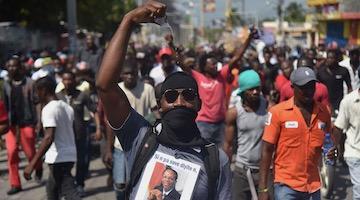 The West’s treatment of Haiti confirms that white supremacy has still not abandoned its plan to impose a racially racist, violent, capitalist and imperial world order.
 Community Control is Best Route to Abolishing Policing As We Know It
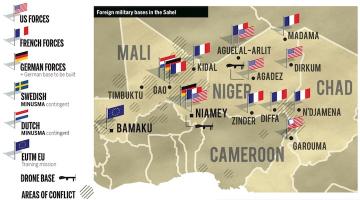 To justify US and European military occupation of much of Africa, migrants seeking jobs in the north of the continent or in Europe “are labeled as criminals and terrorists” when they are “just look
 At a webinar last week, Jericho Movement chairperson Jihad Abdulmumit said the Black Is Back Coalition’s National Black Political Agenda for Self-Determination “covers everything,


