by Glen Ford

At the beginning of the American Civil War, Abraham Lincoln wasn't contemplating an Emancipation Proclamation, but wholesale deportation of Blacks - slave and newly freed alike. Problem was, Lincoln wasn't sure where to send the human cargo. A look at Lincoln's 1861 State of the Union Address.
A Long-ago State of the Union Address: Lincoln Proposes to Ship Blacks Out of Country
by BAR Staff
"It might be well to consider, too, whether the free colored people already in the United States could not...be included in such colonization."
Knowing that we would go to press before George Bush began his annual fulminations and lies to the American people, both Houses of Congress, and the assembled Supreme Court, we thought it timely to flash back to another State of the Union Address, 195 years ago.
On December 3, 1861, the Union was falling apart on Abraham Lincoln's watch. The eleven states of the Confederacy were so far winning the war that had begun earlier that year, and Lincoln's greatest fear was that other slave states - Delaware, Kentucky, Maryland, and Missouri - might yet secede.
The president felt he must tread lightly on the sensibilities and pocketbooks of the slave states that remained in the Union. Under no circumstances must the war be framed as a struggle to emancipate the Blacks. But there was a problem. Congress had declared that those persons in rebellion against the United States had forfeited their claims to "the labor and service of certain other persons" - their slaves. More compelling, many tens of thousands of slaves had already liberated themselves, finding refuge in Union armies where they were listed as "contraband." By law, these persons could not be returned to their rebellious masters and, in Lincoln's words, "are already dependent on the United States and must be provided for in some way." The ranks of de facto free men and women were swelling - a quandary for Mr. Lincoln.
In his State of the Union address, Lincoln announced his solution to the excess no-longer-slaves problem:
"...I recommend that Congress provide for accepting such persons from such States, according to some mode of valuation, in lieu, pro tanto, of direct taxes, or upon some other plan to be agreed on with such States respectively; that such persons, on such acceptance by the General Government, be at once deemed free, and that in any event steps be taken for colonizing both classes ["contraband" and slaves newly freed by States of the Union] at some place or places in a climate congenial to them. It might be well to consider, too, whether the free colored people already in the United States could not, so far as individuals may desire, be included in such colonization."
Get rid of them - somehow, somewhere. Which raised another problem: the United States had no colonies to which to transport the freedmen. What's a president to do, with so many ex-slaves underfoot, cluttering up the war? Lincoln had a plan:
"To carry out the plan of colonization may involve the acquiring of territory, and also the appropriation of money beyond that to be expended in the territorial acquisition. Having practiced the acquisition of territory for nearly sixty years, the question of constitutional power to do so is no longer an open one with us. The power was questioned at first by [President] Jefferson, who, however, in the purchase of Louisiana, yielded his scruples on the plea of great expediency. If it be said that the only legitimate object of acquiring territory is to furnish homes for white men, this measure effects that object, for the emigration of colored men leaves additional room for white men remaining or coming here. Mr. Jefferson, however, placed the importance of procuring Louisiana more on political and commercial grounds than on providing room for population.
"On this whole proposition, including the appropriation of money with the acquisition of territory, does not the expediency amount to absolute necessity - that without which the Government itself can not be perpetuated?"
Fewer Blacks, more room for white men. At the time, Lincoln appears to have found a certain elegance in the equation. But the destination for this human exodus was still lacking. For more than half a century, the United States had refused to recognize the Republic of Haiti, founded by rebel slaves. The U.S. also had no diplomatic relations with Liberia, founded by free American Blacks through the American Colonization Society, a group close to Lincoln's pre-war racial outlook, partially funded by slave owners intent on cleansing the nation of free Blacks. However, when Liberia declared itself a republic in 1847, the slave South prevented U.S. recognition of Liberian independence. Free Blacks flying their own flag - even an ocean away - was anathema.
"The emigration of colored men leaves additional room for white men remaining or coming here."
Either Lincoln would have to invade some other country (a tropical one, with a "climate congenial to" the freedmen) as a repository for the unwelcome Blacks, or he could negotiate with the two existing Black republics to accept flotillas of new immigrants. Lincoln proposed the latter:
"If any good reason exists why we should persevere longer in withholding our recognition of the independence and sovereignty of Hayti and Liberia, I am unable to discern it. Unwilling, however, to inaugurate a novel policy in regard to them without the approbation of Congress, I submit for your consideration the expediency of an appropriation for maintaining a charge' d'affaires near each of those new States. It does not admit of doubt that important commercial advantages might be secured by favorable treaties with them."
Such was Lincoln's thinking in December, 1861. But expediency - that quality so admired by Lincoln - won out. It became expedient to issue the Emancipation Proclamation, January 1, 1863, to deprive the slave states of captive labor. It was expedient to enlist "colored" troops to thicken the Union ranks, as whites in New York and scores of other Union cities rioted against conscription in a war to "free the nigger." By war's end, one out of five Union soldiers was Black, and only fools spoke of "colonization."
What a difference a war makes.

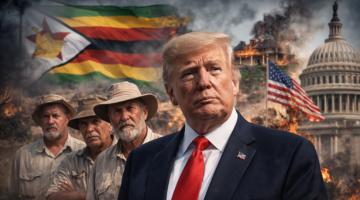 The push by white farmers to enlist Donald Trump in a compensation battle over Zimbabwean land is a brazen, neo-colonial plot to undo African liberation history.
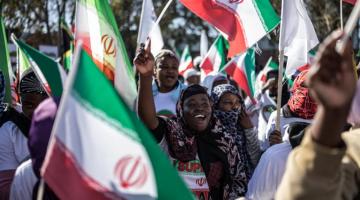 The imperial assault on Iran is punishment for the crime of sovereignty, a protracted siege that oppressed nations worldwide recognize as a weapon threatening their own future.
 In this week’s segment, we talk about human rights and citizenship and the Trump administration's persecution of Haitian immigrants. We begin with a discussion of the need to protect the 14th…
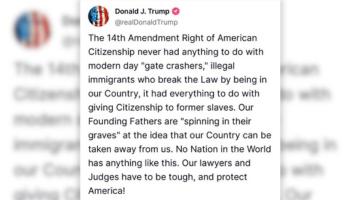 Donald Trump's executive order challenging birthright citizenship also endangers the 14th Amendment guarantees of due process and equal protection. DaMareo Cooper is co-executive director of Popular…
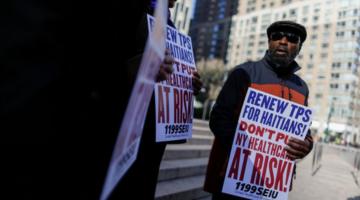 Trump's attacks on immigrants have focused on Haitians. Temporary Protected Status (TPS) may end for 350,000 people, and even those scheduled to be sworn in as citizens are now being denied. Abraham…


