 by Sikivu Hutchinson
A Somali woman gains fame in Europe for denouncing Islam. Ayaan Hirsi Ali, atheist, feminist, and author has secured a “plum position at the neoconservative American Enterprise Institute” while “morphing into a champion of Israel.” In the process, she has reinforced western demonization of Muslim society and whitewashed the West's “own anti-democratic traditions and human rights transgressions.”
Feminism’s Freedom Fighter? On Feminism, Atheism and Ayaan Hirsi Ali
by Sikivu Hutchinson
“Feminism, when invoked at all in mainstream media, is framed as the province of white women.”
In mainstream media, public conversation about the intersection between atheism and what I will loosely term third world feminism is as rare as Halley’s Comet. In the corporate media universe, the groundbreaking work of feminists of African descent like bell hooks, Angela Davis and Patricia Hill Collins remains largely unknown, relegated to academe. Feminism, when invoked at all in mainstream media, is framed as the province of white women, a vestige of a less “enlightened” phase of American civil society.
The phenomenon of world renowned atheist feminist author Ayaan Hirsi Ali, however, would seem to defy this pattern. In a recent Los Angeles Times interview entitled “Feminism’s Freedom Fighter,” the Somalian-born Ali proclaimed women’s rights the human rights issue of the 21st century. An outspoken critic of Islam, Ali is a controversial and uncompromising figure with a compelling personal story of triumph over adversity. A victim of clitoral mutilation in her youth, she has dedicated her life to challenging institutional sexism and patriarchy in Muslim societies. Her activism against gender-based terrorism and repression of Muslim women has been influential in the West, generating international accolades as well as death threats from Muslim extremists. Rising to prominence in the post 9/11 anti-Muslim hysteria of the Bush era, Ali has elicited controversy for her perceived Muslim-bashing, garnering a plum position at the neoconservative American Enterprise Institute and morphing into a champion of Israel.
“She absolves bourgeois democracies like the United States of their schizoid relationship to women rights and human rights.”
Much of Ali’s feminist ideology is based on the contrast between the violent repression of women under Islam and the liberal humanist traditions that supposedly shape women’s rights in the West. In her writings and public discourse she is fond of making sweeping pronouncements deriding the cultures of Muslim societies, valorizing the West in ways that downplay its cultural hierarchies. In a 2007 interview with Reason Magazine she waxed, “Western civilization is a celebration of life…everybody’s life, even the life of your enemy.” Of course, in many Muslim societies feminism is still a dangerously radical concept. For many Muslim feminists, the very notion of women’s personal freedom is a space of epic struggle. Yet Ali’s totalizing assessments set up a false dichotomy between the West and Muslim societies. By portraying feminism as a battle that the West has already won, she absolves bourgeois democracies like the United States of their schizoid relationship to women rights and human rights, a relationship in which rape and domestic violence are part of the national “democratic” currency. And by ignoring the historical context of the “third world within the first world,” she ignores the very real socioeconomic differences that exist between American women of color and white women.
For Ali, white supremacy is no longer a credible threat or motivation for feminist struggle. In the Times interview she rightly criticized men of color for their perpetuation of sexist beliefs and practices, calling for heightened focus on the “internal” politics and tyrannies of misogyny in “third world” communities. Addressing the subject of President Obama’s recent trip to Cairo she stated, “It would have been fantastic if…Obama had said, we have taught the white man that bigotry is bad and he has given it up, at least most of it. Now bigotry is committed in the name of the black man, the brown man, the yellow man.” Ali’s apparent unwillingness to engage the connection between white supremacy, imperialism and sexism is a critical blind spot. Her failure to acknowledge the persistence of institutionalized segregation and its relationship to the disenfranchisement of women of color is problematic. These biases, and her paternalistic stance on Islam, explain why she has been such a darling of the European American conservative elite.
“Ali’s apparent unwillingness to engage the connection between white supremacy, imperialism and sexism is a critical blind spot.”
Certainly when one assesses women’s socialization into and investment in organized religion there are many commonalities between Muslim and Christian systems of patriarchy. Granted Western women are not subject to some of the more overtly terroristic and repressive social prohibitions that Muslim women are. Clitoridectomies and honor killings are not part of Western cultural practices (nor, as many critics of Ali have pointed out, do they occur in all Muslim societies, and in fact derive from tribal not Islamic law). And granted men of color are responsible for the very intimate interpersonal violations of the lives and bodies of women of color. However, legacies of colonialism and racist beliefs about the sexuality of women of color continue to limit equitable access to health care and social welfare in the U.S. Women of color in Western societies are still subjugated by the dictates of Judeo Christian culture masquerading as secularized society. Puritanical prohibitions on women’s sexuality and mobility inform institutionalized sexual and domestic violence against women. Rising rates of sexually transmitted disease and (in many highly religious white fundamentalist Christian and Latino Catholic communities) compulsory pregnancy due to failed abstinence-only sex education policies continue to imperil life conditions for women. Staggeringly high HIV/AIDS contraction rates, infant mortality rates and intimate partner homicide rates among African American women bespeak unequal access to health and social services in communities of color. Epidemic rates of sexual assault among Native American women reflect not only patriarchal control but the invisibility of Native communities vis-à-vis federal health public policy.
Thus Ali’s contention that the West has “adjusted” its cultural and institutional structures to redress the hierarchies of Judeo Christian ideology is short sighted. Indeed, one need look no further than the wide cultural berth given to the Religious Right to see that it is one of the most powerful contemporary threats to civil rights and civil liberty in American history. The white Christian fundamentalist movement’s assault upon human rights, women’s rights and reproductive justice have the potential to reverse gains women have made in the U.S. over the past few decades. In the aftermath of decades of abortion clinic vandalism, bombings and murders of practitioners there is still no international outcry over the insurgent white Christian fundamentalist terrorist movement in the U.S.
“Ali’s contention that the West has 'adjusted' its cultural and institutional structures to redress the hierarchies of Judeo Christian ideology is short sighted.”
From an atheist feminist of color perspective it is problematic to espouse reductive critiques of non-Western religions through the lens of a Western or American exceptionalism; particularly when these paradigms are based on the othering of people of color. The West has xenophobically demonized Muslim societies for their backwardness while “whitewashing” its own anti-democratic traditions and human rights transgressions. Ali’s perspectives unfortunately reinforce this propaganda.
As an atheist woman of African descent Ali’s life narrative and struggle for gender justice is a powerful example for women under the yoke of traditional Islam. Yet her analysis of the path to liberation has been severely clouded by superstar patronage from the very forces that would undermine the human rights mission of feminism.
Sikivu Hutchinson is the editor of blackfemlens.org and a commentator for KPFK 90.7 FM.

 Tensions increase in the Red Sea and the Gulf of Aden.
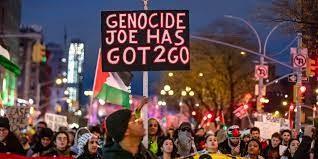 "Genocidal Joseph’s coat of many logos or Boss Tweet’s swastika sensibilities?" is the latest from BAR's Poet-in-Residence.
 In the U.S., a nation built on the enslavement and exploitation of humans, the system of slavery cannot be destroyed. It has merely changed from one form to another.
 Cedric Robinson's Black Marxism can be used as a tool to further expand our understanding of Israel's settler colonial domination over Palestine.
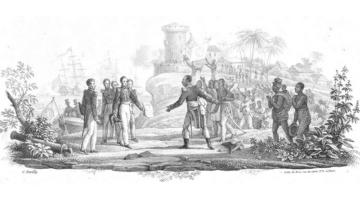 Black scholars have worked to challenge the accepted white supremacist imperialist historical narrative of colonialism and enslavement. The legacy of the Haitian Revolution sits at the center of this…


