Click the flash player to listen to or the mic to download this commentary in mp3 format.
President Obama's economic stimulus was very kind to the general category of education. But Black higher education got the butt end of his budget, with a net of $73 million in cuts, while traditionally Hispanic schools got an increase in funding. "It would be difficult to find anyplace in the federal budget where $73 million has a more concentrated impact on the fortunes of a particular ethnic group." Even southern Republican lawmakers are wondering aloud about Obama's priorities.
First Black President Cuts Funds for Black Higher Education
A Black Agenda Radio commentary by Glen Ford
“Obama should be given a brief refresher course in the history that makes direct aid to Black schools necessary.”
Barack Obama encourages people to believe that he deserves to be remembered as the “Education President.” However, Obama will definitely not go down as a friend of historically Black higher education. Historically Black colleges and universities – HBCUs – take a $73 million hit in Obama’s educational budget. The cuts are even more disturbing, since education as a general category is a big winner in the president’s economic stimulus plan.
Obama’s people claim that an increase in maximum Pell Grant monies for low-income students will help all educational institutions, including historically Black ones. But that’s not quite true. Even if every one of the 132,000 Pell Grant students that attend HBCUs collected the maximum $200 extra dollars in Obama’s budget, that would only make up for one-third of the administration’s cuts to the Black schools. In other words, Obama’s slightly rising tide of Pell Grants will not sufficiently lift historically Black higher education boats.
The $73 million loss would have an outsized impact on the 105 Black institutions, many of which are on perennially shaky financial ground, and all of which have been hit hard by the current economic crisis. Although Black schools make up only three percent of total U.S. college enrollment, they account for one out of every five undergraduate degrees awarded to African Americans. It would be difficult to find anyplace in the federal budget where $73 million has a more concentrated impact on the fortunes of a particular ethnic group.
“The Obama budget actually increased direct federal aid to heavily Hispanic schools, from $93 million to $98 million.”
A direct comparison might be made with colleges that traditionally serve large numbers of Hispanic students. However,the Obama budget actually increased direct federal aid to these schools, from $93 million to $98 million. Native American higher education, on the other hand, gets the “Black” treatment: a decrease in federal funding to Indian schools.
The Obama administration’s callous disregard for Black colleges is even more curious, considering the president’s constant quest for areas of bipartisan consensus. Support for Black higher education is one of the rare issues around which southern white Republicans and members of the Congressional Black Caucus often find common ground. North Carolina is home to 11 HBCUs. The state’s Republican Senator, Richard Burr, wonders how Obama managed to find $9 million to fund a museum on the history of the whaling industry, but makes devastating cuts in Black higher education.
The timing couldn’t be worse. Many Black colleges were the products of philanthropy, and depend on it, still. But philanthropy is way down, which has pushed many Black institutions even closer to the edge.
President Obama should also be given a brief refresher course in the history that makes direct aid to Black schools necessary. Blacks were deliberately shut out of most higher education for almost the entirety of United States history. For that reason, Black institutions operate under specific disadvantages, while shouldering oversized responsibilities. There is nothing “race-neutral” about it. Past and present racial realities require that Obama give up the money.

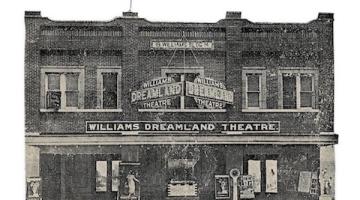 In 1921 thousands of whites attacked the Black population of Tulsa, Oklahoma with machine guns, airplanes, fire and pure hatred, killing at least 300.
 More policing rarely results in justice for anyone, and only puts Black, Indigenous, and other communities of color (BIPOC), including Asian people, at risk for more violence.
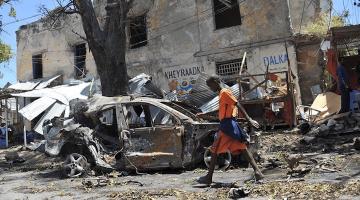 “Bombing Somali civilians is one of AFRICOM’s main projects,” writes Mohamed Haji Ingiriis, a young Somali historian.
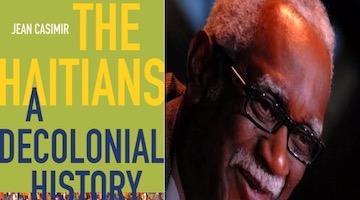 The worldview animating Haitian masses today is leading to a social context ungovernable within the framework of prevailing economic neo-liberalism.
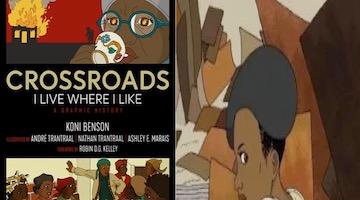 This book challenges the myth that 1994 was the turning point in South Africa -- because the liberation process is unfinished.


