A Black Agenda Radio commentary by Glen Ford
Racial myths are slow to die, because they serve the purposes of those who rule through mechanisms of racial oppression. Black mass incarceration, which has been public policy of the United States for four decades, is underpinned by assumptions of Black criminality – especially drug abuse. “A new study, however, shows that Black and Asian kids are, in fact, much less likely than their white counterparts to abuse or become dependent on drugs and alcohol.”
White Kids Abuse Drugs and Alcohol at Twice Rate of Blacks
A Black Agenda Radio commentary by Glen Ford
“Nine percent of white kids develop drug dependencies and disorders – twice the rate of Blacks, and three times that of Asians.”
For some time, social scientists have known that the stereotypes were a lie: that Blacks were no more prone to drug and alcohol abuse than whites, and probably somewhat less so. Study after study has indicated that a rough racial equality exists in terms of young people’s desire to get high. A new study, however, shows that Black and Asian kids are, in fact, much less likely than their white counterparts to abuse or become dependent on drugs and alcohol – a finding that, in a more just nation, would have vast ramifications for public policy.
A team from Duke University conducted the study of young people aged 12 to 17. It was based on confidential federal surveys of more than 72,000 adolescents in all 50 states, from 2005 to 2008. This is a much larger and geographically representative group than previous studies, and presumably more definitive. It shows that 9 percent of white kids develop drug dependencies and disorders – twice the rate of Blacks, and three times that of Asians. Native Americans suffer by far the highest rates of disorders from drug and alcohol abuse, at 15 percent.
Not surprisingly, marijuana is the drug of choice for teenagers, and of the kids that smoke marijuana, 26 percent fall into the abuse or dependence category.
Overall, 8 percent of U.S. kids have a substance disorder, while 37 percent reported using drugs or alcohol at some time in the past year. But the news was in the racial breakdown.
Native American youth were found to use the most drugs or alcohol, with 48 percent having done so in the past year. Whites were second, at 39 percent; Hispanics, 37 percent; mixed race kids, 36 percent, followed by Blacks at 32 percent. Asians were far less likely to indulge drugs or alcohol, at only 24 percent.
“Native Americans suffer by far the highest rates of disorders from drug and alcohol abuse.”
The racial pattern was somewhat different for drug use, alone. In the past year, 31 percent of Native American teenagers got high off drugs; 23 percent of mixed race kids; 20 percent of whites; 19 percent, Blacks; 18 percent for Hispanics, and just 12, Asians.
That’s about the same rate of drug use for whites and Blacks: 20 and 19 percent, respectively. But white youth are substantially more likely to have imbibed alcohol in the past year: 35 percent for whites, 25 percent for Blacks.
So, what does this new knowledge mean in terms of public policy? The author of the study, Prof. Dan Blazer, of Duke University Medical Center, says the data should help programs “focus on the subgroups of adolescents who are at greater risk.” At risk of what? The numbers show whites are more at risk than Blacks for actual drug and alcohol disorder and abuse. But Black kids are far more at risk for incarceration for drugs. Public policy, through police surveillance and stop-and-frisk, is justified by assumptions about human behavior, such as that Blacks are more involved in drug use and abuse than whites. But once again, this has been proven to be factually false. The Duke University data show that the United States criminal justice system – not Black behavior – is responsible for the vast racial disparities in incarceration for drug offenses. The system is rigged, and science proves it. The fundamental problem is that America is drunk on racism and constantly indulging in Black-people-abuse.
For Black Agenda Radio, I'm Glen Ford. On the web, go to BlackAgendaReport.com.
BAR executive editor Glen Ford can be contacted at Glen.Ford@BlackAgendaReport.com .

 Bernie exposed the white supremacist and imperialist contradictions of white feminism to the disinfecting sunlight of reason.
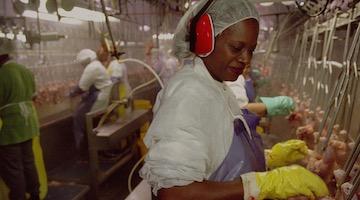 Poultry-processing plants are critical sites of racial capitalist accumulation produced through an unequal valuation of people and places.
 This week voting in November and the crisis of the Democratic Party was on your mind.
 Required reading for black study and abolition: a syllabus for an abolitionista on the run. “Abolition requires an ongoing radical belief in the impossible.”
 Underground labor allowed many women to sustain themselves and the people and religious institutions that they cared about.


