A Black Agenda Radio commentary by Glen Ford
America’s top hit man in Africa, Uganda’s President Yoweri Museveni, is calling for a much larger air, sea and land war in Somalia – with Museveni’s forces on point. The saber-rattling follows on the heels of Uganda’s and Rwanda’s threats to withdraw from UN “peacekeeping” missions, such as in Somalia. What’s up?
Uganda, America’s Pit Bull, Wants to Lead a Larger War in Somalia
A Black Agenda Radio commentary by Glen Ford
“Uganda also volunteers to head up a coalition of African nations for a renewed military campaign to save the U.S.-backed puppet regime.”
Uganda, long a military client of the United States, proposes that a no-fly zone be imposed on Somalia and that the nation’s ports be blockaded by aircraft carriers in order to starve out the Islamic Shabaab resistance. Uganda also volunteers to head up a coalition of African nations for a renewed military campaign to save the U.S.-backed puppet regime, which controls only a few neighborhoods of Mogadishu, Somalia’s capital. All of this would, of course, be paid for by what Ugandan President Yoweri Museveni calls “the international community” – meaning, the United States and Europe.
Museveni’s troops, along with soldiers from Burundi, another central African nation in Washington’s orbit, are all that keep the puppet Somali regime barely alive. It is commonly accepted that, if the Ugandans left, the puppet government would collapse in a matter of hours. The Shabaab resistance, it goes without saying, has no air force, and is not supplied by air from any outside source, so it is difficult to imagine whose planes President Museveni wants to keep out of the skies. His calls for a blockade by sea are also problematical. An informal international armada, including China, already operates off the Somali coast to curb piracy against cargo vessels. The U.S. Indian Ocean fleet is always nearby. But Somalia’s pirates have not been allied with the Shabaab – at least not until quite recently – and the Americans had hoped to keep it that way. If the U.S. wanted to shut down every port on Somalia’s coast, it could easily bomb them out of existence. To do so, however, would turn every Somali irrevocably against the Americans. The possibilities of maintaining a viable puppet regime would evaporate, forever, requiring endless military occupation in the face of guerilla resistance.
“The Ugandans and Rwandans are angry at the United States for failing to suppress a recent United Nations report on mass murders in Congo.”
It is also widely acknowledged that the Shabaab resistance eats what the Somali population eats, so starving them out would be an act of genocide – not that the United States has not considered such a solution. And the Shabaab appear to get all the weapons and ammunition they need from constant defections and weapons sales from the American-financed puppets in Mogadishu.
Museveni is already scheduled to get thousands of reinforcements and money for his troops in Somalia, paid for by the Americans and Europeans. There is plenty of military business for Uganda, which acts as a hit man and enforcer for neocolonialism in Africa.
So what is Uganda's Museveni up to, with his saber-rattling?
Uganda was implicated, along with Rwanda, another American client, in the massacre of Hutus during the two countries' invasion of the Democratic Republic of Congo – massacres that could lead to genocide charges. The Ugandans and Rwandans are angry at the United States for failing to suppress a recent United Nations report on the killings, as Washington had suppressed previous reports of mass murders in Congo. Both Uganda and Rwanda had threatened to withdraw their troops from so-called UN peacekeeping missions – such as in Somalia – but the UN called their bluff. Museveni is making big war talk in Somalia to call attention to his ongoing service to U.S. policy in Africa. He is telling the top gangsters in Washington that the hit man still has value; that the hired killer deserves his proper respect.
For Black Agenda Radio, I'm Glen Ford. On the web, go to www.BlackAgendaReport.com.
BAR executive editor Glen Ford can be contacted at Glen.Ford@BlackAgendaReport.com.

 The UN panel’s reports on Nicaragua recycle claims from U.S.-backed opposition groups, serving as a propaganda arm for Washington’s regime change agenda.
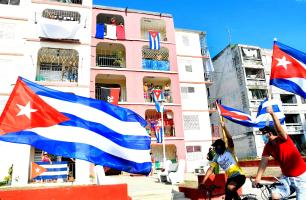
 In this week’s segment, we hear about an effort to build community-based power and self-determination for a Black working-class Washington, DC community. But we begin with a report on conditions in…
 We're joined by Suzanne Adely of the National Lawyers Guild and the International Association of Democratic Lawyers and Corinna Mullin of the US Peace Council and Anti-Imperialist Scholars Collective…
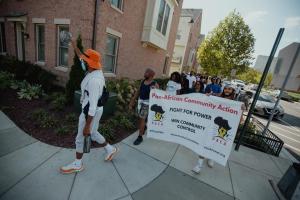 Pan African Community Action (PACA) recently released a plan for political empowerment in Washington DC, "Community Control DC, A People’s Platform for Collective Self-Determination." Oliver Robinson…
 Jacqueline Luqman, Margaret Kimberley, Netfa Freeman, and Gus Griffin were among the panelists joining Your World News Media to discuss the lies and war propaganda that fuel the brutal war of…


