by Yessenia Funes
The fight against the Dakota Access Pipeline isn’t only about water rights and sacred sites; it’s also about the U.S. government’s historical refusal to honor treaties—when “they interfered with Manifest Destiny.” Washington violated its treaty with the Sioux in 1877, and later declared its power to void all Native treaties. “There are now talks of using the treaty to legally regain land rights to end the pipeline's construction.”
One Treaty Could Change the Fight to Stop the Dakota Access Pipeline
by Yessenia Funes
This article previously appeared in ColorLines and Portside.
“Highway 1806 has become the no surrender line.”
When activists talk about the controversial Dakota Access Pipeline [1] and the Native uprising surrounding its construction, they often frame it with regard to the environment. Water. Sacred burial grounds. Grandmother Earth.
Opponents site potential environmental risks to water resources like the Missouri and Mississippi rivers to defend their stance against the 1,172-mile long pipeline, which would have the capacity to transport up to 570,000 barrels of crude oil a day from the Bakken oilfields of North Dakota to markets across the U.S.
What many ignore, however, is another facet of the #NoDAPL [2] movement: Native sovereignty.
Most of the confrontations between water protectors and law enforcement are occurring near the Standing Rock Reservation. The reservation currently takes up roughly 3,625 square miles [3] across southeastern North Dakota and into South Dakota. More than 8,000 people [4] live in scattered communities, all connected by a common history—one which includes land theft and treaty violations.
The construction of the Dakota Access Pipeline has brought this history to the current day. “Our standoff is on treaty land, so we have every right to defend what is rightfully ours,” says Cody Hall, a Lakota civil rights activist with the Cheyenne River Tribe who has spent time on the frontlines in North Dakota.
When he speaks of “treaty land,” he’s referring to land allotted to the Great Sioux Nation by the Treaty of Fort Laramie of 1851 and 1868.
“Our standoff is on treaty land, so we have every right to defend what is rightfully ours.”
The revised treaty established the Great Sioux Reservation in 1868, which the federal governement would eventually shrink to what became the Standing Rock Reservation. The treaty land crisscrossed between seven present-day states—North Dakota, South Dakota, Nebraska, Kansas, Colorado, Wyoming and Montana—including the reservation and unceded territories reserved for hunting.
These boundaries were created to ensure peace between Native people and colonizers. The temptations of gold, however, meant that travelers were soon in tribal territory. Almost immediately after its conception in 1851, the U.S. violated the treaty by not policing its citizens' entry onto Native land.
For Native Americans, treaties function as the law of the land. Article VI of the U.S. Constitution clearly states:
This Constitution, and the laws of the United States which shall be made in pursuance thereof; and all treaties made, or which shall be made, under the authority of the United States, shall be the supreme law of the land; and the judges in every state shall be bound thereby, anything in the Constitution or laws of any State to the contrary notwithstanding.
The U.S. government would honor treaties—until they interfered with Manifest Destiny. “It was all about colonial expansion,” says Frank Pommersheim, a professor at the University of South Dakota School of Law who specializes in Indian law. In 1877, without consent from the Sioux, the United States stole their sacred Black Hills. The land was the center of their world, their birthplace.
This act set in stone U.S.-tribal relations. From then on, the United States slowly diminished the land it left for tribal peoples. By 1889, the Great Sioux Reservation became what it is today: 3,625 square miles tucked between North and South Dakota, stripped of ancestral burial grounds and lush buffalo populations with which the Sioux used to coexist.
In 1903, fewer than 30 years after the Black Hills seizement, the Supreme Court ruled in Lone Wolf v. Hitchcock [5] that Congress may unilaterally break treaties between the U.S. and Native Americans using its plenary power. “It is unfortunately a part of American law. That basic precept is totally unacceptable to Native people in the context of treaties,” Pommersheim explains. "It is just a collision between cultures and different understandings and interpretation of what treaties actually mean."
“Almost immediately after its conception in 1851, the U.S. violated the treaty by not policing its citizens' entry onto Native land.”
He is correct that a vast number of Native Americans find this unacceptable.
“To us [these treaties] are very much still alive and a part of our everyday life,” says Remi Bald Eagle, the intergovernmental affairs coordinator for the Cheyenne River Sioux Tribe in South Dakota. “We still honor those treaties, and I know the chairman has said that he expects America to do the same.”
And while the U.S. has violated said treaties over the past century, it’s never declared the treaties null or void, Bald Eagle adds.
With the Treaty of Fort Laramie in mind, water protectors opposing the Dakota Access Pipeline have tried to take action. On October 23, pipeline opponents declared eminent domain [6] over land owned by Energy Transfer, the company behind the pipeline, by citing the treaty. Joye Braun, an Indigenous Environmental Network organizer, said in a statement:
We have never ceded this land. If DAPL can go through and claim eminent domain on landowners and Native peoples on their own land, then we as sovereign nations can then declare eminent domain on our own aboriginal homeland. We are here to protect the burial sites here. Highway 1806 has become the no surrender line.
The Sacred Ground Camp had already existed for over a month with about 300 people camped out, but occupiers extended the camp on October 23 by creating three road blockades to prevent militarized law enforcement from entering. (This came just a day after police arrested roughly 127 water protectors [7] directly across the road from where private security for Energy Transfer had unleashed dogs [8] on activists one month earlier.) The camp also intended to halt construction where the remaining proposed pipeline route would connect with the Missouri River.
Four days after declaring eminent domain for the camp, on October 27, law enforcement from seven states arrived there fully equipped with riot gear, all-terrain vehicles, armored vehicles and helicopters. They arrested 141 water protectors [9]—after beating them with batons and issuing pepper spray. Law enforcement ultimately destroyed the camp, along with its tipis and sweat lodges.
“We did everything in our power that we could do to defend our camp in a nonviolent approach,” says Cody Hall of the Cheyenne River Sioux Tribe. “Because the only way to really defend it would have became a violent approach because you're meeting officers with a force of weaponry.”
“We still honor those treaties, and I know the chairman has said that he expects America to do the same.”
There are now talks of using the treaty to legally regain land rights to end the pipeline's construction, according to Hall and others on-site. There is a precedent for taking this approach: In May, the Lummi in Washington state called on the U.S. Army Corps of Engineers to reject a coal terminal permit on the premise that it would harm Lummi fishing grounds, which the federal government is legally mandated to protect per an 1855 treaty. The Lummi won [10]. No terminal was built, fishing grounds were not harmed and the treaty was honored.
“[DAPL] brings to the surface all the issues dealing with treaties," says Bald Eagle. "It brings up all the wrongdoings that have been happening in the past. The American government has repeatedly shoved all of their wrongdoings underneath the rug, and the issue with the Dakota Access Pipeline has pulled that rug off, and now we have to look at everything that’s been done wrong.”
He lays out three choices for the U.S. government: correct its wrongs, put the rug back or commit another wrong.
President Barack Obama [11], when interviewed by social media news site NowThis, stated that the Corps is figuring out [12] how to reroute the pipeline over the next several weeks, saying, "There is a way for us to accommodate sacred lands of Native Americans." But construction has nearly reached the Missouri River, sacred water for the Sioux. Several more weeks may be too late.
Yessenia Funes is the climate justice reporter for Colorlines. She was previously an editor at YES! Magazine, where she covered racial justice with a solutions lens. Her work has appeared in Grist, AlterNet, Public Radio International, and Truthout.

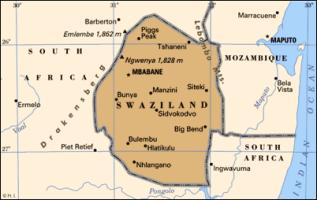 June 29 was observed as a day of commemoration in Swaziland to honor the dozens of people killed by the forces of King Mswati III during the unprecedented anti-monarchist uprising of 2021
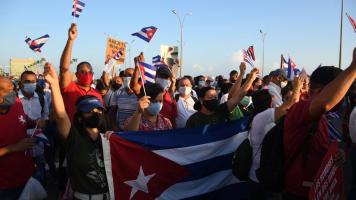 Black Alliance for Peace condemns U.S. sanctions on Cuba and supports self-determination and sovereignty for that nation.
 U.S. involvement in Cuban protests on July 11, 2021, Black community in Atlantic City, NJ fights for justice, and Democrats' political pressure and voter intimidation remove Green Party from North…
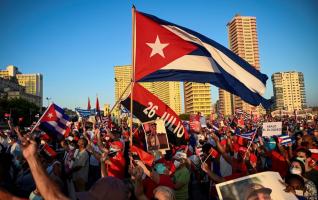 The U.S. played a role in orchestrating what were described as anti-government protests in Cuba on July 11, 2021. Isaac Saney is a history professor and Cuba specialist at Dalhousie University in…
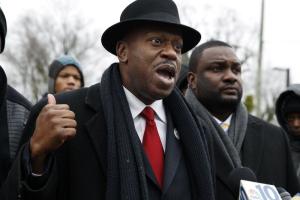 On July 4, 2020, seven Black men were arrested while protesting the police killing of George Floyd. But Atlantic City’s black community also suffers from ineffective political leadership, corporate…


