The current strike is driven by gross inequalities in earnings among workers, as well as between labor and management.
“Labor power gives Blacks more collective power to tackle other societal issues, such as police brutality and gentrification.”
Why The Strike?
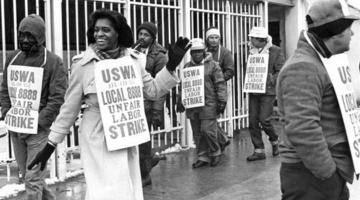
About 51,000 members of the United Auto Workers walked off the job on September 16 against General Motors. General Motors and the striking United Auto Workers union are at opposite ends over these issues. One is how fast to move newer hires up to the top wage and how soon temporary workers should qualify for full employment. Another sticking point is that GM wants employees to pay a larger share of health benefits.
A disproportionate number of temps and two-tier workers are black and brown workers. They earn as little as $15 an hour at the beginning of their employment. In comparison, the legacy workers (those working before the two-tier system) make $30 an hour). Now new hires need to work eight years to reach the level of permanent. Even fewer benefits accrue to the temps. The two-tier wage system began in 2007.
“Now new hires need to work eight years to reach the level of permanent.”
Yet, GM CEO,Mary Barra made over $20 million in the last two years, 281 times the median wage of the GM worker, according to the Detroit Free Press. GM pays little in federal taxes, but took in $35 billion profits in the US in the previous three years.
Today’s highly profitable GM was a product of Obama’s corporate welfare in 2009. Obama agreed to GM’s downsizing actions, resulting in thousands of layoffs. GM bosses then demanded further concessions over the last 12 years. Why then does GM want still more concessions, not roll back on others? It is to increase its rate of return on profits?
Now, the U.S. government’s role is to try to tame or break the UAW. Like the tick-tock of the clock, the feds charged the UAW with corruption complete with raids on union officials’ homes -- part of the capitalist charade.
Brief History Of Labor And Black Workers
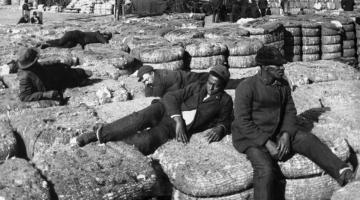
Some brief background of organized labor and black working-class history is needed. Blacks began their forced work journey in the organized system of black slavery in the New World. White colonial powers grew rich through primitive accumulation of capital. They used racism to justify black slavery.
Black skin now meant human inferiority. But, as Karl Marx said, “In the United States of America, every independent movement of the workers was paralyzed as long as slavery disfigured a part of the republic. Labor cannot emancipate itself in the white skin wherein the black it is branded.”
Phillip Foner’s Organized Labor and the Black Worker 1619-1981, remains the most definitive work written on the topic. I also strongly recommend Black historian Robin D.G. Kelley’s analysis of Foner’s work. According to Kelley, there exists a deep history of white working-class intransigence in tandem with episodes of interracial class solidarity and the elusive promise of a radical future.
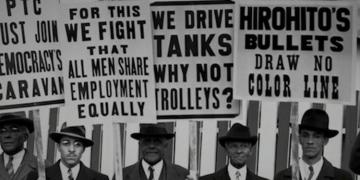
As Kelley and Foner noted, the labor movement was marked both by periods of black-white working-class solidarity and vicious racist division. Again and again, Blacks showed white workers the way, from the Colored National Labor Union to A. Phillip Randolph’s Brotherhood of Sleeping Car Porters to he League of Revolutionary Black Workers to the Coalition of Black Trade Unions. Black workers consistently appealed for solidarity.
Blacks Inside The Auto Industry
Since the birth of the UAW-CIO in 1935 black auto workers faced all sorts of discrimination, but not nearly as much as in the American Federation of Labor. Black autoworkers still were often placed in the dirtiest and most dangerous jobs. Plus, the big three auto industry bosses used blacks as replacement workers in classic divide-and-conquer, whites-against-blacks tactics. But with the union doors opened wider to blacks, there was much less crossing of picket lines.
Revolutionary union movements arose in the auto industry from 1968 to 1972. These groups started wildcat strikes and other adversarial actions against unsafe working conditions and persecution of organizers, and fought to knock down institutional racial discrimination in the plants and within the union, itself.
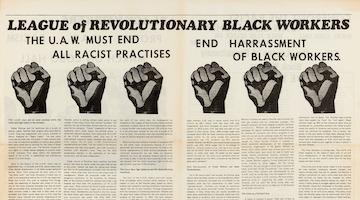
The League of Revolutionary Black Workers served as a coordinating group in the beginnings of 1969. It aimed to be the leadership of the working class. The League published a newspaper that focused on the decrepit quality of life in the black community, as well as conditions on the job. The solution, then as now, was anti-capitalist and anti-imperialist. Revolutionary black unionists had a profound impact on the politics of the era. However, the League collapsed in factional disputes in 1972.
The United Auto Worker’s civil rights legacy includes permitting blacks to join the union, placing anti-discrimination clauses in collective bargaining agreements, supporting Dr. King’s 1963 March on Washington to its present strike activities.
Black Participation In Unions
According to the Brookings Institute, black male union membership swelled to over 40 percent, while white men were between 30 and 40 percent. In the later 1970s, about one in four black women were in a union -- almost double that of white women.
The severe drop in collective bargaining among workers of all racial and ethnic groups in the last four decades has occurred in tandem with rising racial wage inequality. The year 1983 found 31.7 of black workers in unions, compared to 23.7 percent of the general workforce. By 2017, those figures fell to 12.7 and 10.7 percent, respectively. From 1979 to 2016, the average earnings of African Americans declined from 80 percent of white males to 70 percent of white male income. For black females, average earnings dropped from near equality with white women to 82 percent of white women. Union jobs pay about 16.4 percent higher wages than nonunion jobs.
Why Blacks Need Unions in A Capitalist Economy
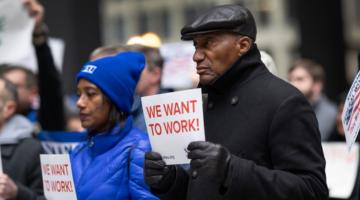
During a capitalist economic upswing, blacks are last hired and first fired. During a downswing, blacks are first fired and last hired. We need health benefits. We need two-tier, and temporary worker status knocked down. We need good pension plans. We need a fair tenure system. Whatever the scenario, black working-class folk need a democratic rank and file union.
Most of us are working-class. The ability to withhold working class labor is an essential weapon in the fight against capitalism. Labor power gives Blacks more collective power to tackle other societal issues, such as police brutality and gentrification. Immigrants and workers around the world are our allies.
Support the UAW. March in the UAW picket line. Volunteer. Speak out.
Dr. Ken Morgan is an activist scholar internationalist, educator, former labor organizer, member of the CBTU, and Maryland Council of Elders. He can be reached at kmorgan2408@comcomcast.net.




 Trump is terrorizing Minnesota’s Somali Americans in a desperate xenophobic and racist appeal to voters in the state’s white farming and mining communities.
 Artificial intelligence and hyperscale data center buildout constitute a new front of environmental racism and a project to optimize white supremacy, with Black communities targeted as sacrifice…
 Erik Prince's mercenary operations in the Democratic Republic of the Congo serve U.S. imperial and corporate interests in critical minerals and violate the Congolese peoples' sovereignty.
 Mali, Burkina Faso, and Niger are leading the way toward the realization of Pan-Africanism and the struggle against imperialism in the 21st century.
 The 1976 bombing of Cubana Flight 455 was part of a six-decade U.S.-orchestrated campaign of destabilization against Cuba, which has now escalated into a genocidal siege aimed at starving the Cuban…


