Minnesota pushed back against ICE until its visible presence seemed cut in half, but Trump does not forgive or forget, and it’s a time to be organized.
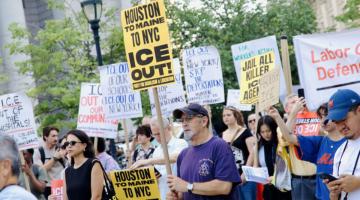
Over 100,000 people attended the “No Kings” rally in Saint Paul, Minnesota on March 28, 2026. The “No Kings” organizers made Minnesota the “flagship” of their 3300 rallies involving an estimated eight or nine million people because their fierce battle with ICE appeared to be the most successful yet. Bruce Springsteen sang and Vermont Senator Bernie Sanders gave a rousing speech including his usual indictment of billionaires and condemned Trump’s illegal war on Iran. Protesters also heard from Minnesota’s outgoing Governor Tim Walz and Senator Amy Klobuchar, who is running to succeed him.
Trump bludgeoned Walz so badly with unsubstantiated allegations about how he handled Medicare and Medicaid fraud investigations that he canceled his campaign for re-election. He had dared to run with Kamala Harris and as we all know, Trump does not forgive or forget.
Sanders praised Minnesota’s response to the ICE occupation in which Trump deployed thousands of masked gunmen, some of whom shot Renée Good and Alex Pretti dead and left another dozen with life-altering injuries. He praised Minnesota’s “courage and sacrifice,” resonating with the national movement to resist ICE.
It is true that many of the masked ICE gunmen who killed Renée Good and Alex Pretti have been withdrawn from Minnesota. Visibly their presence seems about half what it was before. It is also true that their nakedly racist attacks on people of color in apartment complexes, parking lots, and department stores have been tamped down.
However, the conclusion that Minnesota has defeated Trump and his ICE goons, and that it should be a model for the rest of the nation are exaggerated and premature.
The No Kings rallies are produced by Indivisible, a Democratic Party NGO created to build an electoral majority against Trump, to defeat him in November’s mid-terms and beyond. ICE is Indivisible’s primary issue but the organization fails to address the US’s forever wars that propel immigration.
Would so many Venezuelans, Cubans, Haitians, Salvadorans and other Latin American nationals be here seeking asylum or opportunity if the US hadn’t hammered their countries with sanctions, proxy wars, and IMF strangulation? Do Democrats disagree with Elon Musk’s offhand assertion, with regard to Bolivia and its lithium, that “we’ll coup who we want”?
That’s not an Indivisible issue. They remain within the Democratic Party’s ahistoric, neoliberal narrative. Never mind that US wars enrich US elites, impoverish the rest of us, and ravage foreign nations.
In Minnesota, the Democratic Party is called the Democratic Farmer Labor Party (DFL). The crowd of more than 100,000 and all the luminaries who came to St. Paul made them confident that, come November, they’ll hold onto the governor’s mansion, with Senator Klobuchar succeeding Governor Waltz, and that they’ll be able to flip at least one, maybe even two seats now held by Republicans in the House.
Senator Klobuchar has a base in Hennepin County, the most densely populated county in Minnesota, where she served as County Attorney. She has been a US Senator since 2007. Always positioning herself as a moderate, she ran for president in 2020, but lost the primary to Biden. She is not one to take bold progressive positions that would make her a natural leader of those now valiantly rising up to defend their neighbors.
Speakers at the St. Paul rally led chants of “No Wars!” and “No Billionaires!” but, like Indivisible, Klobuchar isn’t one to help broaden their horizons in that direction.
Early polls and political handicappers give Klobuchar a slight edge in the race to replace Walz, who represented Minnesota’s First District before moving on to the Governor’s mansion. The First District spans from the Wisconsin border to the South Dakota border and includes Rochester, where the Mayo Clinic is headquartered. Its workforce is mostly college educated, and college students make up a major part of its Mankato area. Trump historically underperforms with both demographics, but the DFL believes that Kamala Harris was such a weak candidate that she cost them in down ballot races in 2024.
Minnesota’s 7th and 8th districts are rural. They cover western and northwestern regions of the state bordering Canada. Iron ore mining and farming are the backbone of their economies. Iron ore is essential to making steel. Both districts are currently represented by Republicans, though they have been DFL strongholds in the past. Democrats Collin Peters and Jim Oberstar, who chaired the House Farm and Transportation Committees for many years, formerly represented these districts.
Republicans flipped both with the help of Trump’s isolationist, anti-immigrant rhetoric and his promise of hefty tariffs on steel imported from China.
Trump told iron ore miners that taxing steel from China would create more demand for steel made in America, and that they would somehow benefit in the process, but that didn’t happen.
Instead, the region is desperately trying to reinvent itself as a tourist destination showcasing the heydays of iron ore mining. The state spent $9 million to build a new museum promising that “visitors to a state park in northern Minnesota can once again travel nearly a half mile underground into the dark bowels of a historic iron ore mine.” Sounds like a nice way to honor labor, but it’s not going to save a suffering industry.
China retaliated with tariffs of its own that hurt corn and soybean farmers, who saw their warehouses filled with unsold products. Now, during the planting season, these farmers are also hit with drastically higher fertilizer prices thanks to Trump’s war on Iran.
Their suffering makes DFL hopeful that the political pendulum will swing back their way in November, but Trump is escalating his racist, anti-immigrant, and especially anti-Somali rhetoric to excite and motivate his supporters and keep them in the MAGA Republican fold.
He has focused obsessively on the Somali American community concentrated in Minneapolis/St. Paul, and particularly on Congresswoman Ilhan Omar, whom he calls “garbage” while his supporters chant “Send her back!” He is actually trying to win the mid-terms by raving that Somali fraud in Minnesota is a national crisis.
On February 25, 2026, The Washington Post reported the resignation of John Hurley, the Treasury Department’s Undersecretary for Terrorism and Financial Intelligence, after he objected to Trump’s central campaign plan for 2026. The centerpiece of this plan is to indict more Somali Americans and close more of their businesses under a secret program dubbed Geographical Targeting Order (GTO).
Hurley objected to GTO on constitutional grounds, but the program proceeded anyway. Some financial institutions succumbed to pressure from the Treasury Department and started debanking Somali Americans in Minnesota.
Trump explicitly ordered Treasury Secretary Scott Bessent to generate reports on financial crimes committed by Somali immigrants and Somali Americans that could be used in 2026 campaigns for Republican candidates. Treasury officials told the Washington Post that “he [Besent] is under a lot of pressure from The White House to show some interim results. Trump needs something for 2026 [on Somalia]” after his nearly nine-minute rant about ‘Somali fraud’ in Minnesota during his State of the Union address.
In addition to GTO, the Treasury Department is pressuring financial institutions to target Somalis. The Department of Justice (DOJ) expedited court hearings for the nearly 3,000 Somali asylum seekers in the now defunct Temporary Protection Status (TPS) program. The US Immigration Court system has millions of petitions from nationals around the globe but the several thousand Somalis have been targeted for exigent deportation. Furthermore, the DOJ has convened two grand juries to investigate Somalis, one in Minnesota and another in Virginia.
Both grand juries are shrouded in secrecy. According to one attorney who accompanied a client to a proceeding, the whole purpose of both grand juries is to investigate Somali fraud.
On April 29, 2026, federal agents raided 22 Somali-owned businesses in Minnesota. On May 21, 2026, Trump sent Secretary of Health and Human Services Robert F. Kennedy and Medicare and Medicaid Services Administrator Dr. Mehmet Oz to Minnesota to hold a press conference and unseal new indictments.
The strategy is very clear. It is to keep the Somali fraud issue in the headlines through the November 2026 elections. More indictments are expected in the summer and there may even be a surprise indictment of a prominent Somali right before voters go to the polls.
Trump himself halted $259 million in Medicaid funds earmarked for Minnesota on the day after his State of the Union address. Minnesota sued and the hearing was held on March 12, 2026, with a judgment still pending.
Trump knows full well, however, that Medicaid fraud in Minnesota is miniscule. According to the Centers for Medicare & Medicaid Services, the national rate of improper Medicaid payments in 2025 was 6.55 percent. (Improper payments include both intentional fraud and human error, but a higher rate of improper payments indicates a higher rate of fraud.)
On January 30, 2026, the Georgetown University McCourt School of Public Policy released a report titled CMS Quietly Releases Medicaid State Improper Payment Rates for 2025: How Did Minnesota Do? This is a long document written in technical language, but deep inside it says:
Fast forward three years to reporting year 2025. Minnesota maintained its low overall improper payment rate of 2.2%. While this was no longer the lowest rate among the states in the cycle, it is still well below the national rolling rate of 6.12%.
In Florida by comparison, nearly 7 percent of all Medicaid payments were improper, according to another study by Georgetown University. Trump ally Rick Scott was CEO of a healthcare company which paid a $1.7 billion settlement for the largest Medicare fraud in history before becoming a Florida Senator.
The widely reported Feeding Our Future fraud during the Covid-19 pandemic in Minnesota is estimated at $250 milllion. Trump seems to be talking about this in multiple rants about Somalis stealing $19 billion from American taxpayers, including his State of the Union address and a speech at the Davos Economic Forum in Switzerland, but it’s never quite clear what he’s saying except that Somalis are to blame. Minnesota Public Radio tried to figure that out in their fact check of Trump’s State of the Union, but failed to come to anything conclusive. What was he talking about? He was raving. He was frothing at the mouth. He was appealing to people’s ugliest instincts.
Trump’s targeting of Somalis is an age-old political strategy. Lyndon Johnson described it succinctly as it related to his Civil Rights Act. Johnson, a southerner from Texas, confided to an aide, “if you want to convince the lowest white man he’s better than the colored man, he won’t notice you’re picking his pocket. Hell, give him somebody to look down on, and he’ll empty his pockets for you.”
For Trump, Somalis are the best boogeyman to drive this point home. He describes them as immigrants even if they’ve been born in America. They are Muslims, they are Black and they fled civil war in what he calls “not even a country.”
Minnesota’s First, Seventh, and Eighth districts may be national bellwethers.
A close vote in any of these three districts could be a flashpoint in election disputes and trigger a constitutional crisis. The state’s election rules call for automatic recount if the margin between candidates is at or less than 0.25 percent. Trump has threatened to deploy ICE agents in polling stations.
Should we applaud and emulate Minnesota for pushing Trump back, reducing visible ICE presence by half and curbing their excesses? Of course. Should we mourn Alex Pretti and Renée Good, who paid the ultimate price for our human rights? Absolutely. Have Trump and his constituents given up on the state? Absolutely not. Trump does not forgive or forget.
Ann Garrison is a Black Agenda Report Contributing Editor based in the San Francisco Bay Area. In 2014, she received the Victoire Ingabire Umuhoza Democracy and Peace Prize for her reporting on conflict in the African Great Lakes region. She can be reached at ann@anngarrison.com. You can help support her work on Patreon.
Jamal Abdulahi is a Somali American software engineer and writer based in Minneapolis. He is currently CEO of a digital healthcare firm dedicated to increasing access to social services in historically disadvantaged communities. His work has appeared in many publications, including the Minneapolis Star Tribune and LA Times. His other work for BAR can be found at Jamal Abdulahi and he can be reached on X, @fuguni.




 The Hague Group’s goal is to “. . . take coordinated legal and diplomatic measures against Israel’s violations of international law.” But international law was never a reality.
 “I believe that the Movement of Nonaligned Countries…can buttress the united will of the Arab nation and help it to prevail against intervention and aggression.”
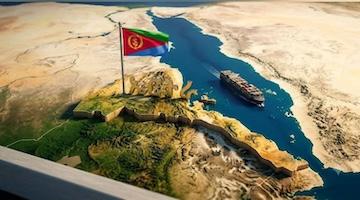 There is no evidence that Eritrea has surrendered its Red Sea Coast in exchange for relief from US sanctions.
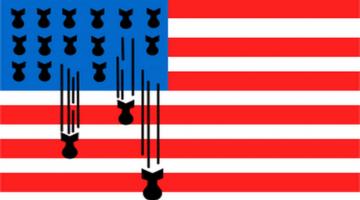 The liberal news media treat U.S. violence and oppression as aberrations from the country's founding ideals rather than expressions of its fundamental character as a settler colony, empire,…
 The U.S. relocation of MQ-9 Reaper drones from Africa to Latin America is not a drawdown of imperial aggression but a strategic reallocation, with the drones likely to be used against Cuba, Venezuela…


