“The Trump administration takes every opportunity to divert attention from the fact that there are a lot of people suffering in poverty in the richest country in the world.”
Symbolic Violence
The mistreatment of migrants at the border has been at the top of the headlines, thanks in no small part to the painful issue of family separation, a key part of Trump’s so-called “zero tolerance” strategy on immigration. Splitting children away from their parents has epitomized the cruelty with which the Trump administration is dealing with migrants. Even before becoming president, it was clear that Trump was going to make the castigation and scapegoating of immigrants a centerpiece of his regime. After all, what can be expected of a politician who launched his presidential campaign by denigrating Mexican immigrants as “rapists” and “drug dealers.” Family separation and the detainment and caging of children at the border adds an element of symbolic violence to the increasingly harsh treatment to which immigrants are subjected.It is this symbolic violence which, I argue, most distinguishes the Trump administration treatment of migrants from previous administrations.
To be clear, it is not that previous administrations’ treatment of migrants was necessarily humane -- it wasn’t -- but rather, thatthe Trump administration has turned the suffering and humiliating of migrants into spectacle, reminiscentof former sheriff and convicted felon, Joe Arpaio’s desert tents and humiliating pink prison uniforms.
“The Trump administration has turned the suffering and humiliating of migrants into spectacle.”
That Trump has ratcheted up the cruelty and disdain with which immigrants are dealt with cannot be denied. However, as many commentators have rightly pointed out, the differences between him and the previous administration, when it comes to strategies and the numbers of people being detained, are commonly exaggerated. A fact often neglected by many mainstream liberals, who express outrage at Trumps anti-immigrant politics but who stayed largely silent when the Obama administration reached historic levels of people being detained and deported. This is the reason why activists and migrant advocates gave him the “deporter-in-chief” moniker. However, in a political climate in which the analysis of issues rarely reaches beyond simplistic two-party system thinking, it often seems that the preoccupation is less about deportations (and their impact) than on who is doing the deporting and what party they belong to. This handicap can lead people not only to overestimate the differences between the current and previous administrations, but importantly, to ignore that the previous administration in many ways set the stage for what is taking place now at the border. Analyzing the role of this symbolic violence is a key way of understanding what we can expect from the Trump administration when it comes to the issue of immigration and the lives of migrants.
Sending a (multi-sided) Message
What is substantially different between the Trump and Obama administrations is the symbolism behind the egregious treatment of migrants and the issue of immigration in general, including that of refugees and asylum seekers. Officials in the Trump administration have stated that, through his “zero tolerance” policy, they intended to send a messageto would-be migrants. The message was, putatively, that it was not worth it to migrate to the US and that they would be punished harshly for their “transgression.” Whether this stated goal was in fact the intended purpose of “zero tolerance” is debatable. However, I argue that the actual targets of the message were not so much would-be migrants, but rather those migrants already living in the country (as well as other negatively racialized people suspected of being migrants). It is a message intended to remind them of the precariousness of their status and presumed disposability; a message meant to render their labor-power more vulnerable and therefore more readily and efficiently exploitable.
“The actual targets of the message were not so much would-be migrants, but rather those migrants already living in the country.”
Besides migrants residing in the country, I argue that there is an altogether separate target audience for this message of “zero tolerance.” This other audience is made up of those segments of the population racialized as white, and particularly working-class and poor whites. For them, the message was aimed to remind them of their superior status as compared to migrants and other negatively racialized groups. It was a message meant to reinforce the value of “being white,” although covered under the banner of nationalism. This is the audience for whom the first lady’s “I really don’t really care, do you?” message was meant, when she visited a migrant child caging facility. It told them, “why should they care” about what happened to those kids? After all, as one of the hosts of the president’s favorite TV show, Fox and Friends, remarked, “these are not our kids… it's not like he is doing this to the people of Idaho or Texas. These are people from another country.” And these are the optics that the Trump administration wants to emphasize. As, GOP strategist Rick Wilson remarkedon a recent CNN interview, “the pictures of the cruelty of this administration are a very deliberate part of this …[t]hey are a feature, not a bug, of the Trump administration’s policy.”
Managing the capitalist crisis through racism and (symbolic) violence
At a time in which the actual socioeconomic status of working class whites continues to decline, boosting the symbolic value of whiteness becomes a favored tool for elites and transnational capitalists in their attempts to mask the effects of the economic crisis and of the ever-increasing gap between the super wealthy and the rest of us. To clarify, it’s not that those racialized as white are the only people hurting due to the increase in wealth polarization -- working people of all backgrounds are struggling just to survive and get by. As the UN Special Rapporteur on extreme poverty and human rights recently noted in his report to the UN, “40 million Americans live in poverty and 18.5 millions of those live in extreme poverty. In addition, vast numbers of middle class Americans are perched on the edge, with 40% of the adult population saying they would be unable to cover an unexpected $400 expense.” But, as I argued in a previous piece, white people (as a so-called “race”) are the only ones who can reminisce about a time in which “things were better.” Hence, the that Trump’s claim to “make the country great again” (and which, I argued, should be read as a call to “make whiteness great again”) was appealing to many within these segments of the population.
“White people (as a so-called ‘race’) are the only ones who can reminisce about a time in which ‘things were better.’”
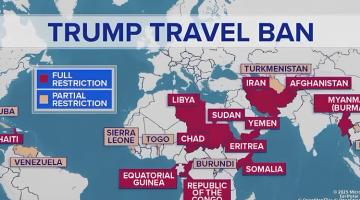
The (manufactured) migration crisis at the border should be understood in the context of other actions that the Trump administration has taken, dealing with race and the treatment of non-whites: 1) in the context of the hypercriminalization and violence with which the state increasingly treats Black people in the U.S., where police officers who murder Black people regularly are found “innocent” -- literally getting away with murder, and 2) in the context of the Muslim travel ban, that the administration has pursued relentlessly since it came to power, and, that in fact, Trump was already pushing long before most people even took him seriously as a candidate. I argue that both of these phenomena point to a renegotiation of the capital-labor relation on a racialized basis in a time of crisis. In order to shore up the ever-decreasing legitimacy of the capitalist system, the Trump administration takes any opportunity to divert attention from the fact that there are a lot of people suffering in poverty in the richest country in the world -- a reality that is increasingly pushing people towards solutions beyond what the current political economic system can offer, leading to the popularity of left-leaning political candidates. A trend that ruling elites, including Trump, try to stifle at all costs. In this context, scapegoating non-white people and immigrants and promoting racist thinking are becoming simply “how business is done.”
Salvador Rangel is a PhD student at the University of California at Santa Barbara.





 The bipartisan consensus for regime change against Iran hit the wall of Iranian resistance. But Trump is forced into talks while democrats attack him from the right and expose themselves as partners…
 “The U.S.A. decided to annex Cuba economically and Cuba made history by becoming the first country in the world to be a victim of neocolonialism.”
 NBA superstar Victor Wembanyama grapples with the times we’re living in, even as his career takes off.
 "War House hosted cage-fighting for 250th what’s next?" is the latest form BAR's Poet-in-Residence.
 The Democrat establishment poured millions into protecting its incumbents in New York City, but voters chose progressive anti-genocide challengers. That party will fight against the reality that…


