The UN's renewal of the Gang Suppression Force mandate is part of a wider hemispheric project to reassert military control across the Americas. Caribbean leaders cannot claim to support a Zone of Peace while also supporting the occupation of Haiti.
Originally published in Black Alliance for Peace.
Oct 2, 2026 – The Black Alliance for Peace (BAP) rejects the renewal of the Gang Suppression Force (GSF) mandate by the UN Security Council on September 29, 2026, and affirms that Haiti’s sovereignty cannot be renewed away. One year ago, Security Council Resolution 2793, drafted by the United States and Panama, authorized a foreign force of up to 5,500 police and soldiers to replace the Kenya-led Multinational Security Support Mission that also proved ineffective at stemming armed violence. The GSF was to conduct operations to “neutralize, isolate, and deter” armed groups independently or alongside Haitian security forces. A foreign commander and a Standing Group of participating countries shape the mission, while Haitians have little authority over its operations. The resolution also established a United Nations support office to provide the force with logistics and operational support. The mandate was renewed by 12 votes in favor, with China, Russia, and Pakistan abstaining amid concerns that an under-resourced military approach will not resolve Haiti’s deeper crisis, calling for stronger oversight, enforced arms embargo, and a Haitian-led path forward.
However, this “technical roll over” is not a temporary arrangement, but one that extends a neocolonial foreign military grip over Haiti. The GSF’s expanded roll out has yet to quell ongoing attacks, and Haiti has no elected national government. An unelected government’s request to renew the GSF is not the Haitian people’s democratic mandate for another abusive foreign occupation force.
The anti-democratic conditions under which Prime Minister Alix Didier Fils-Aimé remains in office make that distinction clear. In January, Haiti’s Transitional Presidential Council voted to remove him. Washington publicly opposed the move and Secretary of State Marco Rubio insisted that the Council dissolve on schedule while emphasizing that Fils-Aimé should remain prime minister. The U.S. Embassy threatened violence for Haitian officials who supported a change in leadership, and the State Department revoked the visas of two Council members and their families. Before the Council’s mandate ended on February 7, the U.S. sent a warship off the coast of Port-au-Prince and without elections or an elected successor, Fils-Aimé remained the country’s executive authority. Washington used coercive political and military power to shape who would govern. The same administration that sought renewal of the GSF emerged from that imposed political arrangement.
Separately from the GSF, Haitian security forces have carried out explosive drone strikes with support from a U.S.-based private military company led by Blackwater founder Erik Prince. 1,243 people have been killed in these strikes between March 2025 and January 21, 2026, including 17 children. These operations show the civilian consequences of a security strategy built around an external force with little public accountability and how Haiti serves as a laboratory for imperialist violence in the Americas. The devastating consequences of this for the whole region are now even clearer, as U.S. assassinations in the Caribbean and Pacific continue unabated and U.S. moves MQ-9 Reaper drones from the African continent to the Caribbean and Latin America.
Washington also bears responsibility for the conditions it claims foreign forces must solve. Firearms trafficked into Haiti originate in the southeastern U.S. At the same time, nearly 200,000 people were forcibly returned to Haiti in the first eight months of 2026, and Temporary Protected Status (TPS) was removed for over 300,000 Haitians on July 27, despite ongoing insecurity that U.S. meddling has worsened. The attacks on Haitians through TPS termination, ICE detention, surveillance, and deportation are connected to the wider policing and carceral apparatus that oppresses all African and colonized peoples in the belly of the beast.
Ultimately, a government that helps arm the region, restricts Haitian migrants’ right to safety, and pressures Haiti’s political leadership, cannot present another externally directed security mission as an act of solidarity.
We understand this latest GSF renewal within a wider U.S. hemispheric project to reassert military and political control across Our Americas. Washington has escalated the Monroe Doctrine, organized the Shield of the Americas/Joint-Task Force Hemisphere, threatened to use “unmatched military might,” after U.S. forces abducted Venezuela’s President Nicolás Maduro and First Combatant Cilia Flores, while intensifying the blockade and military threats against Cuba.
At the 81st UN General Assembly, Prime Minister of Barbados, Mia Mottley called for the Caribbean to remain a Zone of Peace while supporting the full deployment and renewal of the GSF in Haiti. CARICOM’s Zone of Peace language rings hollow when Haiti is treated as an exception.
We reaffirm the call for a true Zone of Peace of Our Americas, grounded in nonintervention, national and popular sovereignty, self-determination, and resolving disputes without external force among the Community of Latin American and Caribbean member states (CELAC). A renewed GSF mandate violates the goal of a regional Zone of Peace based in People(s) Centered-Human Rights,and deepens the contradiction by placing Haiti under another foreign command while Haitians themselves remain excluded from decisions over their future.
The Haitian people deserve safety from armed violence and a foreign force with broad powers, and an imperialist command structure (U.S. Southern Command) subverting their democratic rights. An unaccountable Haitian political authority cannot resolve this crisis of imperialism, the flow of weapons, and decades of foreign intervention. Renewal of the GSF risks making this neocolonial, imperialist intervention permanent while offering no guarantee of collective security or self-determination.
We call on:
- Governments to withhold personnel, funds, weapons, logistics, and operational support to a foreign GSF occupation force with no accountability to the Haitian people.
- The United States to stop the flow of arms into Haiti and cease its interference in Haiti’s political affairs.
- An end to the Core Group’s political tutelage and to the United Nations’ role in supervising Haiti’s political future. Haitian people and popular movements must be able to determine their own path through a truly sovereign process.
- An End to deportations across Haitian communities and the right to freedom of movement and asylum.
- Black/African organizations and communities in the United States and beyond, including the Congressional Black Caucus, to oppose the imperialist assault on Haiti and stand unequivocally with the Haitian masses in defense of popular sovereignty and self-determination.
- Social movements, civil society, trade unions, and popular organizations across the Caribbean and Latin America to engage in anti-imperialist regional solidarity in support of people-centered movements rooted in the Haitian masses, recognizing Haiti as the first independent Black republic, whose revolution materially supported liberation struggles across the Americas.


 In this week’s segment we hear about the right-wing politics of the anti-migrant movement in South Africa, ANC failures, and upcoming elections in that country. But we begin with the first and only…
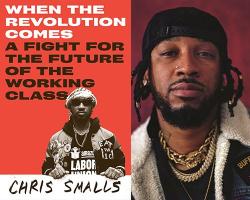 Chris Smalls discusses his memoir, "When the Revolution Comes: A Fight for the Future of the Working Class," published by Penguin Random House. He is the first and only union leader to successfully…
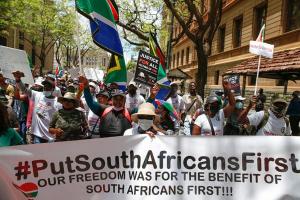 Our guest is Nairobi based political writer and strategist Clinton Nzala. He joins us to provide an update and an analysis of the South African anti-migrant March and March movement, which is…
 The Hague Group’s goal is to “. . . take coordinated legal and diplomatic measures against Israel’s violations of international law.” But international law was never a reality.
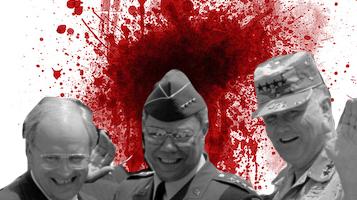 “I believe that the Movement of Nonaligned Countries…can buttress the united will of the Arab nation and help it to prevail against intervention and aggression.”


