An explosion on October 1, 2025 sheared off the corner of a Mitchel Houses high-rise apartment building.
The cause of the explosion at Mitchel Houses in the South Bronx harkens back to the arson-for-profit schemes of the 1970s that caused mass destruction of Black and Latine communities. Decades later, the method of destruction has changed from matches to government bureaucracy, but the target has not.
“NYCHA always gets away with bullshit” - Resident of Mitchel Houses @jjjerrellon.
For residents of public housing, unaddressed maintenance requests are part of a decades-long routine of malicious negligence. The persistent leak, the broken elevator, the mold spreading behind the radiator are reported into a bureaucratic void where they are logged, ignored, and allowed to fester. At Mitchel Houses in the South Bronx, that routine came to include the smell of gas.
Tenants had been smelling it for months. Wilfredo Melendez, who lives on the eighth floor, caught it near the boiler room on his way out of the building, and Dee English, on the fourth, said it was strong enough that something was obviously wrong. Residents took it to management on September 30, 2025, and their calls went nowhere.
The next morning, that negligence turned into catastrophe. An explosion tore out of the boiler room at 205 Alexander Avenue, up through the building's chimney, and sheared the corner off a twenty-story tower.
Thirty-five households left with what they were wearing, without clothes and without the medications they take daily. Children were among the injured and went untreated, while the city put some families in hotels and moved others into a crowded shelter.
The boiler that exploded had been running on a certificate to operate that expired in 2009, and the Department of Environmental Protection had not inspected it in seventeen years. It was one of at least fifty boilers across fourteen NYCHA developments operating on lapsed registrations. NYCHA's answer is that the Department of Buildings examined the boiler in June and found "no major safety issues."
Three weeks later, NYCHA has cleared some residents to return to a building that has no gas and therefore no heat, with no date given for either and no timeline for repairs. Many say they have received no guidance at all. The fear of the next one has not gone anywhere.
Tenants smelled gas for months and said so, and the agency they said it to is the same agency that let the certificate sit dead for sixteen years — the landlord, the inspector of record, and the office where the complaint is supposed to go.
Their continued suffering weeks after the collapse is a direct indictment of a system that fails to protect them before disaster strikes and leaves them to bear the consequences. This was not just a simple accident. It was the latest battle in a protracted war which, as the Black Alliance for Peace articulates, is “the strategic invasion, destabilization, and potentially elimination of a people, their land, and their agency.” This front of the war is waged through manufactured decay against Black, Brown, and working-class people.
Mitchel, like the other developments in the borough, was built as a fortress. NYCHA towers in the Bronx went up with dense cement walls and fire-isolating compartments designed to hold a blast or a blaze inside a single unit, and for decades they did. A policy of strategic disinvestment brought the walls down at 205 Alexander Avenue, carried out by a state apparatus that treats the people inside as disposable. The city's chroniclers have spent fifty years blaming the residents instead.
The negligence follows a seasonal pattern. Beginning in the fall and running through the winter, complaints about missing heat and hot water rise across the Bronx at the highest rates in New York City. Tenants left without heat turn to stoves and ovens and space heaters to get through the night, and those improvised solutions meet buildings whose wiring, doors, and boilers have gone unmaintained for years. The combination makes a tinderbox of every cold season. The city permits landlords to defer maintenance on heating systems, and the deferral produces the same crisis on schedule.
The boiler at Mitchel Houses blew on October 1 — the start of heat season in New York City.
In January 2022, a fire tore through the Twin Parks North West apartments in the Bronx and killed seventeen people, most of them Gambian and West African. The city blamed a malfunctioning space heater. What turned a single-unit fire into a building-wide death trap was a self-closing door that violated city code and failed to close, letting smoke fill the stairwells. A landlord had been free to neglect life-saving infrastructure in a Black and African community, and seventeen people paid for it. The fire also did what fires in these neighborhoods reliably do. It devastated and destabilized a vibrant, tight-knit community, demonstrating how calculated neglect functions as a tool of displacement and social destruction.
Twin Parks was not public housing. Still, the explosion at Mitchel Houses is part of the same overarching assault on the very right of people to exist and thrive in the Bronx. The front line runs through the whole borough, and the targets are Black/African and Brown working-class people wherever in it they live.
These events descend directly from the Bronx fires of the 1960s and 70s, and from the story the city told about them. A media spectacle painted a borough consumed by its own chaos: riots, gangs, people burning down their own homes. Black and Latine savagery, on the evening news, nightly.
It was a lie, and a different kind of arson was underway. Landlords holding devalued property and looking at insurance payouts paid to have their buildings lit. City planners acting on the logic Robert Moses had already written into the borough with the Cross Bronx Expressway, and on the "benign neglect" advocated by Daniel Patrick Moynihan to Richard Nixon, shut off water mains and closed fire companies in the neighborhoods burning fastest.
Moynihan's January 1970 memo to Nixon is worth reading in his own words. "Fires are in fact a 'leading indicator' of social pathology for a neighborhood," he wrote, and he brought receipts: New York City fire alarms had more than tripled between 1956 and 1969, from 69,000 to 240,000, and in 1968 a single "slum area" recorded an alarm rate per square mile thirteen times the city's average. He read those numbers as evidence of what was wrong with the Black and Puerto Rican people who lived there. He had it backward. The fires themselves were the pathology. A white supremacist and capitalist order, showing up as smoke.
The groundwork was laid decades earlier. The history of the Bronx fires era of fire goes back to the 1930s, when redlining became the primary mechanism of managing neighborhoods and hardening segregation in New York City. Between roughly 1917 and the 1970s, Black people arriving from the South in the Great Migration and Puerto Ricans arriving from the colonized island moved into the city in growing numbers, and into the Bronx above all. Uptown became a place where communities lived alongside one another and built something out of it, creating a culture of their own.
Then the strategic decay set in — disinvestment, rezoning, and the exodus of white residents who dressed their flight in the language of "better schools" and "better housing." Redlining and rezoning corralled Black and Puerto Rican families into deliberately inhumane conditions and built the tinderbox that went up in flames, setting the terms of the ever-intensifying siege that has never lifted.
The decades since have refined the method rather than abandoned it. Public housing has been handed to private managers like C+C Management, and the "renovations" at Mott Haven and Edenwald Houses have destroyed more than they have repaired. This is the tried and true neoliberal method. Manufacture the crisis through disinvestment and policy, then present private capital as the only available rescue. The point of the exercise is displacement.
The data provide undeniable evidence of a structural assault on certain neighborhoods in New York City. The Area Deprivation Index, which scores neighborhoods on income, education, employment, and housing quality, tracks closely with fire incidence and severity across the city; the neighborhoods that rank worst on one tend to rank worst on the other. The Bronx is not only the poorest borough in the city, but also constitutes the largest non-white population. Where Black people are concentrated, the risk of fire escalates.
As gentrification advances in the South Bronx, a media offensive is laying the groundwork for the next round of displacement. Coverage of the fires is negligent while reports of "violent crime" surge in northern Bronx neighborhoods like Wakefield, which sits directly on the border of wealthy Westchester County. The blitz manufactures consent for fewer resources, heavier policing, and the removal of Black and Brown people from ground that has become valuable.
The fires and the rotting of public housing are instruments of external control, and our movements have always read them that way. The Black Panther Party newspaper said plainly that substandard housing was a function of capitalist and racist exploitation, tied dilapidated buildings to police violence and imperialist war, and organized tenants to demand repairs and assert their humanity in the same breath.
That tradition of on-the-ground investigation ran through White Lightning, the newspaper of a white revolutionary organization based in the Bronx and circulated through the 1970s. Where the dailies reported fires as weather, White Lightning named the arsonists — landlords in neighborhoods like Fordham torching their own buildings for insurance windfalls.
Both publications framed the crisis as a counterinsurgency against the poor and then organized around what they had found. They dismantled the myth of Black self-destruction and put the evidence directly into the hands of the people it was about.
The work continues. Dare to Struggle investigates these assaults and organizes tenants in NYCHA developments, publishing literature that identifies the conditions as a war on poor and working-class people and names the parties waging it. At Mitchel Houses, the tenant association has been making the same case for years.
The explosion at Mitchel Houses was a preventable disaster. The smell of gas was a warning from a history we are forced to repeat. However, it is also a moment to learn from.
True peace will not be found in the quiet after the rubble settles. It will be built by people who reclaim the tradition of those who came before them and move from analyzing this crisis to confronting it — with organized, unyielding power, for self-determination and sovereignty, in the domestic colony and everywhere else this war is being waged.
Imani Nile is the assistant to BAR's Executive Editor, a proud member of the Black Alliance for Peace (BAP) NYC/NJ, and the BAP Communications Team Lead. She works in movement communications and media.




 "A whistle and honk for our cities under siege" is the latest from BAR's Poet-in-Residence.
 The political theater of condemning Trump's racism serves the function of diverting attention from the more dangerous, policy-based racism that operates with bipartisan support.
 To dismantle ICE, we must first understand its purpose in a global system. The struggle against this agency is a struggle against the machinery of imperialism itself.
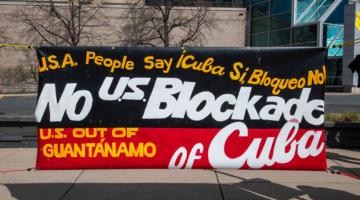 True solidarity means recognizing an attack on Cuba as an attack on all who resist empire.
 Missing organs from Palestinian bodies and a history of organ harvesting without consent make Israel's supposed organ donation record very suspicious. Palestinians are demanding an independent…


