Roughly a third of the people who were arrested by LAPD in the city of Los Angeles for cannabis-related offenses since 2020 were arrested in Westchester. Nearly all of those arrests happened at Los Angeles International Airport (LAX) and 75% of those arrested are Black.
Originally published in L.A. Taco.
There’s one neighborhood in Los Angeles where you’re more likely to be arrested by the Los Angeles Police Department (LAPD) for possession of cannabis than anywhere else in the city:
Westchester.
Roughly a third of the people who were arrested by LAPD in the city of Los Angeles for cannabis-related offenses since 2020 were arrested in Westchester—the majority-white, upper-middle-class, suburban community on the city’s westside—according to LAPD data.
Nearly all of those arrests happened at one location:
Los Angeles International Airport (LAX).
Every year tens of millions of travelers from around the world fly through LAX, one the world’s busiest airports. Although local laws permit travellers to bring up to an ounce of weed to the airport, once you try to take your stash through a Transit Security Administration (TSA) checkpoint or onto an airline, you’re technically in violation of federal law.
If you've flown out of LAX recently, you might have noticed trash cans just before you reach the metal detectors, with signage encouraging you to ditch your greenery before you reach the TSA workers in blue uniforms.
Out of the countless travelers who pass through LAX every year with joints, vapes, or maybe even a suitcase full of weed, one racial group is arrested by LAPD for weed possession at LAX drastically more than any other.
According to an L.A. TACO analysis of LAPD arrest data, in the last five years Black people accounted for roughly 75 percent of all cannabis-related arrests at LAX, despite making up only a small fraction of the world’s population.
Out of over 800 people arrested by LAPD at LAX for weed during that time frame, more than 600 people were Black, according to LAPD data.
While fewer than 80 were white.
Los Angeles County Public Defender Elizabeth Lashley-Haynes finds this data to be “not shocking at all.”
“You have no idea the disparities I look at all day long, pick any charge,” the 22-year career public defender said during an interview with L.A. TACO.
Lashley-Haynes is a lead attorney for the public defender’s Racial Justice Act Unit, a recently formed unit that allows defendants to bring claims of bias or animus that they experienced in their cases or during trial.
Lashley-Haynes notes that everyone gets searched at the airport, but some people get searched more thoroughly than others.
“A situation like an airport allows for racial profiling, whereas outside the airport there is a little more protection,” Lashley-Haynes said.
When California officials legalized recreational cannabis in late-2016, they did so in part because Black people were disproportionately arrested for cannabis offenses, even though studies show that people of all races use marijuana at almost identical rates.
“Weed became legal for corporations and wealthy white people to make money,” Lashley-Haynes argued. “And then it became another excuse for police to harass Black people.”
The trend of Black Americans (and people who identify as Latino) being disproportionately impacted by marijuana law enforcement, is not surprising given the origins of prohibition.
Cannabis prohibition in America began in the early 20th century. The earliest laws were originally used to target Mexican immigrants and Black jazz musicians.
“There are 100,000 total marijuana smokers in the U.S., and most are Negroes, Hispanics, Filipinos, and entertainers,” Harry Anslinger, the first commissioner of the Federal Bureau of Narcotics, beginning in 1930, once said. “Their Satanic music, Jazz and Swing result from marijuana use. This marijuana causes white women to seek sexual relations with Negroes, entertainers, and any others.”
By the 1970s, the federal government launched the so-called “War on Drugs” under President Richard Nixon.
In a 1994 interview with Harper’s Magazine, Nixon’s domestic policy chief, John Ehrlichman, revealed to Harper’s that the War on Drugs was a political tool to fight against Black Americans and the hippie movement.
“We knew we couldn’t make it illegal to be either against the war or black, but by getting the public to associate the hippies with marijuana and blacks with heroin. And then criminalizing both heavily, we could disrupt those communities,” Ehrlichman said (Ehrlichman’s family has disputed claims that he was racist).
"Time and time again, we see that the enforcement of marijuana prohibition laws is meted out in a manner that is far from even-handed,” Paul Armentano, deputy director of NORML, the prominent cannabis reform organization launched in 1970, said in a written statement to L.A. TACO. “Our sense of justice and fairness demands that we acknowledge the racist origins of cannabis prohibition and that we work to once and for all abolish the legacy of racially disproportionate enforcement that it has left behind.”
While the number of people being arrested by LAPD for weed has significantly decreased in recent years, Black people are being arrested for cannabis at even higher rates then they were before recreational weed was legalized. And arrests at LAX have increased.
Prior to legalization—between 2010 and 2017—Black people comprised around 33 percent of all cannabis-related arrests on average across the city, according to LAPD data analyzed by L.A. TACO.
After recreational cannabis sales were made legal in 2018, the percentage of Black people arrested by LAPD for cannabis dropped slightly the following year, before increasing a year later to over 50 percent, the highest percentage in a decade.
And since 2020, nearly half of all the people who were arrested by LAPD across the city for weed were Black—despite the fact that Black Angelenos represent less than a tenth of the city’s population. Meanwhile, white people made up fewer than 15 percent of arrests.
A similar pattern is seen when looking at arrests specifically at LAX.
“This is not shocking to me,” Lashley-Haynes said when presented with our findings. “This is our legal system.”
Lexis-Olivier Ray is a housing, justice and culture reporter for L.A. TACO.


 The UN panel’s reports on Nicaragua recycle claims from U.S.-backed opposition groups, serving as a propaganda arm for Washington’s regime change agenda.
 In this week’s segment, we hear about an effort to build community-based power and self-determination for a Black working-class Washington, DC community. But we begin with a report on conditions in…
 We're joined by Suzanne Adely of the National Lawyers Guild and the International Association of Democratic Lawyers and Corinna Mullin of the US Peace Council and Anti-Imperialist Scholars Collective…
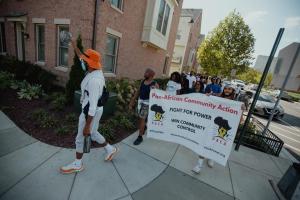 Pan African Community Action (PACA) recently released a plan for political empowerment in Washington DC, "Community Control DC, A People’s Platform for Collective Self-Determination." Oliver Robinson…
 Jacqueline Luqman, Margaret Kimberley, Netfa Freeman, and Gus Griffin were among the panelists joining Your World News Media to discuss the lies and war propaganda that fuel the brutal war of…


