Despite selling out Haiti, former Haitian leftist Gerard Pierre-Charles’s 1983 diagnosis of the imperialist assault on current movements still resonates today.
Gerard Pierre-Charles (December 18, 1935, Jacmel – October 10, 2004, Cuba) was a Haitian economist and Marxist, a founder of the Parti unifié des communistes haïtiens (PUCH), and a leader in the resistance movement against the Duvalier dictatorship. After spending many years in exile, he returned to Haiti and became a key organizer and architect of the popular movement (“Lavalas”) supporting the Rev. Jean-Bertrand Aristide, the parish priest from Port Salut who became Haiti’s first democratically elected president. As with many Haitian bourgeois intellectuals, Pierre-Charles eventually broke with Aristide. He became a bitter and embittered critic of Aristide’s personality and the policies of Famni Lavalas, the political party that was created in 1996 from the split of the larger “Lavalas” movement. Pierre-Charles abandoned the leftist principles that had guided his political life and joined the Democratic Convergence, the reactionary opposition coalition that advocated for Aristide’s overthrow while creating the ideological conditions for Haiti’s current ongoing foreign occupation. The Democratic Convergence was backed by the rightwing International Republican Institute and the National Endowment for Democracy, the soft power front of the CIA.
What lessons can be learned from Pierre-Charles’s tragic, yet unfortunately all-too-typical, turn away from the left and his alignment with right-wing forces? Certainly, there is a cautionary tale of how easily progressive individuals, in the face of external adversity and internal conflict, can easily be co-opted and, how, in the process, leftist formations can be obliterated by outside forces. Indeed, it is striking to see how, in the face of attacks on the left, the right is able to constitute itself as the only “common sense” and pragmatic (if cynically pragmatic) viable political and economic option. This has been the great trompe l'oeil, the imperious sleight of hand, the grand, hoodwinking sham of neoliberalism over the past few decades. It is also how foreign military intervention and regime change are cast as progressive stances when it comes to Haiti, Cuba, and Venezuela.
We cannot be fooled into thinking, as, apparently, Pierre-Charles did, that foreign occupation will lead to national sovereignty — or that the call for military intervention is anything more than the racist fantasy of DC policy wonks, under-employed military attaches, and those eager imperialists with their freshly minted International Relations certificates.
Moreover, we also learn that the example of Haiti — where State Department bureaucrats, corporate CEOS, and CARICOM careerists hover like hungry birds of prey — is also an example for Latin America when it comes to sovereignty and imperial policy. Ironically, this is a lesson Pierre-Charles gifted us when he was still in exile, and still a leftist. In 1983, he gave an interview to the Uruguayan magazine Cuestión on the current situation in Haiti. He stated that the challenge of building a populist, democratic movement in Haiti was the same as in the rest of Latin America: the threat of imperialist violence, attacks from fascist terrorists, and the coordination of those local and international forces of right wing reaction. Pierre-Charles made this claim in the 1980s. The same issues continue to impact our movements today. For this reason, we reprint Gerald Pierre-Charles’ interview below.
The Problem of Haiti is the Same as Latin America
Gerard Pierre-Charles interviewed by Cuestión (Uruguay)
Cuestión: What is happening in Haiti today?
Gerard Pierre-Charles: We are living under a dictatorship which has lasted for 26 years and which oppresses the people in an extremely violent way, so in Haiti the prerequisites for an outbreak of revolutionary violence are more than present. Unfortunately, however, in fact the revolutionary forces have not managed in recent years to channel the generalized discontent into more advanced stages of struggle.
What are the manifestations of the people's resistance movement?
The resistance against the Duvalier regime has been constant over the past 26 years, with a high point during the 1960's when vanguards were formed which challenged the regime. In 1969 the revolutionary movement suffered a severe blow. With imperialist support, using techniques of murder and destruction, techniques used also in Uruguay against the Tupamaros and in Argentina against the revolutionary movement, Duvalier won temporary success in his struggle. But in recent years the resistance has become evident again, although not in the form of armed conflict.
Considering the tremendous violence of the regime and the denial of the most basic human rights, the use of violence against the regime is more than justified, but the predominant form of resistance in recent years has been the peaceful effort to assure political freedom for the popular movement.
Aside from imperialist aid, what provides internal support for the regime? During the 26 years that the regime has been taking possession of capital resources, the bourgeoisie has become enormously rich, so this sector supports the regime; but because of the generalized corruption and inefficiency, even the dominant group is troubled by factions and problems.
How much unity do the democratic forces in Haiti have?
There is a resurgence of the popular movement, and new forces are joining the struggle. In the first 15 years of the dictatorship, all the democratic sectors fought Duvalier and all were suppressed. During this stage, the communist movement was the best organized and it led the struggle. Today new groups have joined the fight, such as the Christian and Catholic organizations. PDC [Christian Democratic Party], though it does not take ideological stands, brings to bear the personal valor of its leader Silvio Claude. It cannot be identified with other Christian Democratic groups, and it is a popular anti-Duvalier party with political freedoms which is assisting in the fight against the dictatorship.
What is the goal of the democratic movement in Haiti?
To open the way for political freedom, to raise the level of the resistance, to resist the terror which the dictatorship manipulates in an extremely efficient manner, to promote the unity of all people’s forces, revolutionaries, Christian basic organizations, and the like.
These efforts will tend to create political freedoms and raise the level of the struggle of the Haitian masses.
Does the existence of a social democratic government in the Dominican Republic have any influence on the Haitian situation?
I believe it is favorable to Haitian democracy, but the present situation, the present status of the struggle of the Haitian people, does not permit this favorable influence to be expressed.
Moving to regional questions, Gerard, what is the view of Haitian democrats of the situation in Central America?
In Central America we see the fight of peoples traditionally oppressed and exploited by imperialism. This is a rebellion of small, humiliated nations, and therefore it has great importance as an example for all Latin America.
What do you think is the effect of the Falklands war on the sentiments of the peoples and even the governments of Latin America?
The Falklands conflict has shown the best educated sectors of the dominant classes that there are inevitable and insoluble contradictions between the interests of imperialism and the peoples and nations of Latin America. So the Falklands conflict has stimulated nationalism, anti-interventionism and a distancing from the positions of the United States, even on the part of governments which cannot be considered progressive in internal affairs. The United States was unmasked and paid a high price for this.
We recognize and support initiatives for peace like the efforts of the Contadora group on behalf of Central America. Do you believe that the popular movement is doing enough against intervention in Nicaragua?
You must realize that Reagan has to be taken very seriously; his plan is to wipe out the democratic, popular and independent movement in Central America. We support Contadora, an initiative which has great importance, but the popular movement has not used all the force necessary, if we consider that the fate of Latin America is at stake in Central America.
What more could be done?
In view of the dimensions of the present intervention into Nicaragua, we believe it is a duty of all revolutionaries and patriots in Latin America to provide the fullest support for the Nicaraguan struggle, first by moving forward the developments in their own nations, and in second place, if the situation requires help in material terms, to aid the defense of the sovereignty of the Nicaraguan people, if the Sandinista Front and the government require it.
Gerard, would you care to add any comments for the readers of Cuestión?
I would like to call attention to the Haitian situation. The problem of Haiti is in great measure the same as that of southern Latin America. Aside from coincidental differences, such as the fact that fascist terrorism was established several years earlier than in South America, the situation of oppression and extreme repression is similar. We need the peoples of Latin America and the whole world to show more interest in what is happening in Haiti, where we have an extreme case of poverty and fascist repression. In closing, I would like to reflect on the development of internationalism. Imperialist terrorist violence must increasingly oblige the peoples of Latin America to respond with all their strength in defense of the nations undergoing aggression, for their fate is the fate of all Latin America.
Interview with Gerard Pierre-Charles in Cuestión (Uruguay) (May 1983) translated and reprinted in Latin America Report No. 2758 (United States Joint Publications Research Service (October 28, 1983)

 This week, we discuss efforts in Pennsylvania to end the sentence of life in prison without parole for felony murder. Also, we examine Syria and US imperialist policy there and elsewhere. First, we…
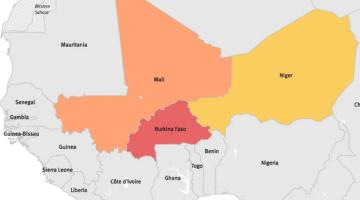 Prudence Iticka and Obioma Ohia recently returned from a delegation that traveled to Mali, Niger, and Burkina Faso, nations that recently formed the Alliance of Sahel States. They join us to discuss…
 Quinn Cozzens joins us to discuss the case of Derek Lee, convicted of felony murder and sentenced to life in prison without parole for a killing he did not commit. Derek Lee is challenging his…
 Margaret Kimberley, Black Agenda Report Executive Editor, was recently a guest on the Revolutionary Blackout Network with hosts Nick Cruse and James Fauntleroy. This is an excerpt of their wide-…
 The indictment of New York City mayor Eric Adams is the latest example of moribund Black politics. Rich donors and corporate media decide who will be elected to office, while the people’s needs go…


