Debris lies around the foundation of a destroyed house after the passage of Hurricane Beryl, on the island of Carriacou, Grenada on July 3, 2024 [File: Reuters/Arthur Daniel]
The IMF and the World Bank give the appearance of aiding Global South nations with economic relief for climate disasters, but in reality, they are burdening them with more debt.
Originally published in Al Jazeera.
As yet another United Nations Climate Change Conference fails to produce a strong commitment to urgent climate action, the climate crisis is on course to get much worse.
While its effects, such as unprecedented flooding, devastating droughts, storm surges, biodiversity loss and more intense hurricanes appear novel in the eyes of many in the Global North, these disasters have caused immeasurable destruction for decades across the Global South, especially the Caribbean.
Extreme weather events not only threaten the economic viability of these societies, but also call into question the role of the most powerful international economic institutions, the World Bank and the International Monetary Fund.
Intervention by these bodies has consistently worsened the economic situation of climate-stricken communities. This is why the World Bank and the IMF need to be abolished to save the planet and human lives.
Caribbean island nations know this reality all too well. On July 1, Hurricane Beryl slammed into Grenada. Two of its island territories, Carriacou and Petite Martinique, were flattened, as Beryl damaged or destroyed nearly 100 percent of homes and devastated infrastructure. At least six people were killed.
The neighbouring island nation of St Vincent and the Grenadines also suffered widespread destruction due to the hurricane. Across the two countries, as many as 80,000 people were affected, with 20,000 people made homeless and 11 killed.
Jamaica was not spared either. The hurricane killed at least four people and affected 160,000. Farming communities suffered devastating losses.
It has been now almost five months since the hurricane swept through the Caribbean and these communities are still struggling to recover. This is because these island nations have been taken hostage by disastrous deals with the IMF and the World Bank.
Instead of helping a region that is at the epicentre of climate disasters, these two institutions force its nations into borrowing arrangements that prioritise austerity and objectives of global capital, rather than immediate and longer-term relief and recovery. As a result, communities suffer under increased public debt and reduced investment in supporting the social infrastructure necessary to respond to climate disasters and mitigate the effects of climate change.
In addition, instead of offering unconditional relief and recovery funding on terms required to truly meet the needs of people, these entities have explicitly supported debt-related financial tools like catastrophe insurance or bonds, debt swaps, and now “disaster clauses” integrated into debt contracts. A disaster or hurricane clause adds to the contractual terms of a debt instrument the ability of a borrower to defer payments of interest and principal in the event of a qualifying natural disaster.
The clause sets out the kinds of preconditions for specific events or triggers that would permit the borrower to temporarily defer repayments of interest, principal, or both for a period of one to two years. This mechanism does not reduce or eliminate debt.
While it purports to offer “relief”, it brings further misery and onerous costs to climate-devastated governments and communities. Take for example the disaster clause, which has been praised and advocated by Caribbean economist and current climate finance adviser of the Inter-American Development Bank, Avinash Persaud, one of the architects of the “Bridgetown Initiative” for the reform of the international financial system.
It can only be triggered when an arbitrary threshold like wind speed or financial cost of destruction during a hurricane has been satisfied or exceeded. In the case of Hurricane Beryl, Grenada was able to trigger this clause, but Jamaica was not able to make use of a similar financial tool. In Grenada’s case, the deferred payments will be added back to the principal in subsequent years.
In Jamaica’s case, a catastrophe bond could not be used because the hurricane did not meet the so-called “air pressure” parameter, which means investors’ funds remain safe. A catastrophe bond is a high-yield debt instrument arranged by the World Bank and designed to raise money for insurance corporations in the event of a natural disaster. These investors profit as much as 15 percent returns on these instruments when they fail to pay out. If a payout was triggered, bondholders could have paid as much as $150m.
These thresholds do not follow scientific evidence or consider the complicated nature and unpredictability of these disasters. That is because they are determined by financial analysts who pursue higher returns for investors.
Without sufficient resources for recovery and relief efforts, Jamaica and Grenada may be forced to request recovery loans from the IMF and the World Bank, therefore increasing debt burdens even further.
The long-term effect of these arrangements can be seen in Barbuda, Sint Maarten and Dominica, which were devastated by Category 5 Hurricanes Irma and Maria in 2017. My recent visits to these islands, which have not fully recovered, show that debt-related financial instruments are not just wholly inadequate, but utterly unjust. They cannot ensure the social, economic and environmental recovery of communities.
In Dominica, for example, debt has mushroomed after the hurricane disaster as climate financing to help it “recover” came in the form of loans. As a result, the nation of 70,000 people is having to pay $30m per year just to service debt. As one Dominican taxi driver put it to me: “The true hurricane started after the hurricane passed.”
The hardship that the IMF and the World Bank heap on climate-devastated communities falls in line with the legacies and realities of colonialism. The logic of their mechanisms can be traced back to the insurance system, capital markets, and financial instruments that fuelled the transatlantic slave trade.
During that time, enslaved Africans were viewed as chattel and nonhuman property, ships owned by enslavers were insured by major brokers, and slave-produced commodities received investment from colonial governments and financial corporations. These all aimed to accumulate the wealth that produced metropolitan Europe.
The World Bank and the IMF operate today as neocolonial institutions that continue the agenda of Euro-American imperial powers. They do not act to mitigate disasters but perpetuate them through debt bondage imposed on climate-devastated countries in the Caribbean and elsewhere.
In this moment of multiple, intersecting crises, they are unsuited for the perils and challenges of the climate crisis. To be sure, the World Bank and the IMF were not intended to serve “The Wretched of the Earth” to borrow Frantz Fanon’s language. They were created to prop up Euro-American supremacy and hegemony and protect the interests of global capital.
We therefore cannot expect these bodies to be reformed and operate against the economic and political interests of imperial powers and big capital. We need a global movement that calls for and acts on abolishing these institutions for us to meet the demands of these critical times. We need to do away with the World Bank and the IMF for the sake of human lives and for the sake of the planet.
The views expressed in this article are the author’s own and do not necessarily reflect Al Jazeera’s editorial stance.
Keston K Perry is a political economist interested in climate policy, natural resources and development issues in the Caribbean and Latin America, and has previously served as an adviser to the United Nations Development Programme.

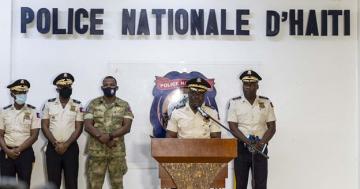 Kenya has chosen its side. That nation has agreed to give cover for the next occupation of Haiti by providing a Black face for imperialism.
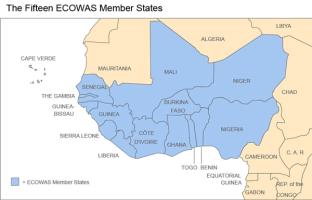 U.S. and African puppet regime threats against Niger and all African states must be condemned.
 As the U.S. and France move to interfere in the Sahel region of West Africa, Niger, Guinea and Mali have spoken up to defend their sovereign rights and declare their determination to be free from…
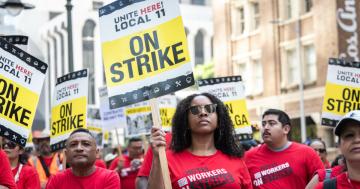 A hotel workers strike in California exposes anti-Black hiring practices, and the predation of the "gig" economy.
 European nations refuse to acknowledge their crimes committed against colonized people. Germany's genocide against the Namibian people is just one such example of unconvincing apologies and refusals…


