“The rich prevail in virtually every contest because their political monopoly matches their monopoly on economic power.”
Senate Republicans passed a tax bill that House Democratic leader Nancy Pelosi described as “simply theft — monumental, brazen theft from the American middle class and from every person who aspires to reach it.” The measure fulfills every corporate wish list compiled in the 30 years since Ronald Reagan last overhauled the tax code. Pelosi, who once co-chaired the Congressional Progressive Caucus, corralled majority Democratic support for a $700 billion war budget -- by far the largest in human history and nearly $100 billion bigger than President Trump requested. It, too, is a “brazen theft” that will be paid for with future social spending cuts.
Polls show the American people oppose both the oligarchic tax code and the apocalyptic war budget, but such facts are of no legislative consequence, because the U.S. political machinery hears only the voice of Capital, as expressed by both corporate parties. If Congress does not undo the war budget -- which means dismantling imperialism -- then the decimation of social programs will continue. But the Democrats, including Bernie Sanders, will not abandon the imperial project. The rich prevail in virtually every contest because their political monopoly matches their monopoly on economic power -- both of which are ultimately secured by force of arms, domestically and in international relations.
“The U.S. political machinery hears only the voice of Capital, as expressed by both corporate parties.”
The rich rule, not because they are smart or even competent, but because there are no organized domestic forces strong enough to stop them -- not even a viable social democratic opposition to temper their obscene excesses with the discipline of common decency. Two generations ago, Black folks tried mightily to rescue America’s “soul” from its origins in slavery and genocide, but no enduring social contract has yet been forged across lines of race and class -- only tentative and conditional arrangements of “tolerance” and "diversity" that are now under Trumpian assault. Black Democrats in Congress follow Pelosi on the warpath, sell their votes to banksters and internet-stealing telecom giants, and eagerly endorse the transfer of Pentagon weapons to local police departments. The transformative yearnings of the Black Radical Tradition strain against the dead weight of a bought-out Black Misleadership Class that won’t pursue any kind of liberation that they can’t wear or spend.
The Movement for Black Lives, endowed with millions from capitalist philanthropy, will discover -- as did a previous generation -- that the revolution will not be subsidized. But they will probably have to exhaust their endowments before the lesson is learned.
“The transformative yearnings of the Black Radical Tradition strain against the dead weight of a bought-out Black Misleadership Class.”
With nobody to stop them, the 1% are free -- for the time being -- to multiply the contradictions of their existence. In the near term, until an effective, genuine “resistance” to the rule of the rich can be galvanized, the plutocrats and their minions will be their own worst enemies, accelerating the process of their own decline.
The orgy of class thievery just completed on Capitol Hill has alarmed and outraged three-quarters of the public, including much of Donald Trump’s racist electoral base -- and the full import of the crime has not yet set in. The oligarchs have no shame, and revel in the ease with which the system allows them to plunder. The ghouls of Wall Street believe they are basking in the glow of the ultimate “creative destruction” -- the elimination of all constraints on capital -- and that they are invincible. Donald Trump tweets that this is so from his hegemonic toilet seat. The rich cannot help but push the rest of our noses in the dirt, and that -- plus the inherent contradictions of capitalism in fatal decline -- will be their undoing.
BAR executive editor Glen Ford can be contacted at Glen.Ford@BlackAgendaReport.com








 Western propaganda about the Rwandan Genocide has been so triumphant that a Rwandan Hutu on trial in the West faces inevitable jury bias.
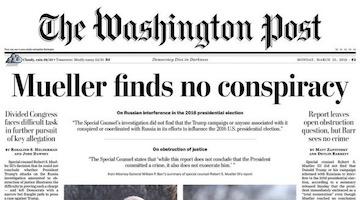 The Mueller Report’s conclusion cannot reverse the damage that has been done to left journalism and activism by the fake news witch hunt.
 This week readers discussed Tulsi Gabbard’s relationship with the Democratic Party and the New York Times coverage of Africa. Letters came for
 A small group of committed antiracist feminist activists changed the global discourse about racism and antiracism.
 The 1950s calypso craze provided black performers with new occasions to intervene in the public sphere as well as new creative and financial opportunities.



