A Black Agenda Report commentary by Glen Ford
The United States resisted signing the international treaty against genocide until 1988 – because it was guilty of the crime, and not necessarily finished. Mass Black incarceration, in both its past and present forms, provides much evidence of U.S. genocidal intent. The bodies have been piling up for forty years – although mainly warehoused, rather than deceased. “The criminalization of genocide was intended to be much more than a kind of legal epitaph for the dead; it was designed, like all laws, to prevent the crime.”
Mass Black Incarceration: Damn Right, We Charge Genocide
A Black Agenda Report commentary by Glen Ford
“Guilt of genocide does not require that the great bulk of the victims be physically wiped out.”
It is well known that the United States is the unchallenged leader in mass incarceration, and that nearly half of the 2.4 million inmates of the American Gulag are Black. Many in the Black Freedom Movement have long contended that mass Black incarceration, as practiced in the United States, fits the legal definition of genocide. Others, because of fear or denial, insist on absolving the United States of the ultimate and ongoing crime of genocide. This is not a semantic question. The charge of genocide differs in international law from war crimes and crimes against peace, in that genocide can occur when a country is technically at peace with the rest of the world.
It is no longer seriously disputed that Native Americans are victims of deliberate, genocidal policies of successive U.S. governments. The proof is in the raw results: millions of dead Indians. But guilt of genocide does not require that the great bulk of the victims be physically wiped out. Otherwise, the charge of genocide would be nothing more a post-mortem, like an autopsy report. The criminalization of genocide, which only began in 1946, was intended to be much more than a kind of legal epitaph for the dead; it was designed, like all laws, to prevent the crime.
For that reason, the four categories of criminal acts cited in the 1951 United Nations Convention on the Prevention and Punishment of the Crime of Genocide include, not just the physical killing of members of “national, ethnical, racial or religious” groups, but also the infliction of serious harm to members of the group; imposition of conditions of life that are calculated to bring about destruction of the group, in whole or in part, or measures intended to prevent births among the group. It is also genocide to transfer children of the group to another group, as happened to Native Americans and natives of Australia.
“Genocide can occur when a country is technically at peace with the rest of the world.”
As in most systems of law, it is the intention to cause harm that is key. In the United States, the criminal justice system established in the post-Civil War South was designed to put Black people back into a kind of bondage. That is the lesson of the recently broadcast PBS documentary “Slavery By Another Name,” which points out that African Americans made up 90 percent of the inmates in some southern states. And it is Michelle Alexander’s position, in her book The New Jim Crow , that modern mass Black incarceration, beginning around 1970, is calculated to create a caste of Black people with no rights, and to stigmatize Blacks as a group as criminals.
At New York’s Riverside Church, this Saturday, revolutionary communist activist Carl Dix will argue that "Stop-and-frisk and other policing policies” that enmesh Blacks in the criminal justice system amount to “a slow genocide which could easily accelerate into fast genocide.”
Even a Being from another planet would conclude that Carl Dix is right. ET would quickly learn that one out of every eight incarcerated persons in the world is African American – about 12 percent of the inmates on Planet Earth – although Black Americans make up less than six tenths of one percent of the global population. ET would recognize that such numbers can only mean that a genocide is in progress, that African Americans have been singled out for some horrible fate by the U.S. government. We cannot sit and wait for the post-mortem. We charge genocide, now!
For Black Agenda Radio, I’m Glen Ford. On the web, go to BlackAgendaReport.com.
BAR executive editor Glen Ford can be contacted at Glen.Ford@BlackAgendareport.com .

 Uganda's anti-LGBTQ legislation has elicited worldwide condemnation. But that nation's history of invading, pillaging, and killing in the Democratic Republic of the Congo, with U.S. blessings, is…
 The Victoire Ingabere Umuhoza Prize for Democracy and Peace is awarded to people who work for democracy, peace, and freedom in the Great Lakes Region of Africa.
 …
… This week’s featured author is Hugo ka Canham. Canham is Associate Professor of Psychology at the University of South Africa and coeditor of Black Academic Voices: The South African Experience. His…
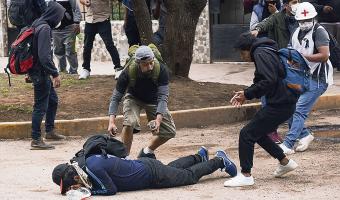 Rosalino Flores is just one of the Peruvians who died in the struggle against the coup government. Clau O'Brien Moscoso continues her dispatches from Peru. A Spanish translation follows.


