The same sports media that celebrate Jaxson Dart's endorsement of Donald Trump called Kaepernick's anti-police violence protest disrespectful. The racial double standard has not changed since the Kerner Commission warned that there are two separate societies, Black and white, separate and unequal.
“Our nation is moving toward two societies, one black, one white—‘separate and unequal.” - The Kerner Report, 1968
As a fan of the New York football Giants, I have become accustomed to disappointment. This is a professional football team that, in the last decade, has found more innovative ways to lose than the Democrat Party. Yet for all of the losing, and the heartbreak that comes with it, the Giants have always provided their fans with a sense of pride due to the culture of the team, which symbolizes the culture and socioeconomics of their fans that, despite being located in and representing one of the most expensive cities and regions in the world, is described by historian Harlan Lewis as, “a broader imagined community rooted in the working- and middle-class culture of the region.”
Eli Manning, the last quarterback to take the Giants to, and win the Super Bowl (twice in fact) embraced this “working class” culture and reflected it with his attitude and work ethic. In a piece entitled, The Blue Collar Hero in Eli Manning, William Ryan writes, “Eli Manning, for Giants fans, represented the consistency of the working man. A lunch pale, blue-collar guy. Sure, he’s made his millions just like every professional athlete in the modern era, but unlike a lot of those athletes, he never took a day off.” Rayan adds, “[Manning] may have been born with a silver spoon in his mouth, being the son of a former NFL quarterback, but that never wavered the interest of fans from an area who give their blood, sweat, and tears to whatever jobs they may have.” Manning was also known as a player who always put his team first and avoided the spotlight in one of the largest and more ubiquitous media markets in the world. As Yahoo Sports reporter Ed Valentine put it, “...in the fish bowl of the New York-New Jersey market, where media members lurk around every corner waiting to joyously capitalize on every alleged misstep and try to shred reputations, gave those sharks nothing. He managed to stay out of the headlines for everything but his abilities as a football player…”
Jaxson Dart, current quarterback for the Giants, could be described as the direct antithesis of Manning when it comes to his personality -flashy, boisterous, in your face, and profound - as well as his style of play. Additionally, unlike Manning, who kept his personal politics close to the chest, Dart just advertised his politics to the entire world when he recently introduced President Trump at a pep rally in New York - an action he referred to as, “a unique opportunity.” The introduction sparked immediate backlash from one of Dart’s Black teammates, Abdul Carter, who took to social media to express his chagrin, posting, in a tweet that has since been removed, “Thought this sh!t was AI, what we doing man.” And with that, a public controversy was engendered with everyday people, current and former athletes, and media personalities moving to their respective camps and expressing their opinions on the matter.
An analysis and reflection on what the reactions of the Dart/Trump/Giants controversy reveals about the NFL and the nation requires some historical context. In response to numerous 1967 urban uprisings or “riots” in cities with significant Black populations, President Lyndon B. Johnson established an 11-member committee, the National Advisory Commission on Civil Disorders. The commission was charged with answering three key questions: 1. What happened during the riots; 2. Why did the riots occur; and 3. What could be done to prevent riots from happening in the future? What came to be known as the Kerner Commission was chaired by then Illinois Governor Otto Kerner.. In 1968, after 20 days of hearings and over 130 witnesses including Martin Luther King and Jay Edgar Hoover, the commission released what is known as the Kerner Report. Among other findings, perhaps the most direct was the report’s admonishment, “Our nation is moving toward two societies, one black, one white—separate and unequal.” This conclusion can easily be utilized to describe the current situation in the National Football League (NFL), its disparate treatment of Black and white players, and how this treatment extends to the larger society’s views of Black and white players as well as Black and white people…especially in instances of conflict. The Dart/Trump/Giants controversy accentuates this, and then some.
In his hard-hitting and thought-provoking book, Things That Make white People Uncomfortable, former NFL player and Super Bowl champion Michael Bennett writes, “They call the NFL the 'No Fun League'—my brother has called it 'Niggas For Lease'—and that’s the most brutally honest thing I’ve ever heard.” Bennett explains the reason for this moniker for the NFL is due to the fact that grown Black men, some of the best athletes in the world, and with millions of dollars in their pockets are still, essentially, the property of their team owners - and they are expected to do nothing but shut up and run, catch, block, and throw, “Your product is you, so you have to look out for what people don’t want you to say. You have no freedom to just be. You are not allowed to be successful unless you wear the mask.” To vindicate this sentiment, Bennett raises the ignominious and iniquitous treatment of former NFL quarterback, Colin Kaepernick (Kaep), who was essentially rendered persona non grata by team owners for choosing to take a knee while the national anthem played before games to speak out against police killing.
The consternation Kaep received for his actions on many levels - from right wing pundits like Fox News host Sean Hannity and conservative analyst and opinion writer Scott Erickson condemning him for “disrespecting the American flag and soldiers who died ‘protecting’ the country,” to President Trump who during a campaign rally, attended by majority white folk, proclaimed, “Wouldn’t you love to see one of these NFL owners ... say, ‘Get that son of a bitch off the field right now. He’s fired!’” Kaep was essentially “fired” for expressing his political opinions by the NFL and its oligarchy of team owners. The reason for exiling him from the NFL was so obvious that former Olympian John Carlos, who is famous for lifting up the Black power fist to protest racial injustice during the 1968 Olympic Games in Mexico City, referred to the treatment of Kaep as “whiteballed,” not blackballed.
Compare this to the reactions to Jaxson Dart introducing Trump. A quick search of social media reveals the racial divide of this situation with the vast majority of white people holding that Dart had every right to express his political views. For instance, John Root, in an article for Fox News, writes, “First off, I don’t believe Dart should have to explain his decision to introduce President Trump at a rally in the first place. But since we live in a day and age where there is a clear political double standard in sports, it's not surprising to see what this has turned into.” He adds, “Liberals, who unfortunately make up the vast majority of sports media, will celebrate athletes endorsing/hanging out with Democrat politicians, while shaming those like Dart that dare to be conservative and Trump supporters.” President Trump also weighed in on his “Truth Social” site, “ “It was great being with you. I know you’re taking some heat from the Radical Left Lunatics who are jealous of you, me, and everyone who surrounds us but, I also know that your Jersey also went to Number One, and you’re making Millions of Dollars so, YOU ARE A WINNER — THEY ARE ALL LOSERS. I’ll see you in the White House!”
I want to be clear, Jaxson Dart has every right to support whomever he wants politically or otherwise - even if that includes support for a white supremacist con man with a proclivity for making racist comments and treating women in execrable and unacceptable ways both rhetorically and physically. In the same vein, Black NFL players should be afforded the same agency - but this is clearly not the case, and it extends beyond Black quarterbacks who are consistently held to higher standards and forced to “prove themselves” more than their white counterparts. When Abdul Carter, who is also Muslim, expressed his chagrin for Dart’s appearance with Trump, the whitelash was immediate - on social media as well as by media pundits. For instance, former NFL quarterback Boomer Esiason essentially referred to Carter as a “boy” and “childish” compared to Dart who acted more like a “man.”
As much as Esiason’s words uphold a racial trope that’s as old as white “supremacy,” what he actually did was demonstrate the ways in which Black NFL players receive harsher disciplinary treatment than white ones. According to data collected by The Institute of Diversity and Ethics in Sport (TIDES), Black players in the NFL between 1991 and 2019 represented an average of 65%, whereas white players made up 30.8%. Based on these numbers, if all things were equal, the percentage of behavioral suspensions between 1992 and 2019 should be roughly 67% Black players and 31% white players. However, according to TIDES, Black players constituted 88.8% (+22.3%) of all behavioral suspensions while white players only made up about 8% (-22.8%). And, as Esaison demonstrated, this disproportionate punishment also extends to the general public opinion of a society that continues to impulsively view Black men as dangerous by nature. The NFL’s harsher disciplinary action for Black players is eerily similar to the criminal (in)justice system in the United States that, according to the United States Sentencing Commission, imposes sentences 13.4% longer for Black males than white males when committing the same crime.
And even when Black players are the subject of the harm, they are still expected to be “bigger men,” even though, as Esaison demonstrated, they are seen as “boys” and “immature.” Carter proved this when days after his initial tweet he wrote, ““Me & JD6 are good!” “We spoke earlier as Men. Y'all can keep y'all narratives.” This still wasn’t enough for white pundits and, on a larger scale, white “America.” Mark Florio, editor and writer for the publication Pro Football Talk proves this when he added onto the consternation of Carter, “...if he wanted to avoid the narrative, should have spoken directly to Dart without calling him out publicly. There’s a decent chance someone delivered the message directly — and pointedly — to Carter that it’s always better to address a disagreement with a teammate privately than to turn it into a public spectacle.” Of course, it was Carter who made it a public spectacle, even though he’s not the one who introduced a white supremacist, and of course, Carter can’t speak or think for himself - after all, according to Florio, he’s just a mindless Black neanderthal bred to be a gladiator that entertains and makes money for rich white people and nothing more.
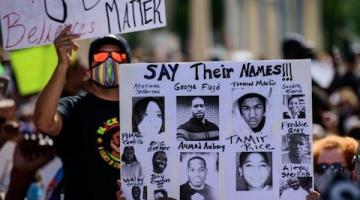
At the end of the day, what the Dart/Trump/Giants situation shows us is that the NFL is essentially a metaphor for the white supremacist, settler colonial project that is the United States. Much like the NFL seems to have remained the same as it pertains to racial justice and its treatment of Black players since the ouster of Kaep, we can say the same for the United States, which, if anything, has regressed since the election of Barack Obama and the “racial reckoning” of 2020 following the lynchings of George Floyd, Breona Taylor, and others. And when it comes to confronting the psychopathology of white “supremacy,” as characterized by North South Project for People(s)-Centered Human Rights founder and director, Ajamu Baraka, that is ensconced in the DNA of this nation, we are in a fourth and long situation and, like the New York Giants’ offense for the last few years, about to punt the ball yet again… which means that Black, Brown, and Indigenous peoples, are about to be on defense, for the majority of the game.
The cycle continues…until we collectively take the steps necessary to break it.
Anthony Karefa Rogers-Wright is an international climate and environmental liberation advocate, a racial justice practitioner, and a writer and policy expert residing in the United States with his family and their mischievous cat, “Evil” Ernie. He is a proud and active member of the Black Alliance for Peace and the Movement for Black Lives. His radio program, “Full Spectrum with Anthony Rogers-Wright,” airs on the Mighty WPFW network every Tuesday at 6:00 PM EST.





 The armed groups in Haiti are not a spontaneous wave of banditry, but a scheme orchestrated by imperialist powers in concert with a reactionary and subservient Haitian political class. The…
 A coalition of Pan-African and socialist organizations has launched an international campaign to defend Cuba, arguing that African peoples must remember the sacrifices Cuban internationalists made…
 If international law and justice are buried in the rubble of Gaza, the global community will ultimately be digging its own grave.
 Three years into Israel's genocide in Gaza, the consequences of a decision driven by siege, settlement expansion, and assaults on Al-Aqsa are still unfolding.
 In this week’s segment we hear about the right-wing politics of the anti-migrant movement in South Africa, ANC failures, and upcoming elections in that country. But we begin with the first and only…


