“U.S. Imperialism is formidable and violently vindictive simultaneously.”
Historian and political activist Gerald Horne is the Moores Professor of History and African American Studies at the University of History. He grew up te Missouri, where he graduated from Beaumont High School in St. Louis in 1966, and obtained a Bachelor’s degree from Princeton (1970), a J.D. from University of California, Berkeley (1973), and a Ph.D. in history from Columbia University (1982). He is the author of more than thirty books addressing the questions of racism, labor, politics, civil rights, international relations, and war. The Public Archive interviewed him about two of his more recent books, Confronting Black Jacobins: The United States, the Haitian Revolution, and the Origins of the Dominican Republic and The Apocalypse of Settler Colonialism: The Roots of Slavery, White Supremacy, and Capitalism in Seventeenth-Century North America and the Caribbean. Both were published by Monthly Review Press.
The Public Archive: I want to begin by asking you about your intellectual biography. You have a law degree from Berkeley and were a practicing lawyer before returning to graduate school at Columbia to complete your PhD in history, with an excellent dissertation, titled Black and Red: W.E.B. DuBois and the Cold War, 1944-1963. What first led you to law and then from law to history? And can you say something about how your approach to archives and research developed during your studies?
Gerald Horne: What led me first to law was the political activism of an earlier era. I went to Berkeley in part because I wanted to be close to the Black Panther Party, whose roots were in nearby Oakland; like others I saw the formation of the BPP as an excitingly transcendent development. Alas, by the time I graduated the political climate had taken a turn for the worst and it was apparent that I—like many others—miscalculated the strength of the U.S. right wing and its capacity for counter-revolution, a trend I have addressed explicitly in my historical writing. So, I moved to New York City and became involved with various forces, including Herbert Aptheker’s American Institute for Marxist Studies and Esther Jackson’s Freedomways magazine and related entities, not to mention anti-apartheid activism and trade union activism (Hospital Workers Union) and the National Conference of Black Lawyers.
“I miscalculated the strength of the U.S. right wing and its capacity for counter-revolution.”
I also entered graduate school in History at Columbia. As for the archives, my association with the foregoing led me to the Du Bois Papers—Aptheker and Jackson both worked closely with him—and my dissertation and first book. It seemed obvious to me that there had to be a deeper explanation for how the mighty Du Bois was made marginal in the last few decades of his life—just as desegregation seemed to be taking root. I explored this apparent paradox in this and other works.
The Public Archive: Confronting Black Jacobins has an obvious debt to CLR James’ classic study, The Black Jacobins: Toussaint Louverture and the San Domingo Revolution. What is the impact of James’ work on your own writing and how does your book diverge from James’?
Gerald Horne: Like James I have sought to emphasize the world historic importance of the Haitian Revolution, how it ignited a General Crisis of the entire slave system that could only be resolved with its collapse and how that was a condition precedent for the post-U.S. Civil War rise of a working-class movement and a socialist movement—not just in North America but globally. Unlike James, however, I see 1776 and the formation of the resultant republic as not a step forward but a Great Leap Backwards, to which 1804 administered a fitting rebuff. Likewise—unlike James—I write of the de facto alliance between Hayti and Britain in confronting the slaveholders’ republic in North America. Perhaps the difference has something to do with my being born under the “Stars and Stripes” and he under the “Union Jack”?
The Public Archive: You’ve taken the Harvard eugenicist Lothrop Stoddard’s comment that the Haitian Revolution provided “the first great shock between the ideals of white supremacy and race equality” to suggest the revolution’s impact far beyond the Caribbean region. What was that impact?
Gerald Horne: As for the impact of the Haitian Revolution, see the immediately preceding paragraph. To elaborate, London recognized the jig was up with 1804 and moved away from the ignominious African Slave Trade by 1807 and then began pressing the U.S. in a similar direction (see my ‘Negro Comrades of the Crown’), while Hayti in turn began aiding revolts of the enslaved throughout the hemisphere (detailed in ‘Confronting Black Jacobins’). Both pressed the analogue of 1776—Texas’ pro-slavery secession from Mexico in 1836, which caused the so-called Lone Star Republic to turn tail and crawl into the U.S. federation, to which it remains attached. This was not minor since early on Texas became a major slave trading state, with its ships found off the coasts of West Africa and Brazil and Cuba (see my ‘Race to Revolution’ on Cuba and ‘The Deepest South’ on Brazil).
The Public Archive: For many historians, the revolution is fetishized and Haitian history ends in 1804. As a result, there are relatively few studies of post-Revolutionary Haiti. What are the major challenges that this newly born Black Republic composed of formerly enslaved-Africans faced across the nineteenth century?
Gerald Horne: Hayti faced destabilization, not least from Spanish Cuba and the U.S., culminating in the secession of the Dominican Republic in 1844, unleashing a seemingly endless cycle of conflict between the close neighbors. The payment to France of a kind of ‘reparations’ is also well known, a criminal injustice that continues to resonate.
The Public Archive: One of the surprising insights of The Apocalypse of Settler Colonialism is your narration of the history of the Muslim world, of the Ottoman and the Barbary Coast, in particular, to the history of modern slavery, settler colonialism, and the emergence of a “pan-European” white identity. What are the main points of this story?
Gerald Horne: Unfortunately, there is this well-known trend of reading the present back into the past: i.e. Turkey is not a major force globally today—though that is changing rapidly—and, ergo, de-emphasizing its past strength has become common. This is unfortunate. One of the points I will make in my 16th Century book is that London surged to the front ranks of nations in part by cutting deals with the Ottomans and Africans against the interest of the Iberians (this included backing Morocco and even the Cimarrones or the “Maroons” of what is now Panama in their contest with His Catholic Majesty). Of course, Western Europeans generally ran the risk of being enslaved themselves as they sailed southward to enchain Africans. The halting of the Ottomans at the gates of Vienna in 1683 was—thus—a defeat for Africa too (at least in the narrow sense). And, yes, the deal cut between England and the Ottomans is—in a sense–reminiscent of the deal cut between China and the U.S. in the early 1970s, with the latter not contemplating that this Asian giant would surge to the forefront, just as the Ottomans did not realize how London would be propelled forward decisively.
“London surged to the front ranks of nations in part by cutting deals with the Ottomans and Africans.”
The Public Archive: I have two questions on the historiographical location of your research and writing, especially concerning the critique of capitalism within Black historical studies. First, what are your thoughts on the “new” history of capitalism — especially with its “discovery” of a link between capitalism and slavery — and how would you situate your own work in relationship to it? Second, the phrase “racial capitalism,” as deployed by the late Cedric Robinson, has gained a recent currency for the discussion of the racialized origins of capitalism. However, “racial capitalism” is not a term that appears in your work and you write instead of “capitalism” as the “ultimate expression” of slavery and white supremacy.
Gerald Horne: I welcome these “new” studies of slavery and capitalism but, as I’m sure you know there is a kind of “Columbus” quality about the enterprise, i.e. “discovering” what Eric Williams, Walter Rodney and others have written about for decades. Besides, some of these scholars write about slavery without slaves—i.e. they mostly discuss the activity of slaveholders, and rarely discuss resistance (at times some scholars explicitly deny the existence of resistance!), which is akin to seeking to judge a pugilistic contest while only focusing on one combatant. Inevitably, it leads to “one-sidedness”: it is baked into the cake. As for “racial capitalism,” I do not reject the term—in fact I have used the term “racialized bourgeois democracy,” as a corrective to how this latter phenomenon has been evaluated.
The Public Archive: Notions of “debt” and “vengeance” circulate within The Apocalypse. What is the significance of both terms, especially for the children of the African diaspora living in the United States today?
Gerald Horne: You may know the lyric, “Love, Love, Love—Makes you do Foolish Things.” For rising nation states, you may well substitute, “Debt, Debt, Debt—Makes you do Criminal Things.” I plan to argue in a forthcoming book on the 16th century that London’s break with the Catholic Church was driven not only by the marital choices of Henry VIII but also to appropriate the wealth of the established faith in England and the immediate environment. This in part was driven by what I note in the first sentence of my 17th century book: England was a minor power on the fringes of Europe at the beginning of this pivotal century and as I go on to suggest, was being pressed by the Iberians, the French, the Ottomans, and—subsequently—the Dutch. London was in debt for some time because of these stiff challenges (London barely repelled the Spanish Armada in 1588), which drove not only the break with the Catholics and the acceleration of religious conflict (Protestant v. Catholic and Christian v. Muslim) but also the advent of settler colonialism, which can be seen not only as a raw lurch for the land and wealth of “others”–at least in terms of North America—but also the outflanking of Spanish Florida and Spanish Cuba by “settling” due north in what is now Virginia. Of course, this brings us to 2018 and musings about what the successor regime—U.S. Imperialism—will be driven to in light of the massive national debt, not to mention consumer debt and student debt but, besides, what the 45th President sees as the related issue of the trade deficit–notably with China.
“The settlers with their religious zeal felt the land and labor improperly obtained was mandated by the ‘Almighty.’”
As for vengeance, establishing settler colonialism based on the illicit expropriation of the land of indigenes, accompanied by their enslavement and the accompanying enslavement of illicitly procured Africans perforce must be perpetrated by massive violence, which inexorably engenders a ceaseless cycle of vengeance. Of course, the settlers with their religious zeal felt the land and labor improperly obtained was mandated by the “Almighty,” and those victimized stoutly disagreed, and—arguably—this resultant cycle has yet to be extirpated altogether.
The Public Archive: A number of your books have been published by International Publishers and you have had an ongoing interest in Communist figures including DuBois, William L. Patterson, and Benjamin Davis. Yet it seems to me that current academic interest in Black radicalism—in the Black Radical Tradition, Black internationalism, etc.—is not matched by a commitment to radicalism in the contemporary Black political sphere where critiques of both capitalism and imperialism are almost non-existent. Can you comment on this gap? And, for you, what lessons for the present can we learn from the Black Communists of the past, especially on the question of anti-imperialism?
Gerald Horne: Yes, I’m afraid that you have detected something that is real and evident. Let me speak prospectively and encourage younger scholars to ascertain who and what represent the most advanced stage of the struggle and seek to build upon what they have constructed: assuredly, do not ignore these trends and personalities. I chuckle when I hear certain colleagues reproving their counterparts in South Africa for “selling out” when—in a real sense—what has happened in recent decades among these colleagues in the U.S. is a decision to “take the money and run.” I understand this since U.S. Imperialism is formidable and violently vindictive simultaneously. However, with the crisis ignited by the rise of China, accompanied by an increasing challenge from the BRICS (Brazil, Russia, India, China, South Africa), not to mention the Shanghai Cooperation Organization and Iran and Cuba and all the rest, U.S. imperialism will not be as capable of assuaging those on the domestic front, meaning a confrontation with Washington and Wall Street on disadvantageous terms, or terms that would have been more advantageous if a more spirited anti-imperialist struggle had been mounted. Because the Euro-American majority in the U.S. tends to lean to the right, it becomes all the more important to engage globally—to lengthen the battlefield by dint of anti-imperialism: failure to do so is suicidal.
This article previously appeared in The Public Archivesite.






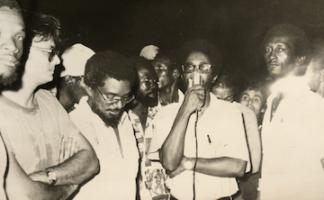 “The Burnham dictatorship crept up upon Guyanese people like a thief in the night.”
 The late Dr. Johanna Fernández left an awesome intellectual and activist legacy that includes her 2010 documentary film “Justice on Trial: The Case of Mumia Abu-Jamal.”
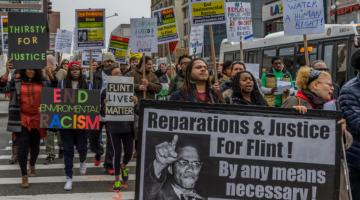 The climate movement will never be effective as long as it refuses to confront white supremacy within its own organizations and as a belief system which is unconcerned about Black and brown death.
 Fisk University, an HBCU, is presenting a $400 million A.I. data center as progress for the North Nashville community. In truth, it means more pollution, more surveillance, and another chapter in a…


