by Spencer Woodman
A Florida court may allow the voters to throw out the state’s lifetime ban against allowing convicted felons to vote – a prohibition that had disenfranchised nearly a quarter of the Black population. The court’s approval clears the way for a grassroots coalition “to move to the final phase of the campaign, which involves collecting some 600,000 additional petition signatures” — ten times the number so far gathered by the coalition.
A Quarter of Florida's Black Citizens Can't Vote. A New Referendum Could Change That.
by Spencer Woodman
This article previously appeared in The Intercept.
“National groups, including the Democratic Party, have shown little interest in placing real resources behind recent efforts to roll back the country’s most impactful voting restriction.”
For more than a century, the state of Florida has presided over one of American history’s single most effective and enduring efforts to disenfranchise voters. By far the most populous of the three states that strip lifelong voting rights from people with felony convictions, Florida is home to some 1.5 million residents who can never again cast a ballot unless pardoned by the state’s governor, according to a calculation by The Sentencing Project.
Florida’s legions of disenfranchised voters are disproportionately Democrat-leaning minorities — including nearly a quarter of Florida’s black population — numbers that advocates say amount to a long-standing and often ignored civil rights catastrophe. This racial skew means that the state’s mass disenfranchisement could have changed the outcome of some particularly important elections — such as Bush v. Gore — and thus the direction of modern American history itself. Most recently, after the state’s Republican governor clamped down on the ability of ex-felons to have their rights restored, Donald Trump won the crucial swing state by a margin less than a tenth the size of the state’s disenfranchised population, leading some to question the effect that felony disenfranchisement may have had on the size of Trump’s Electoral College win.
In spite of the state’s eye-popping voting statistics, national groups, including the Democratic Party, have shown little interest in placing real resources behind recent efforts to roll back the country’s most impactful voting restriction.
“Donald Trump won the crucial swing state by a margin less than a tenth the size of the state’s disenfranchised population.”
Yet in recent weeks, even without any significant organizational backing, a coalition composed largely of disenfranchised Floridians quietly reached a new landmark in a long and laborious fight to overturn the state’s law. Last month, after organizers had spent years gathering the requisite 68,314 petition signatures, Florida’s high court announced it had set a March date to consider the proposal to allow a referendum on the 2018 ballot asking voters to roll back the state’s felony voting restriction.
“To the best of my recollection, never before has a purely grassroots effort gotten as far as triggering a Supreme Court review,” said Desmond Meade, an ex-felon and the chairman of the Floridians for a Fair Democracy, the group leading the effort. “This is a major milestone.”
Meade says that he’s hopeful that the state’s high court will produce a favorable ruling, and he has yet another reason for optimism: even the Florida Division of Elections has reportedly filed a brief supporting the proposed ballot initiative.
Yet even if the court ruling goes Meade’s way, his effort still faces an uphill battle. The court’s approval clears the way for the coalition to move to the final phase of the campaign, which involves collecting some 600,000 additional petition signatures — roughly 10 times the amount that it took his group years to secure. To succeed, Meade will somehow have to rapidly and dramatically expand interest in an issue that appears to have been written off by both major political parties, even though it holds the potential to reshape American elections.
“We weren’t getting funding or anything so it took more time,” said Meade. “But we’ll need 10 times as many people now.”
Spencer Woodman is a freelance journalist based in New York. @SpencerWoodman

 A twenty year battle in Israeli courts ended with a decision to evict more than 1,000 Palestinians from Masafer Yatta. Settler attacks on Palestinians escalated even before the ruling, which allows a…
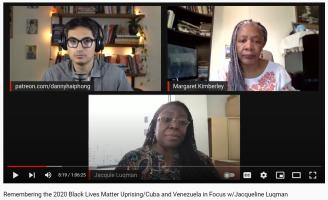 Journalist and activist Jacqueline Luqman joins the Left Lens to discuss the two year anniversary of the BLM uprisings and her recent trips to Cuba and Venezuela.
 The UK sends asylum seekers to Rwanda, the number of police killings in the U.S. continue unabated, and the Democratic Republic of Congo is threatened by U.S. client states and comprador, neo-…
 The United Kingdom is paying the Rwandan government $150 million to accept asylum seekers. The UK is accelerating deportations and denial of legal rights to Global South immigrants. Fiona of the…
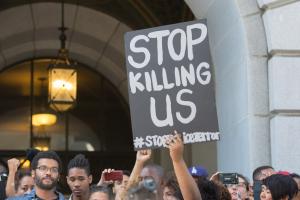 Police killings continue at a rate of more than 1,000 per year in the U.S., with 2022 numbers outpacing those of 2021. Sam Simyangwe of Mapping Police Violence provides analysis of the death toll and…


