This book asks readers ‘to follow Ezili’s lead by imagining worlds in which black women, black queer folk, masisi…ev’ry body has value—ev’ry black body is a divine gift.’”
“The myth of excessive black homophobia is redolent of racist understandings of blackness as primitive and pre-modern.”
In this series, we ask acclaimed authors to answer five questions about their book. This week’s featured author is Omise’eke Natasha Tinsley.Tinsley is Associate Professor of African and African Diaspora Studies at the University of Texas. Her book is Ezili’s Mirrors: Imagining Black Queer Genders.
Roberto Sirvent: How can your book help BAR readers understand the current political and social climate?
Omise’eke Tinsley: In the U.S., “freedom of religion” is increasingly invoked to legalize discrimination against queer folk. Witness the recent Supreme Court decision in Masterpiece Cakeshop v. Colorado Civil Rights Commission, which ruled in favor of a baker who refused to make a cake for a same-sex wedding on the basis of his Christian beliefs. My book offers an alternative vision for how black queer folks galvanize spiritual traditions in resistant ways that are diametrically, strategically opposed to Christian-centric worldviews that are currently threatening the lives and well-being of queer folks, Muslims, pregnant people, and the disabled—among others—under Trump’s reign.
What do you hope activists and community organizers will take away from reading your book?
I thought about black queer activism a lot in writing this, and about the limitations of dominant LGBTQ frameworks for imagining black queer freedom. Too often, black queer activists are imagined as playing “catch-up” with white queer organizing. That is, “common knowledge” assumes that white gay men were and are the vanguard of queer activism and that black communities, by virtue of our mythically excessive homophobia, lag “behind” when it comes to accepting LGBTQ folks. Homophobia is virulent in every racial community in the Americas: the myth of excessive black homophobia is redolent of racist understandings of blackness as primitive and pre-modern. While my book is written with that foundational understanding, though, its main point isn’t proving a negative—that black people aren’t more homophobic than everyone else. It’s exploring a positive: that, through African-derived spiritual traditions, people of African descent in the Americas have a rich tradition of seeing gender and sexual variance as a divine gift. Which means, simply, that Euro-American queer culture might have a lot to learn from African cultures in the Americas, in addition to the reverse. I hope that this point of departure might contribute to empowering black queer activists in their/our work.
We know readers will learn a lot from your book, but what do you hope readers will un-learn? In other words, is there a particular ideology you’re hoping to dismantle?
First and foremost, the common supposition that the “highest” intellectual work takes place in academic settings and through written texts. Ezili’s Mirrorsis a loving, unfinished song to the Haitian spirit Ezili, who represents the divine forces of love, sexuality, pleasure, prosperity, maternity, creativity, and fertility—and who’s known as the protectress of all those black folk who fall outside of their community’s respectability politics, from sex workers to sissies to single mothers. I invite readers to engage the corpus of stories, memories, and songs about Ezili not as a fanciful collection of stories from the Caribbean. Instead, I ask us to consider these stories as one of the media through which people of African descent were able to encode the histories and theories of black/queer genders that couldn’t be housed anywhere but in our own imaginations. Slaveowners and colonizers recorded knowledge housed in libraries; but the enslaved and their descendants kept our knowledge safe and communicable by embedding them in stories and songs likes the ones I engage here, and I want readers to take these forms seriously as public intellectual work.
Who are the intellectual heroes that inspire your work?
My late mentors VèVè Clark and Barbara Christian, always: politically fired, loving, and brilliant scholar-activists who died too soon but whose influence continues to push black feminist thought into bloom across the Diaspora. And all the artists whose work I lovingly engage in my book: Nalo Hopkinson, Sharon Bridgforth, Ana Lara, Mildred Gerestant, Anne Lescot, Janet Collins, Angie Extravaganza, Whitney Houston, Mary Ellen Pleasant, and my great grandmother Arties Phillips Stapler.
In what way does your book help us imagine new worlds?
For me, a book about Ezili can only, always be about imagining new worlds. In her watershed study Divine Horsemen: The Living Gods of Haiti, Maya Deren writes of Ezilias “that which distinguishes humans from all other forms: their capacity to conceive beyond reality, to desire beyond adequacy, to create beyond need…In her character is reflected all the élan, all the excessive pitch with which the dreams of men soar, when, momentarily, they can shake loose the flat weight, the dreary, reiterative demands of necessity.” In other words, Ezili is the lwa who exemplifies the work of the imagination. And so throughout Ezili’s Mirrors, I ask readers to follow Ezili’s lead by imagining worlds in which black women, black queer folk, masisi, hair dressers, sex workers, addicts, dominatrices, factory workers, migrants, ev’ry body has value—ev’ry black body is a divine gift. Without question, the work of the imagination is a central practice of black feminism. Almost 250 years after a black woman helped launch the Haitian revolution, it remains a black feminist necessity to explicate, develop, and dwell in realities other than Western empiricisms that deny black women’s importance in knowing, making, and transforming the world. So I gaze into Ezili’s mirrors to do just that.
Roberto Sirvent is Professor of Political and Social Ethics at Hope International University in Fullerton, CA. He also serves as the Outreach and Mentoring Coordinator for the Political Theology Network. He’s currently writing a book with fellow BAR contributor Danny Haiphong called American Exceptionalism and American Innocence: The Fake News of Wall Street, White Supremacy, and the U.S. War Machine.
COMMENTS?
Please join the conversation on Black Agenda Report's Facebook page at http://facebook.com/blackagendareport
Or, you can comment by emailing us at comments@blackagendareport.com





 The crisis of late-stage capitalism has stripped away the liberal disguise and revealed white supremacy as the official ideology of the U.S. state.
 “It is perfectly clear that the war of aggression waged by Morocco against the [Western] Saharan people is a purely colonial war.”
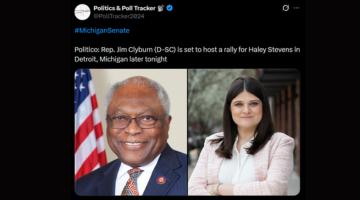 The Congressional Black Caucus electoral strategy has turned the 2026 midterm elections into a dumpster dive for corporate interests and Zionist approval.
 The Democratic Party's continued support for Israel's genocide is not just a moral and political liability but also an economic one which impacts its voters, yet the party refuses to frame it as such.
 "hand ‘em another $350 billion to fight Communism?" is the latest from BAR's Poet-in-Residence.


