Fukuyama's 'end of history' was just an excuse for empire that Wang Huning saw through back in 1991. Now, as America's broken system tears itself apart, our job isn't to save it, but to build something better from the wreckage.
In 1991, as Francis Fukuyama proclaimed the "End of History" and the triumph of liberal democracy, a relatively young Chinese scholar named Wang Huning was documenting a profoundly different reality during his sojourn through U.S. universities and cities. His resulting work, America Against America (1991) reads today not as a historical artifact but as a prophetic text—a meticulous dissection of the internal contradictions that would eventually tear at the fabric of U.S. society.
Where Fukuyama saw the culmination of ideological evolution in Western liberal democracy, Wang observed a nation perpetually at war with itself. His analysis revealed the fundamental tensions between the U.S.'s proclaimed ideals and its lived reality: the gap between rhetoric of equality and the persistence of systemic inequality; between the promise of democracy and the concentration of power in elite hands; and between the mythology of meritocracy and the reproduction of class hierarchies.
The timing of these competing visions—Fukuyama's triumphalist declaration coinciding with Wang's forensic examination of U.S. dysfunction—now appears as one of history's great ironies. While the former Reagan administration official, Francis Fukuyama, celebrated the supposed victory of liberal capitalism over its ideological rivals, Wang Huning, one of the future architects of Xi Jinping's political philosophy, was documenting the seeds of that system's eventual crisis.
The Mask Slips: From Liberal Facade to Fascist Reality
Three decades later, Wang's observations have materialized with stunning clarity. The election and re-election of Donald Trump represents not an aberration in U.S. political development, but the logical culmination of contradictions that Wang identified in his travels through the country during the Reagan years. The liberal democratic mask, always ill-fitting over the imperial face beneath, has finally slipped entirely.
Trump's rise cannot be understood merely as the triumph of demagoguery over reason, though it certainly includes that element. Rather, it represents the moment when the A internal contradictions of U.S. society became too acute to maintain the pretense of liberal democracy. The economic inequality that Wang observed in the early 1990s had metastasized into a full-scale oligarchy. The racial tensions he documented had evolved into a white nationalist movement with significant political power. The cultural fragmentation he witnessed had crystallized into irreconcilable worldviews.
The fascist character of contemporary U.S. politics extends far beyond Trump's personal authoritarianism. It encompasses the systematic disenfranchisement of voters, the weaponization of state violence against protesters and marginalized communities, the complete fusion of corporate and state power, and the cultivation of an imperialist mentality based on mythologized grievance and scapegoating. State legislatures across the country have enacted laws restricting voting rights, criminalizing protest, expanded anti-immigration laws inciting pogroms against migrants, and targeting pro-Palestine individuals with the systematic precision that historical fascist movements employed against their chosen enemies.
The Global Reckoning: When Empire Turns Inward
Perhaps most significantly, the world has begun to see the U.S. clearly. The global response to U.S. actions—from the widespread condemnation of the war in Iraq to the isolation of the US in international forums over its unconditional support for Israeli actions in Gaza—reflects a fundamental shift in global consciousness. The moral authority that the U.S. claimed during the Cold War era has evaporated, replaced by a growing recognition of U.S. hypocrisy and imperial overreach.
The ongoing genocide in Palestine serves as a particularly stark revelation of U.S. contradictions. While proclaiming support for human rights and international law, the United States continues to provide military aid and diplomatic cover for what international observers increasingly recognize as genocide. This contradiction is not lost on the Global South, where populations have experienced U.S.-backed violence for decades. The current moment represents a crystallization of this understanding into concrete political opposition to U.S. hegemony.
China's rise, Russia's resistance, and the emergence of alternative international institutions like BRICS reflect not just shifting power dynamics, but a fundamental rejection of the U.S.-led international order. The world is actively constructing alternatives to U.S. dominance, recognizing that the contradictions Wang identified have made the United States an increasingly unstable and unreliable hegemon.
The Subcontracting of Violence and Its Return
For decades, the U.S. empire managed its contradictions by exporting violence to the periphery. The costs of maintaining global dominance—the wars, the coups, the economic extraction—were borne primarily by populations in Latin America, Africa, Asia, and the Middle East. This geographic displacement of imperial violence allowed U.S. society to maintain the fiction of a peaceful, democratic character.
However, the logic of empire inevitably turns inward. The tools of domination developed for use against foreign populations eventually find their way home. The militarization of U.S. police forces, the normalization of mass surveillance, the criminalization of dissent—these represent the imperial chickens coming home to roost. The violence that was once safely quarantined in the Global South now has begun stalking U.S. streets and institutions.
The current crisis in U.S. cities, where people of color face a lack of affordable housing and struggle to access running water, the rise of domestic terrorism—these phenomena cannot be understood apart from the U.S.'s global role as an agent of violence. A society built on violence—through indigenous genocide and slavery—remains fundamentally violent, and in recent decades, that violence has taken on a different intensity as it turns inward upon itself Wang's observation about U.S. internal contradictions has found its ultimate expression in a nation that can no longer contain the destructive forces it has unleashed upon the world.
This analysis leads to a crucial recognition: the current crisis cannot be resolved through traditional political means. Neither electoral politics nor protest movements nor reform initiatives can address contradictions that are foundational to the U.S. project itself. The attempt to perfect U.S. democracy, to realize its unfulfilled promises, to reform its institutions—these efforts, however well-intentioned, misunderstand the nature of the crisis.
The current contradictions in the U.S. are not bugs in the system; they are features. The gap between democratic rhetoric and oligarchic reality, between egalitarian ideals and systemic oppression, between peaceful self-image and violent practice—these are not problems to be solved but structural characteristics that define U.S. capitalism and imperialism.
The historical moment we are witnessing represents the playing out of these contradictions to their logical conclusion. The overtly fascist turn in U.S. politics, the growing international isolation, the internal violence and chaos—these are not temporary setbacks on the path to a more perfect union. They are the inevitable results of a system built on exploitation, extraction, and violence.
The Dialectic of Destruction and Creation
Even violence—the last resort of failing systems—cannot save the U.S. from itself. The turn toward authoritarianism, the increasing militarization of society, the embrace of political violence—these represent desperate attempts to resolve through force contradictions that cannot be resolved within the existing framework. But violence directed outward has already proven insufficient to maintain dominance, and violence directed inward will only accelerate the system's collapse.
The current historical moment thus represents not a crisis to be overcome but a transition to be navigated. The U.S. empire, like all empires before it, contains the seeds of its own destruction. Wang Huning identified those seeds in 1991; today we witness their flowering into a full-scale systemic crisis.
The task for those who seek justice and peace is not to save the U.S. from itself—an impossible project—but to prepare for what comes after. The future belongs not to those who seek to reform the unreformable, but to those who understand that history's arc bends toward the collapse of systems built on contradiction and violence. In that collapse lies the possibility of creating something genuinely new: a world organized around cooperation rather than domination, equality rather than hierarchy, peace rather than violence.
The end of the U.S. empire will not be the end of history—it will be its beginning.
Matteo Capasso is a Marie Curie Research Fellow at the University of Venice, Italy. He is the author of Everyday Politics in the Libyan Arab Jamahiriya and Editor of Middle East Critique.





 In this week’s segment, we discuss student protests by Black and brown youth in France against austerity measures and race-based inequality in the education system. But we begin with a discussion of…
 Brazil's incumbent president Lula da Silva finished second behind Flavio Bolsonaro in the first round of the presidential election. Because neither man received at least 51% of the vote, a run-off…
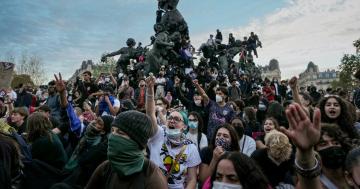 Students in France are engaging in mass protests. Hundreds of them have been arrested and injured by police, and many schools are closed. Annick Metefia joins us from Paris. She is a member of the…
 Ajamu Baraka of the Black Alliance for Peace joins Dimitri Lascaris on BettBeat Media for a conversation about something Western publics have not yet come to terms with — the fact that resistance to…
 Progressive candidates rarely remain so after winning public office. Zohran Mamdani is no exception, but his capitulation to New York zionists angered his supporters, and the people he hoped to…


