by BAR executive editor Glen Ford
“Black Lives Matter” has become the default name for the emerging movement against police atrocities against Black people. Whatever the movement winds up calling itself, “the venerable slogan 'No Justice – No Peace' has served as a workhorse of the current protest, and would be an ideal organizing principle if the implications of the slogan were fully understood, rather than simply mouthed."
Tamir Rice and the Meaning of “No Justice – No Peace”
by BAR executive editor Glen Ford
“If the existing structures of governance and social organization cannot provide justice for Black people, then those structures must be pushed aside – or there will be no civil peace.”
The current campaign against police oppression in Black America is widely dubbed the Black Lives Matter movement, derived from a hashtag created in the wake of 17 year-old Trayvon Martin’s death at the hands of George Zimmerman, in 2013. Young activists in Ferguson, Missouri, originally rallied around placards and chants of “Hands Up, Don’t Shoot,” to emphasize Michael Brown’s stance when the 18 year-old was extrajudicially executed by Officer Darren Wilson, in August of last year. “Hands Up, Don’t Shoot” was limited by the particular circumstances of Brown’s death and, more importantly, widely considered too passive a slogan on which to build a militant movement. “Black Lives Matter” expresses a general sentiment and aspiration, but embodies no substantial political content or direction. Moreover, the slogan is the political property of a particular organization with numerous chapters in the U.S. and abroad, whose positions and priorities are not necessarily representative of the emerging “movement’s” various political tendencies.
In a previous era, neither the SCLC, SNCC, CORE, nor the NAACP or the Urban League could lay claim to the “civil rights” movement, nor was any organization synonymous with “Black Power” or “Black Liberation.” “Black Lives Matter” is even less definitive than the Sixties umbrella terminology, conveying no substantive political objective other than affirming, or achieving, the sanctity of Black lives. It is a vessel waiting to be filled and set on course.
The amorphousness of “Black Lives Matter” is to be expected, given both the incipient movement’s youth – the prospect of a sustained, national campaign against police oppression did not seriously arise until the awakening in Ferguson – and the two-generation-long gap in mass movement experience in Black America. The slogan speaks to the now-generalized Black outrage at police behavior in Black communities, and serves as a banner under which diverse forces have begun to coalesce. It has been a useful umbrella, which is why the term “Black Lives Matter Movement” has served as a catch-all for a broad range of anti-criminal justice protest, including in these pages. However, history will demand more of the new movement than “Black Lives Matter” can provide. Sustained, militant practice informed by increased political clarity will eventually arm the Black awakening with a name that is worthy of a mass “movement.”
“The slogan speaks to the now-generalized Black outrage at police behavior in Black communities, and serves as a banner under which diverse forces have begun to coalesce.”
The logic of the emerging movement is Black self-determination – the principle that Black people have the inherent human right to determine their own destiny – which, in the immediate sense, means control over how they should be policed, and by whom. The venerable slogan “No Justice – No Peace” has served as a workhorse of the current protest, and would be an ideal organizing principle if the implications of the slogan were fully understood, rather than simply mouthed. The slogan takes the political position that the price that Power must pay for continued injustice against Black people is the loss of civil peace. It is a vow by the movement to transform the crisis that is inflicted on Black people into a generalized crisis for the larger society, and for those who currently rule.
“No Justice – No Peace” is consistent with the direct action philosophy of Dr. Martin Luther King Jr. – although not limited by his personal prohibitions against violence. Malcolm’s “by any means necessary” fits just as well.
More than just a threat against Power, the slogan brings clarity of purpose to the participants in the movement. If the existing structures of governance and social organization cannot possibly provide justice for Black people, then those structures must be pushed aside – or there will be no civil peace. The strategies and tactics of the movement must unfold, accordingly.
Recent developments in the Tamir Rice case prove, once again, the impossibility of achieving any semblance of justice from the criminal justice system as configured in the United States. Community leaders in Cleveland availed themselves of a little-used Ohio law that allows citizens to appeal directly to a judge to initiate prosecution of wrongdoers, bypassing the county prosecutor’s office. The law was specifically enacted to prevent the political establishment from protecting its own, as when prosecutors protect the police. A Black municipal judge viewed the damning video of a cop gunning down 12 year-old Tamir from seven feet away only two seconds after exiting his police cruiser – while the vehicle was, in fact, still in motion. Judge Ronald Adrine, who said he was “thunderstruck by how quickly this event turned deadly,” found probable cause to charge the cop with "murder, reckless homicide, negligent homicide, involuntary manslaughter and dereliction of duty," and to charge his partner with negligent homicide and dereliction of duty for not giving the child immediate medical attention.
However, the Ohio law turned out have no legal effect whatsoever. Judge Adrine said he could not himself bring the charges against the policeman; that decision remained in the hands of the county prosecutor, who promptly announced that he would send the case to a grand jury, as usual, with the usual probable results. The legal system is a dead letter for Black people, despite the Ohio law that was designed to remedy prosecutorial collaboration with police and other government agents, and despite the involvement of a sympathetic Black judge.
The federal government provides no recourse for Black people. Cleveland is now under its second U.S. Justice Department consent decree in little over a decade, and remains a killing zone for Blacks, where cops enjoy complete impunity even when they fire dozens of bullets into unarmed Black motorists. Federal consent decrees are designed to get Black people’s consent to a continued reign of terror by local police.
“The legal system is a dead letter for Black people.”
The electoral process has definitively failed to prevent the exponential growth of the Black Mass Incarceration State, in all its murderous aspects. Cleveland was the first major U.S. city to elect a Black mayor, Carl Stokes, in 1967. One of Stokes’ first acts was to put Black former Air Force general Benjamin O. Davis in charge of the police. Davis promptly OK’d the use of dum-dum bullets and took the side of his officers in every dispute over the use of excessive force. In the intervening nearly half-century, the nation’s elected Black leadership has collaborated at every stage of the construction of a criminal justice regime so hostile to the very presence of Black people, that one of out every eight prison inmates on the planet is an African American.
The U.S. legal system does not work for Black people, and the political system that makes the laws of the nation will not change the legal system, except under the most intense, extra-legal duress. Effectively, Black people are outside the law, beyond its protections, and will not get meaningful concessions from Power unless we create a crisis for the system of governance, itself – “by any means necessary,” in Malcolm’s words.
The movement that presently goes under the heading “Black Lives Matter” can find its way to the logic of Black self-determination through the organizing principle of “No Justice – No Peace.” It is a slogan that leads to a place where Black people have the power to decide for themselves if Black lives matter, or not.

 The very physical category of femaleness was articulated by feminists and non-feminists alike as the sole property of whiteness in the 19th century,
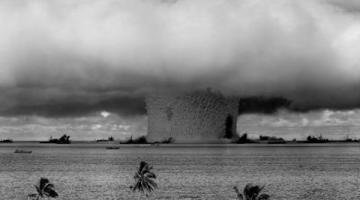 Seventy years after the civil preparedness film Duck and Cover, it is long past time to reckon with the way white supremacy shaped U.S.
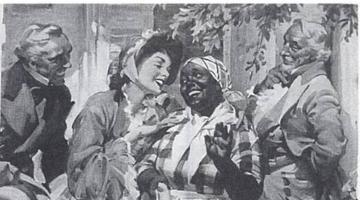 Textbooks are a battleground in which the humanity and status of black Americans are contested
 Amazon will not stop squeezing every drop from workers until those workers have more power.
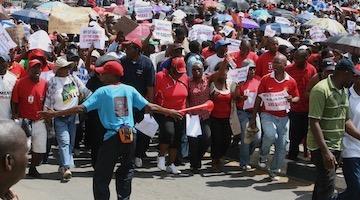 The Swazi military has reportedly warned the population to “obey instructions” or “face full wraith of troops.”


