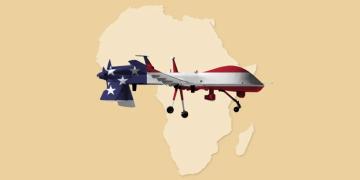
The U.S. relocation of MQ-9 Reaper drones from Africa to Latin America is not a drawdown of imperial aggression but a strategic reallocation, with the drones likely to be used against Cuba, Venezuela, and other targets of the "Donroe Doctrine."
The recent announcement that the U.S. will be removing most of its MQ-9 Reaper drones from Africa triggers impulsive, momentary elation, but knowledge of the dialectically, diametrically opposed interests of Africa and U.S. imperialism prompt an immediate, sober reality check. As might be expected, these remotely controlled weapons used for intelligence gathering and lethal precision strikes will not be retired. They will instead be relocated to select locations in Latin America.
The relocation of these weapons is noteworthy because the use of drones in Africa is a deadly tradition that was established by Barack Obama. In attacks on what the U.S. called “Islamic terrorists” primarily in Somalia, there have been literally hundreds of drone strikes. In 2020, the U.S. admitted to killing only two civilians, but other monitoring groups estimated that the numbers were much higher.
At the time, Amnesty International said: “We’ve documented case after case in the USA’s escalating air war on Somalia, where AFRICOM thinks it can simply smear its civilian victims as ‘terrorists’, no questions asked. Not only does AFRICOM utterly fail at its mission to report civilian casualties in Somalia, but it doesn’t seem to care about the fate of the numerous families it has completely torn apart.”
As the U.S. changes course, observers’ eyebrows are raised, and the speculation has already begun. The Independent commented: “The move highlights the tradeoffs confronting a military stretched across multiple regions… In the Middle East, questions have been raised about the supply of MQ-9 Reaper drones after at least 45 aircraft, or about 25 percent of the fleet, were reportedly lost in the Iran war.”
So, what are the imperialists up to? What connection is there between U.S. interests in Africa and Latin America? Only time will tell for certain, but here is what AFRICOM’s General Dagvin Anderson told the Senate Armed Services Committee:
“Since 2024, we have seen an increased flow of drugs emanating from the Americas through Africa into Europe, with a nearly sixfold increase of cocaine flowing across the Atlantic Ocean. Additionally, Mexican, Venezuelan, and Caribbean cartels seek to franchise industrial-scale drug production on the continent by exporting lab expertise to Africa and using Africa as a transshipment point to generate revenue.”
That’s the story they tell, but the real story likely has more to do with pursuit of what the Trump Administration calls “The Donroe Doctrine” which (like the Monroe Doctrine) seeks total U.S. domination of the Americas. The evidence is found in the Trump Administration’s establishment of what is called The Shield of the America’s Coalition. Its purpose is supposedly to fight international narco-terrorists and cartels, but its actual aims are political. Of the leaders of the coalition’s member states, Dr. Christopher Sabatine, Director of the Chatham House Latin America Program said: “All are center- to hard-right leaders, whom President Trump has either praised or endorsed when they were candidates. The others have vocally supported Trump’s policies in the Western Hemisphere.”
Secretary of War Pete Hegseth urged coalition members to withdraw from the International Criminal Court (ICC) which human rights groups have urged to investigate the U.S. strikes on Venezuelan fishing boats. No doubt the Trump administration will want the coalition’s support when the U.S. similarly attacks boats, oil tankers and other vessels bound for Cuba. Trump himself said he was going to “take care of Cuba.” He said: "As we achieve a historic transformation in Venezuela, we're also looking forward to the great change that will soon be coming to Cuba. Cuba is at the end of the line. They're very much at the end of the line.”
Clearly a stock of MQ-9 Reaper drones will be useful as the U.S. pursues its campaign of death against Cuba and others standing in the way of total U.S. hegemony in the hemisphere. But what of Africa? The militarization of America’s southern hemisphere and the militarization of Africa are not mutually exclusive. How will the U.S. compensate for a reduction in weapons in Africa? It’s possible that for strategic reasons the U.S. no longer perceives a need for them.
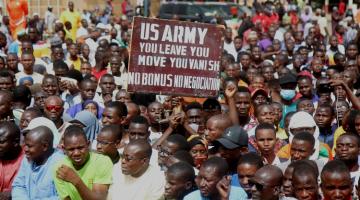
In addition to the Horn of Africa, AFRICOM has been preoccupied with the Sahel. Like the U.S., France has a strong interest in the region, particularly because of its extensive uranium mining operations in Niger. France has been committed to bullying the region militarily, and this accounts in part for a decision by Niger, Mali and Burkina Faso to establish a mutual defense coalition called the Alliance of Sahel States (AES).
Although France is a partner in imperialist crimes, the U.S. has been more strategically flexible. AFRICOM has been framed not as an invading military force but rather as a resource for its African “partners.” Like France, the U.S. has a powerful lust for the gold, uranium and lithium in the Sahel region, but unlike France it has apparently concluded that military aggression alone is not the most effective way to satiate that desire. Among other things, the State Department issued a statement explaining that it was sending a representative to Mali “to convey the United States’ respect for Mali’s sovereignty and desire to chart a new course in the bilateral relationship and move past policy missteps.” The statement went on to say the U.S. was looking forward to “cooperating and consulting with other governments in the region, including Burkina Faso and Niger, on shared security and economic interests.”
If, as it appears, the U.S. strategy is to employ a carrot for Africa and a stick for those targeted as U.S. enemies in Latin America, then it makes devious, evil sense to relocate the drone weapons. Forces in this hemisphere that are anticipated targets of the drones should begin to plan for defense. Those in Africa who are the focus of supposed diplomatic outreach must remain acutely alert, because as we know from history, imperialists are not above planting bombs in the flower bouquets that they deliver with a smile.
Mark P. Fancher is an attorney and writer. He can be contacted at mfancher@comcast.net.



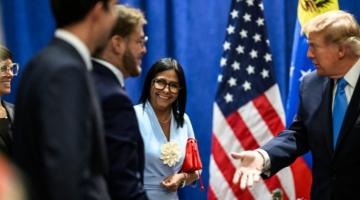 A photograph of Delcy Rodríguez smiling with Donald Trump after the U.S. kidnapped Nicolás Maduro is evidence of subordination to the United States. These images cannot be reconciled with the dignity…
 Imperialist competition and wars that facilitate extractivism have long shaped the use of seaports for access to resources, markets, and devalued labor. In the last decade, countries in the chain of…
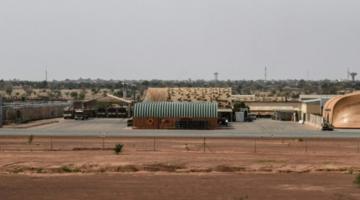
 Iraqi Kurdish leaders say the US withdrawal will leave their region, long a CIA and Mossad hub, vulnerable to Iranian attacks.
 BAR Executive Editor and Senior Columnist Margaret Kimberley advises caution when people say the US is in decline. Evidence from foreign policy rebuts that. There's been a bipartisan effort to bring…
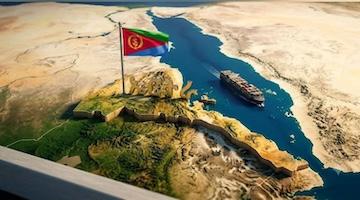
 In this week’s segment, we discuss events in the Horn of Africa as the Somaliland region requests U.S. recognition and the Trump administration ends some sanctions against Eritrea. But we begin by…


