"Cuba has remained a shining example of internationalism and holds a special place in the history of people's struggles against imperialism."
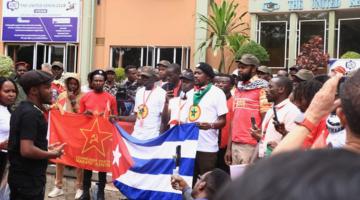
In the name of internationalism and the unity of oppressed peoples against imperialism, we, The Coalition for the Elimination of Imperialism in Africa and our brotherly Pan-Africanist organizations around the world, affirm our steadfast and unconditional solidarity with the Republic of Cuba in the face of mounting economic and political pressure from the United States government. For 66 years now, Washington has maintained a brutal, genocidal blockade against Cuba in order to punish them for the success of their revolution. On January 1st, 1959, Fidel Castro and his comrades successfully overthrew the US-backed dictatorship of Batista and two years later, on April 16th, 1961, proclaimed the socialist character of the Cuban revolution. The United States government would never forgive the Cuban people for their courage, their dignity and for building a socialist revolution just a few miles away from US shores and have worked to destroy the Cuban revolution ever since. The US blockade against Cuba contributes to shortages of food, medicine, fuel, and essential supplies, makes banking and trade more difficult, and increases the cost of everyday life for the Cuban people.
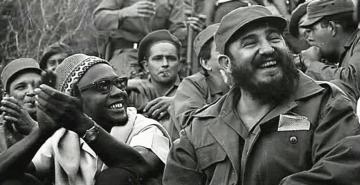
Despite these hardships, Cuba has remained a shining example of internationalism and holds a special place in the history of people’s struggles against imperialism. While many African countries were fighting colonialism, foreign domination, and the apartheid regime, Cuba provided significant support to several national liberation movements. In Algeria, Guinea-Bissau, Angola, Namibia, South Africa, the Democratic Republic of the Congo—where Che Guevara was present—, thousands of Cuban internationalists contributed to decisive battles for independence, while fostering cooperation in the fields of health, education, and training.
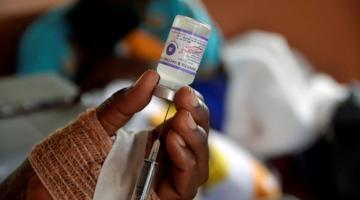
Today, Cuba continues its internationalism through the Henry Reeves Brigade which is a contingent of thousands of Cuban doctors who are deployed around the world to provide medical solidarity. In Africa, it was reported that nearly 4000 Cuban doctors are operating throughout the continent, free of charge. During the Ebola crisis of 2014, Cuba was the first nation to assist Africa by sending 103 nurses and 62 doctors as volunteers to Sierra Leone.
In addition to providing medical services to the African continent, Cuba is also training Africa’s future doctors at the Latin American School of Medicine (ELAM) where tuition, food and housing is entirely free so long as the student promises to return to their homeland to practice medicine.
Despite the difficulties created by American aggression, Cuba has remained a decisive ally of Africa and stood by the continent through some of its toughest battles. African people must not forget the long history between our peoples. African people must not forget the great sacrifices the Cuban people made in the name of internationalism and the struggle against imperialism.
Today, American imperialism has heightened its attacks against Cuba by strengthening its energy blockade and threatening a military intervention. African people cannot continue to be mere witnesses to the economic and political asphyxiation of Cuba. We must act in defense of Cuba, the same way Cuba once acted in our defense.
We call on all Pan-African and socialist organizations, progressive movements, labor unions, youth organizations, and all people committed to sovereignty to express their solidarity with Cuba and to preserve the memory of the historic ties that unite Africa and Cuba. We call on progressive governments in Africa, particularly, the AES, to deepen their ties with the Republic of Cuba and to offer them diplomatic support in the face of heightened pressure by the American government.
Solidarity amongst oppressed peoples is not a thing of the past. It remains a necessity in the face of today’s challenges.
Long live the friendship between Africa and Cuba!
¡Hasta la victoria siempre!



 Miami serves as a heightened case to explore such contradictions as I look closely at tensions between African Americans, white Cubans, and Black Cubans.
 In typical critical analyses and progressive multiracial mobilizations Black suffering is acknowledged while antiblackness is negated
 Historian Elizabeth Hinton’s book reveals that, in the late sixties and early seventies, there were hundreds of local rebellions against white violence and racial inequality.
 The U.S Has a long history of blaming Asian immigrants for outbreaks of disease, and every time, democracy and public health suffer.
 Prison officials could have prevented sickness and death by releasing those who were most vulnerable to coronavirus and least likely to reoffend — older incarcerated people.



