Black and brown volunteers were considered both “essential” and “dispensable” in past disease-ridden US conflicts, just as they are in today’s Covid crisis.
“Black people conscripted into imperial service wrestled with notions of death and honor.”
In this series, we ask acclaimed authors to answer five questions about their book. This week’s featured author is Khary Oronde Polk. Polk is Associate Professor of Black Studies and Sexuality, Women's and Gender Studies at Amherst College. His book is Contagions of Empire: Scientific Racism, Sexuality, and Black Military Workers Abroad, 1898–1948.
Roberto Sirvent: How can your book help BAR readers understand the current political and social climate?
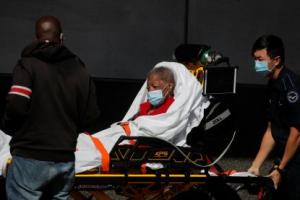
Khary Polk: I think Contagions of Empire is useful for thinking about race, labor, and the ongoing coronavirus pandemic. When we talk about essential workers, for example, we know that the majority of these workers in the U.S. are Black and Brown, and that in practice “essential” often means “disposable.” A similar use of African American volunteers happened one hundred and twenty years ago during the Spanish-Cuban-American War. In 1898, Black men and women signed up to serve as “immune” soldiers and nurses in the U.S. military due to a belief that Black people were immune to tropical diseases. Like essential workers today, these military workers were seen as indispensable for their grunt and care labor during the yellow fever epidemic in Cuba, but their lives and sacrifices were ultimately expendable to the larger project of American imperialism.
The pathology and treatment of Covid-19 is also as mysterious today as yellow fever was for American scientists in 1898. Yet Black men and women still served, and many hoped that their valiant service in the face of an unknown viral foe would be rewarded with full citizenship rights, or “immunities,” for the African American community back home. Sadly, this didn’t happen. Today, health workers of color have been disproportionately affected by the coronavirus. The historical parallels between the moment of black sacrifice I study and today are pretty shocking. I hope this history can help us create new political strategies for a post-Covid world.
What do you hope activists and community organizers will take away from reading your book?
I think it’s important for Black people to understand our place in the American imperial project. We should understand the community investments we’ve made in American militarism over the centuries, and that we continue to make with our disproportionate enlistment in military service. Perhaps more importantly, we should also know that there is a genealogy of Black military thought that has been centuries in the making, and we can use those lessons to better understand our relationship to the nation today. I hope organizations like the Black Veterans Project can look to this genealogy in their efforts to address longstanding disparities in the treatment and care of African American servicemembers. I also hope it gives their critique of the racial hierarchy in the military today – evidenced by the low numbers of Blacks in the officer corps – historical support.[1]
We know readers will learn a lot from your book, but what do you hope readers will un-learn? In other words, is there a particular ideology you’re hoping to dismantle?
I began this project as a racial and sexual history of the U.S. military abroad. However, as the archive I assembled grew, it became something slightly different. It soon became a study in which race and sexuality became the optics through which Black people, conscripted into imperial service, wrestled with notions of death and honor. The concept of American martial honor, far from immune from the historical machinations of race, class, and gender, gains its greatest expression through these registers of difference. Death in battle, death from disease, and death through labor carried racialized and gendered meanings within this discourse, and military officials recurred to those categories explicitly in recognizing the performance of black soldiers in life and death.
The afterlife of honor, made material through memorials, monuments, graveyards, pensions, and parades, helps us understand that who and how we honor is a deeply racialized affair.
Yet it’s important to note that this discourse was not wholly controlled or enabled by white military officials; African American leaders like Booker T. Washington were also invested in showcasing the honorable sacrifice of black military workers as well. In this sense, I use terms like “political immunity” and “necropolitical citizenship” to describe this honor-bound discourse that required the sacrifice of Black people in heroic service in order to entertain the very possibility of the extension of citizenship rights to the Black soldier, and through him or her, the wider Black community. Given the high stakes of this strategy, however, I wonder if we can recuperate the notion of honor in a way that does not require the death of the Black subject, or the violation of the Black body? I’m still trying to answer that question.
Who are the intellectual heroes that inspire your work?
In addition to Black feminist scholars like Darlene Clarke Hine, military historians like Alfred Vagts, and a wide range of gender, queer, and critical race theorists, I’d also consider the subjects of my study – those individuals who challenged white supremacist notions of honor during their military careers – as heroes and heroines in their own right. People like Namahyoka Curtis, the social maven from Washington D.C. who organized the black immune nurses sent to in Cuba; David Fagen, the Buffalo Soldier-turned-revolutionary who led Aguinaldo’s forces in the Philippines against U.S. troops; or Charles Young, the first black colonel in army history who chose exile and death in Africa rather than succumb to racism in the United States. Each of these individuals took different roads to self-determination, and their lives offer us new ways to understand the paradoxes and possibilities of African American military service abroad.
In what way does your book help us imagine new worlds?
I hope that Contagions of Empire contributes to the number of current theoretical and historical projects that work to excavate the afterlife of slavery in modern life. By choosing the military as a site of analysis, my book aims to document the carceral dimensions of American militarism, and to show how Black people and Black labor were crucial to the growth of U.S. empire. If we can understand African American servicemembers as not only soldiers but as workers, then we—civilians, activists, leftists, and scholars—might find a different empathy for their experiences, develop new pathways of solidarity, and create new premises for political action.
Roberto Sirvent is a teacher living in California.
COMMENTS?
Please join the conversation on Black Agenda Report's Facebook page at http://facebook.com/blackagendareport
Or, you can comment by emailing us at comments@blackagendareport.com
[1] https://www.blackveteransproject.org/mission

 The Trump administration plans to execute five people before there is a change of power. “The death penalty is the ultimate human rights violation.”
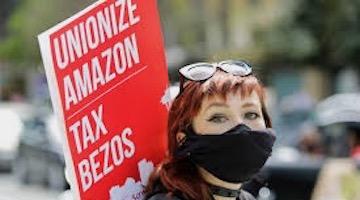 Dozens of leaked documents from Amazon reveal the company’s use of Pinkerton operatives to spy on warehouse workers, labor unions and social movements.
 Cuban medical professionals created a project to join science and statecraft and secure health as a fundamental right of citizenship.
 Imperialists continue to exercise control of former colonies from the comfort of their metropolises as their former subjects appear resigned to their post-colonial fates.
 Writing one’s own history is an act of emancipation. “Former slaves organized a government and controlled most of the colony.”


