“The artist Shepard Fairey has a history of appropriating images from activist-artists of color and selling them for a profit, without ever acknowledging the originals.”
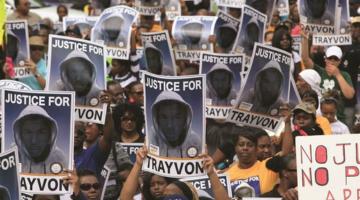
Shepard Fairey, the graphic artist known for the iconic 2008 Obama “Hope” poster, as well as the Trayvon Martin and Women’s March posters, wants to donate a mural near the site where Heather Heyer was murdered by a white supremacist car attack on August 12, 2017 in Charlottesville, Virginia. The proposed mural, which depicts a leaf with seven blades with Heyer’s face in the middle, was conditionally approved by the city’s Board of Architectural Review but is now tabled due to community criticism. It has caused controversy since some argue that the proposed image fails to recognize the city’s history of black resistance. Thus far, these critiques leave room for the artist to propose a different mural, one more representative of the community’s history. However, many do not know (but perhaps should) that the artist Shepard Fairey has a history of appropriating images from activist-artists of color and selling them for a profit, without ever acknowledging the originals.
In particular, Fairey tends to appropriate images from an understudied but profoundly important political movement called the Tricontinental––or the Organization of Solidarity of the Peoples of Africa, Asia, and Latin America––headquartered in Havana, Cuba, which was dedicated to a global struggle for racial justice. Beginning in 1966, this organization produced posters, magazines, bulletins, books, and newsreels in Spanish, French, English, and sometimes Italian and Arabic, and distributed them around the globe. Through its propaganda, the Tricontinental became the driving force of international political radicalism and the primary engine of its cultural production around the world. It played a pivotal role in generating international solidarity with the U.S. Civil Rights Movement as well as with the anti-apartheid struggle, and its vision of global resistance was shaped by its foundations in black internationalism and by the close involvement of African American and Afro-Latinx activists.
“Tricontinental became the driving force of international political radicalism and the primary engine of its cultural production around the world.”
This organization, which is the subject of a book to be published next month, is still in existence to this day. It has influenced contemporary social movements, like the World Social Forum and the Movement for Black Lives, both in its political ideology and radical aesthetics. As the poster archivist Lincoln Cushing has pointed out, several of Fairey’s screenprints are almost direct copies of Tricontinental posters. A 1999 image made for his Obey Giant graphic design company appropriates a 1968 Tricontinental poster created in solidarity with Korea by the Cuban artist Gladys Acosta Ávila, changing only the background and adding the Obey logo. Other Fairey images, like his 2003 poster of Angela Davis called “Angela Rough” and his “Cuban Rider” image, reproduce works done by Tricontinental artists for other Cuban organizations. The Obama “Hope” poster, while not a direct copy, is closely reminiscent of several 1970s Tricontinental posters that were dedicated to heroes of African liberation movements like Patrice Lumumba and Amílcar Cabral in which the subject, who is stylized in the Tricontinental’s signature simple design and bright spot colors, similarly gazes upward and to the left of the frame.
Fairey is not alone in reusing Tricontinental images without attribution. Both Tricontinental magazine and Tricontinental Bulletin included a statement on the first page authorizing total reproduction of all articles and images since this was part of its anti-capitalist ethos that discouraged bourgeois individualism and the cult of authorship. During the 1960s and 1970s, images from Tricontinental posters appeared in publications by groups as geographically distant as the Palestinian group Al Fatah and the Black Panther Party. Glad Day Press, a leftist printing press (1967–1973) in Ithaca, New York, reissued some of the Tricontinental’s materials with their logo below. People’s Press of San Francisco published a slightly revised, North American edition of Tricontinental, and People’s Press artist Jane Norling even worked at the Tricontinental headquarters in Havana for several months in 1972 where she designed a poster in solidarity with Puerto Rico. According to Norling, the Tricontinental posters “appeared on every wall in the San Francisco houses in 1970 where activists met in the struggle for civil rights/women's rights & against the war in Vietnam.” In more recent years, reproductions of Tricontinental posters have been used by the Ontario Coalition against Poverty and the Irish Anti-war Movement.
“During the 1960s and 1970s, images from Tricontinental posters appeared in publications by groups as geographically distant as the Palestinian group Al Fatah and the Black Panther Party.”
The difference, however, between these recycled images and those by Shepard Fairey is that Fairey does not simply use these images for local activism as they were intended, but rather sells them for a profit through his Obey company. He does not share these profits with the Tricontinental organization or with the original Cuban artists, some of whom are still living. This may be an important point for considering whether Fairey is the right artist to paint a mural in Charlottesville dedicated to racial justice activism.
The proposed mural has been criticized for centering whiteness through lauding Heather Heyer as a martyr and leaving silent the long history of black activism in a town with a legacy of slavery and Jim Crow segregation and with contemporary racial injustice around education and housing. But the problem goes deeper since the artist himself has appropriated and silenced the work of non-white anti-racist activist-artists throughout his career. As critics in Charlottesville have pointed out, the contentious Robert E. Lee statue at the heart of the August 11-12, 2017 white supremacist rallies was also a gift to the city from a famous artist. In a place where debates over public art have led to deep division and even bloodshed, Charlottesville organizers are calling for an open dialogue with diverse stakeholders about proposed murals. In these conversations, organizers may also want to consider the ethics of the artists behind such public works of art.
Anne Garland Mahler is a professor at the University of Virginia in Charlottesville, Virginia and the author of From the Tricontinental to the Global South: Race, Radicalism, and Transnational Solidarity.





 Nicaragua's recent elections were conducted with transparency and freedom of choice for voters. The only problem is with the United States and its determination to undo the will of Nicarag
 COP26 ended the way climate summits always do, with promises for change from countries which have every intention of keeping the status quo.
 Rich capitalist nations use a variety of means to escape paying compensation to the Global South for climate change damage. The outcome at COP26 was no different in this regard.
 The island nations of the Caribbean are vulnerable to the impacts of climate change.
 In this extensive interview, socialist activist and writer Issa Shivji discusses the peasantry, capitalist development and socialism.



