“The book is a reminder of the Black Panther Party’s continued relevance.”
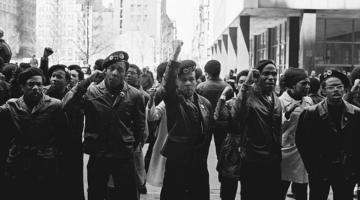
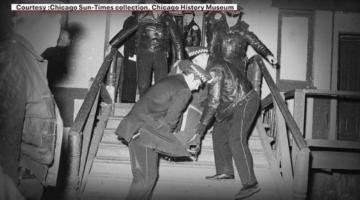
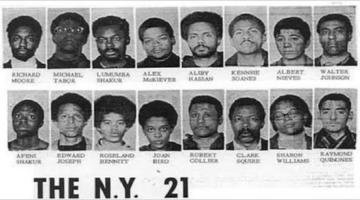
The indictment and trial of the New York “Panther 21” was an attempt by several elements of the US police state apparatus to destroy the Black Panther Party. Despite the fact that none of the charges stuck, one could argue that the attempt was successful. By the time the trials were over, there was no Black Panther chapter in New York City and the national organization was in a downward spiral. Of course, the New York 21 trial was only one aspect of the attack on the Party; others included police murders of party members, numerous other trials on fabricated charges, police infiltration of the party, and other forms of activity too numerous to recall. All of this law enforcement action was part of the national operation coordinated by the FBI known as COINTELPRO. The original indictments were handed down on April 2, 1969. Police raids took place across Manhattan and Brooklyn. Most of those on the indictments were arrested that day and the next. Some members were able to disappear underground. The trial ended on May 12, 1971. All of those charged were acquitted on all 156 charges. The jury only took a few hours to reject the prosecution’s charges.
“By the time the trials were over, there was no Black Panther chapter in New York City and the national organization was in a downward spiral.”
A collective biography of the defendants in the case titled Look for Me in the Whirlwind was published in 1971. Borrowing its title from a speech by the Pan-African nationalist Marcus Garvey, it was available for a short time during that period. I recall seeing it for the first time in a bookstore in downtown Frankfurt am Main. A friend who was recently discharged from the Army and in the Panthers lent me his copy so we could discuss it in the “study” sessions we had in a city park. Read together with Huey Newton’s Revolutonary Suicide and Bobby Seale’s Seize the Time, the text rounded out a reading list that took books like Claude Brown’s Manchild in the Promised Land and Richard Wright’s Native Son and moved them into a hyperpolitical space.
Recently, PM Press took the original text of Look for Me in the Whirlwind and added some more recent articles, poems and reflections written by a few of the original defendants and their supporters. Titled Look for Me in the Whirlwind: From the Panther 21 to 21st-Century Revolutions, this book is both an essential piece of history and a call to reinvigorate the movement for Black liberation and free those still imprisoned as part of the COINTELPRO operation four decades ago. Perhaps the most striking (and distressing) aspect of the additions to the original text is the fact that the struggles of the late 1960s and early 1970s are so similar to the struggles of today. Then again, given the history of the United States, maybe it isn’t so striking after all.
“This tale is testimony to the audacious determination of the individuals to free themselves from their economic and political oppression.”
Essentially an oral history, the original text tells the story of a group of Black women and men in the United States and their struggle for freedom and justice for themselves and their people. As the stories progress, the reader is presented with police brutality, urban poverty, the life of struggle and the hustler’s life. More importantly, though, is the stream of an expanding political consciousness experienced by all the Panthers involved. This tale is testimony to the times, the work of the Black Panther Party and other revolutionaries and the audacious determination of the individuals to free themselves from their ecnomic and political oppression.
While I was reading this edition of Look For Me in the Whirlwind, a friend and I had a discussion about Frederick Douglass, William Lloyd Garrison and the question that some historians consider to be what placed them at odds. This question revolved around whether the Constitution was a slaver document and therefore needed to be replaced, since the end of slavery was not possible as long as the Constitution was written the way it was. In a rather synchronistic manner, Look For Me in the Whirlwind ends with a letter to the judge who presided over the trial of the 21 detailing how the Constitution was not just a document that upheld slavery but that is designed to uphold the racist reality of the United States.
“The struggles of the late 1960s and early 1970s are so similar to the struggles of today.”
Graced with a cover that features the artwork of Black Panther artist Emory Douglas and a design by the modern day graphic artist Josh McPhee, this book is nicely edited by political activists déqui kioni-sadiki and Matt Meyer. It includes writings by several Panther members and is by its very existence a reminder of the Black Panther Party’s continued relevance in a world where white supremacists still control much more than just the conversation. It is also a call to work for the freedom of those Panthers and allied political prisoners still in prison. Look for Me in the Whirlwind reminds the reader that in a racist nation, political action fighting that racism is often criminalized. Reading this book is one of the better written efforts in pointing out that it’s the system of white supremacy that is criminal, not the people fighting it.
Ron Jacobs is the author of Daydream Sunset: Sixties Counterculture in the Seventies published by CounterPunch Books. His latest offering is a pamphlet titled Capitalism: Is the Problem. He lives in Vermont. He can be reached at: ronj1955@gmail.com.
This article previously appeared in Counterpunch.





 by BAR poet in residence Raymond "Nat" Turner Our poet recalls the living memory of the Watts LA uprising a half century ago this week
 by Danny Haiphong Social media, like conventional print and broadcast media, are tools in the hands of the owning class. Consumers of these media are distracted and miseducated with lies, irrelevant…
 by Ann Garrison Barack Obama will likely be remembered by history as the president that honed “humanitarian” intervention into a favored weapon of regime change. Samantha Power is the trigger. The U.…
 by Thomas C. Mountain China will soon station 10,000 troops in Djibouti, on the Red Sea in the Horn of Africa, alongside U.S., French and Japanese bases. When they wake up to the new reality,…
 Alemayehu G. Mariam Last month, President Obama declared that Ethiopia has a “democratically elected government.” That is the country where, in May elections, the ruling party won all the 547 seats…



