by BAR executive editor Glen Ford
The best thing that could happen to poor Black people is for a Katrina-like catastrophe to hit their city, scattering them to the four corners of the country. So says an article in a leading “liberal” magazine, which maintains that “the forced exodus of Katrina should be replicated as public policy, for the good of both the purposely displaced and society as a whole.” In the real world, white supremacy and capitalism created the ghettos.
Katrina: The Logic of Genocide
by BAR executive editor Glen Ford
“Black populations in the United States are concentrated because of white supremacist behavior and capitalist public policy.”
The very upscale New Yorker magazine marked the tenth anniversary of Hurricane Katrina with a celebration of the benefits that supposedly accrued to the 100,000 mostly Black and poor people forced into exile from New Orleans. “Starting Over,” by magazine staff writer Malcolm Gladwell, a biracial Canadian who made his bones promoting the hyper-aggressive “broken windows” police strategy, concludes that involuntary displacement is a good thing for people who are stuck in “bad” neighborhoods or bad cities where poverty is high and chances for upward mobility are low. Since every heavily Black city in the country fits that description, the logic is that Black people should be dispersed to the four winds and prevented from forming concentrated populations.
The forced exodus of Katrina should be replicated as public policy, for the good of both the purposely displaced and society as a whole.
Gladwell deploys selected studies of neighborhood and county economic health to buttress his inherently racist argument. One study rates locales by the statistical chances that children of people in the bottom fifth of society will move up to the richest quintile. Places like Seattle, Salt Lake City, and Minneapolis – all quite white – score very well by this measure, with Seattle at the top. New Orleans Parish is almost at the bottom, scoring 99th out of 100 counties, just ahead of Fayetteville, North Carolina. Virtually all of the bottom-scoring locales ranked by Harvard University’s Raj Chetty, on whom Gladwell relies, are heavily Black and brown: Baltimore, Chicago, Detroit, Milwaukee, New York’s Bronx borough. The conclusion is clear: such places of low economic mobility must be broken up, and their populations scattered.
“The logic is that Black people should be dispersed to the four winds and prevented from forming concentrated populations.”
Another study shows that prison inmates that relocated to other cities because they could not return to their no longer existing New Orleans neighborhoods were less likely to go back to prison. Gladwell quotes David Kirk, a sociologist trained at the University of Chicago, now teaching at Oxford. “Those who went home had a recidivism rate of sixty per cent,” said Kirk. “Those who couldn’t go home had a rate of forty-five per cent. They moved away. Their lives got better.” Conclusion: in addition to hard prison time, offenders from Black inner cities should be sentenced to a life of exile, in the interest of diminished recidivism.
Gladwell’s numbers games are nothing new. Apologists for imperialism, slavery and Jim Crow have long abused statistics to prove the benign effects of their savagery. The white regime in South Africa justified apartheid by citing statistics that showed Black South Africans lived longer and were better educated than Blacks elsewhere on the continent, i.e., they never had it so good. In reality, highly regimented Black labor had created an economically developed society in South Africa, a small portion of the benefits of which trickled down to the Black majority. American segregationists made similar comparisons between Africans on the continent and “their” Blacks, whose forced labor was the engine that propelled the U.S. to world power and unprecedented technological heights. A statistical case could be made that the best way for an African woman to ensure that her descendants would have at least some access to Western wealth and science, would be to offer herself to the captain of the nearest slave ship.
By Gladwell’s warped reasoning, young Black people in New Orleans with a history of encounters with the criminal justice system should be picked up and exiled straight from the street to Seattle or Salt Lake City, before their next conviction, for the greater good. If the exiled young man was raised in a neighborhood of deep poverty, the rest of his family should probably be sent out of town, too – but not to the same city as the son, since that would tend to further concentrate the Black poverty that, according to Gladwell, makes cities go bad, and would also reinforce the son’s bad habits. Momma and daughter get a ticket to Minneapolis.
“Apologists for imperialism, slavery and Jim Crow have long abused statistics to prove the benign effects of their savagery.”
Not that Minneapolis would welcome a steady flow of new Black arrivals; neither would Salt Lake City and Seattle, nor any other mostly white destination. Black populations in the United States are concentrated because of white supremacist behavior and capitalist public policy. Black people didn’t design the ghettos, or create 67 percent Black majorities like pre-Katrina New Orleans, or today’s 82 percent Black Detroit. White “flight” – a refusal to share urban space with Blacks – and government and corporate economic and spacial engineering concentrated Black Americans in the inner cities (and, previously, the “Black bottoms”) of the United States. The Black cities were then starved of capital and jobs, saturated with drugs, and locked down by a thoroughly racialized criminal justice system, the largest and most pervasive on the planet.
The Gladwell’s of the world maintain that the Black poor must pay for the crimes of white supremacy and capitalism through perpetual exile, traveling from city to city in pursuit of a squat in the “best” neighborhood:
“The neighborhoods that offer the best opportunities for those at the bottom are racially integrated. They have low levels of income inequality, good schools, strong families, and high levels of social capital (for instance, strong civic participation).”
Sounds like a neighborhood with good jobs, where the police do not prey on the young. Black people, like anyone else, would thrive in such surroundings, as minorities or majorities. But such places do not remain integrated long in the U.S. They are either reconfigured by white flight, or ethnically cleansed by gentrification. Once whites flee, the structures of public and private support are withdrawn. White supremacist behavior in a capitalist society means that the presence of “too many” Black people will always devalue property and neighborhoods, so Blacks will always be chasing whites in search of “good” neighborhoods which turn “bad” once too many Blacks find them.
It is far too kind to say that Gladwell and his white supremacist sociologists and statisticians blame the victim. The logic of their reasoning is genocidal: the elimination – rather than mere deconcentration – of “bad” populations.

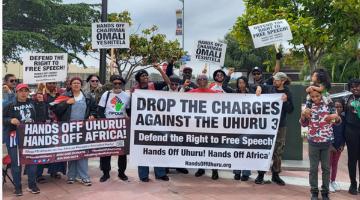 The federal trial of the Uhuru 3 has begun. The egregious charges of being foreign agents don't bode well for the future of free speech and the radical Black movement. However, the movement will…
 The new lithium mining project between Germany and Serbia appears to be part of an ongoing imperialist strategy to compete with China. The Serbian people are rising to reject this project and…
 The options for political representation are bleak - it may be better to say there isn't much of a choice at all. With Kamala Harris as the Democratic nominee, voters may have someone who presents a…
 Liberals are demanding that Black people in the U.S. put aside our long tradition of anti-imperialism to support Kamala Harris and sacrifice Palestine in the process.
 Israel has increased its attacks in the West Bank as it pushes to expand its settlements and attempt to expel Palestinians from their lands.


