by Jeffrey B. Perry
The same folks who'd have us believe politics is just Republicans and Democrats, and that the current black political class is the culmination of black history have tried to erase the history of black giants like socialist Hubert Henry Harrison, whom historian Joel A. Rogers called “the foremost Afro-American intellect of his time.” and who was a mentor to Marcus Garvey.
On the 132nd Anniversary of Pioneering Black Radical Hubert Henry Harrison's Birth
by Jeffrey B. Perry
Hubert H. Harrison (1883-1927) is a true giant of Black, Caribbean, Diasporic African, and U.S. radical history. He was a brilliant writer, orator, educator, critic, and political activist who was described by the historian Joel A. Rogers, in World’s Great Men of Color, as “the foremost Afro-American intellect of his time” and by A. Philip Randolph as “the father of Harlem Radicalism.”
Harrison was born to an immigrant mother from Barbados and a formerly enslaved Crucian father on Estate Concordia in St. Croix, Danish West Indies (now U.S. Virgin Islands), on April 27, 1883. On St. Croix he lived amongst immigrant and native-born working people, learned customs rooted in African communal systems, and grew with an affinity for the poor and with the belief that he was equal to any other. He also learned of the Crucian people’s rich history of direct-action mass struggle including the 1848 enslaved-led emancipation victory; the 1878 island-wide “Great Fireburn” rebellion in which women played prominent roles; and the October 1879 general strike.
After arriving in New York as a seventeen-year-old orphan in 1900 Harrison made his mark over the next twenty-seven years by struggling against class and racial oppression and by helping to create a remarkably rich and vibrant intellectual life among those he affectionately referred to as “the common people.” He played unique, signal roles in the development of what were, up to that time, the largest class radical movement (socialism) and the largest race radical movement (the “New Negro Movement”/Garvey movement) in U.S. history. His ideas on the centrality of the struggle against white supremacy anticipated the profound transformative power of the Civil Rights/Black Liberation struggles of the 1960s. His talks before large crowds at Wall and Broad Streets (on Socialism) and in Harlem after the 1917 pogrom against the East St. Louis African-American community (East St. Louis is less than 12 miles from Ferguson) were precursors to recent “Occupy” and “Black Lives Matter” movements.
Harrison was the foremost Black organizer, agitator, and theoretician in the Socialist Party of New York during its 1912 heyday; he founded the first organization (the Liberty League) and the first newspaper (The Voice) of the militant, World War I-era “New Negro Movement”; edited The New Negro: A Monthly Magazine of a Different Sort (“intended as an organ of the international consciousness of the darker races – especially of the Negro race”) in 1919; wrote When Africa Awakes: The “Inside Story” of the Stirrings and Strivings of the New Negro in the Western World in 1920; and he served as the editor of the Negro World and principal radical influence on the Garvey movement during its radical high point in 1920.
His views on race and class profoundly influenced a generation of “New Negro” militants including the class radical A. Philip Randolph and the race radical Marcus Garvey. Considered more race conscious than Randolph and more class conscious than Garvey, Harrison is a key link in the two great trends of the Black Liberation Movement – the labor and civil rights trend associated with Randolph and Martin Luther King, Jr., and the race and nationalist trend associated with Garvey and Malcolm X.
Harrison also was a pioneer Black activist in the freethought and birth control movements; reportedly developed "the first regular book-review section known to Negro newspaperdom"; and helped develop the 135th Street Public Library into what has become known as the internationally famous Schomburg Center for Research in Black Culture.
People are encouraged to commemorate Hubert Harrison’s life and work and to share information on him with others.
Additional information on Hubert Harrison the Voice of Harlem Radicalism, 1883-1918 can be found at:
For more information on Hubert Harrison see
For a video on Hubert Harrison from Boston Neighborhood Network TV
Jeffrey B. Perry is an independent, working class scholar who preserved and inventoried the Hubert H. Harrison Papers (now at Columbia University's Rare Book and Manuscript Library) and is the editor of A Hubert Harrison Reader (Wesleyan University Press, 2001) and author of Hubert Harrison: The Voice of Harlem Radicalism, 1883-1918 (Columbia University Press, 2008). He is currently working on volume two of the Hubert Harrison biography, editing Harrison’s writings for placement on Columbia University’s Rare Book and Manuscript Library webpage, and preparing a new edition of Harrison’s When Africa Awakes for Diasporic Africa Press.

 Black Agenda Report Editor and Columnist, Ajamu Baraka, recently gave a presentation at the 4th International Conference “Palestine: The Nation’s Central Cause.”
 The US and Israeli war of aggression against Iran continues the ecocide committed against the people of the region.
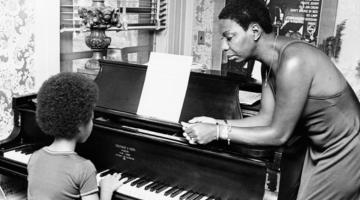 "Play, Black Girl, play! (For the Oakland Public Conservatory of Music’s girls)" is the latest from BAR's Poet-in-Residence.
 It should be clear to Gulf Arab states hosting US bases that the American presence does not protect them but instead places them in danger.
 Kenyan workers are still the underpaid labor behind A.I. training, moderation, and sex chatbots. The Data Labelers Association is fighting back.


