by Danny Haiphong
Automation has conveyed great advantages to capital over labor, worldwide. Black American revolutionary worker James Boggs “asserted that the only effective counter offensive to automation’s assault on labor would be for workers to make ‘politics’ instead of ‘things’” – that is, to create a more humane social system.
Lessons from James Boggs: Capitalist Automation in the 21st Century
by Danny Haiphong
“The racist antagonisms in the UAW led Boggs to revolutionary conclusions about the US capitalist system.”
The primary principle of capitalism is the maximization of profit from the exploitation of labor. Capitalist exploitation has transitioned into its imperialist stage, where no corner of the globe is untouched by its plunder. Imperialism has rapidly expanded the production of technology. Bourgeois economists often equate the rapid development of technology with progress for (white) “civilization.” However, technological development in the grips of capitalist logic has proven to be an enemy of the global working class, whose conditions are worsening due to the inherent contradictions of the world capitalist system.
James Boggs was a revolutionary Black autoworker in the Post World War II era, a period where technology boomed from the vast expansion of “war-time” industries. He broke from the racist leadership of the United Auto Workers (UAW) to help organize the League of Revolutionary Black Workers in the early 60's. Boggs organized Black workers, a growing sector of the working class that was first hired and first fired for the worst industrial jobs and excluded from union leadership. The racist antagonisms in the UAW led Boggs to revolutionary conclusions about the US capitalist system, especially the ways in which it utilized technology for automation.
In The American Revolution: Pages from a Negro Workers Notebook, Boggs examines the impact of capitalist automation. During the industrial period of US capitalism, advanced technologically was first implemented to speed-up, or automate, productive factories. This development grinded away at traditional labor union structures, displacing “skilled” workers and pressuring labor unions to bargain for defensive protections of "bread and butter" gains instead of offensive campaigns for workplace power. Boggs asserted that the only effective counter offensive to automation’s assault on labor would be for workers to make “politics” instead of "things." Automation paved the way for deindustrialization and precipitated a decline in conditions for all workers that could not be remedied under the US capitalist system.
“Technological development in the grips of capitalist logic has proven to be an enemy of the global working class.”
Today, the impact of automation in the era of finance capitalism is felt by the oppressed both in the US and abroad more harshly than Boggs could have detailed at the time. Automation has produced a decline in the total rate of profit alongside heightened insecurity for workers. Capitalist profit derives from the amount of labor time unpaid, or simply put, from capitalists paying workers less than their output produced over time. This is the basis of labor exploitation. Technology creates a decrease in the total rate of profit because it is a past product of labor exploitation. Thus, technology is a cost for capitalist enterprises. And under capitalism, costs to profits means consequences for workers.
In response, monopoly capitalists have instituted massive layoffs, increased labor output per worker, relied on usurious financial speculation, ordered permanent state intervention under prolonged crisis, and globalized imperialist economic and military power to secure needed resources on the cheap at the expense of entire nations. These actions have cushioned capitalist profits from the negative impact of automation on profits. However, they have also sharpened the contradictions of capitalism. On the one hand, technology has assisted capitalist enterprises by allowing them to increase production and labor exploitation. But on the other, automation has exacerbated the permanent, growing crisis of overproduction in the world capitalist system.
Automation requires the capitalist class to increase labor exploitation to astronomical levels. Wages are falling nationally and globally. Real unemployment only rises or holds steady. Finance capitalists are on a relentless search for new ways to indebt workers and capitalize on their own economic crises. Mortgage-backed securities, rental-backed securities, and student loan debt are contributing to the permanent crisis of overproduction. This is the most important contradiction of global capitalism. The growing impoverishment of workers hinders the ability of capitalist enterprises to sell their products on the market, leading to global economic crises such as the financial collapse of 2008. This forces capitalist enterprises to institute cost-cutting measures and lobby for state subsidies to stabilize profits, further impoverishing the rest of us and creating conditions for future, and larger, economic collapse.
“Wages are falling nationally and globally.”
The National Employment Law Project (NELP) and Oxfam recently published studies that underscore how the capitalist system has exacerbated exploitation for the majority of the global working class and oppressed. The NELP found that low wage jobs constitute nearly 60 percent of "growth" since 2008. Oxfam's study revealed that 85 individuals possess as much wealth as the world's 3.5 billion poorest. Activist and scholar Michael Parenti corrected these findings, rightfully asserting the impossibility of the 3.5 billion poorest possessing as much wealth as the 85 richest. 80 percent of the planet lives on less than $10 a day while the 85 richest own most of the means of production of the capitalist system responsible for this disparity.
These insufferable conditions all connect back to the conclusions James Boggs made about capitalist automation. Boggs firmly believed that the destructive impact of automation was not a problem of technology itself but rather of the capitalist system from which technology is utilized. According to Boggs, automation requires workers to begin making politics instead of "things." The enormous productive and technological capacity capitalism is wasting on the exploitation of the many and profit for the few could easily provide the world's people with their basic needs and eliminate the necessity of work as it is currently constituted. It will be up to the independent organization of workers, communities, and oppressed people to create a politics of liberation in this historical moment. Our focus should not be on making "things" that will stabilize a crashing political order, but on building a new one capable of meeting the needs and humanity of all.

 Ajamu Baraka argued that the Ukrainian crisis was a “manufactured crisis” primarily created by the miscalculations of policy-makers in the U.S. and Western Europe who were blinded by the prospect of…
 According to Dr. Gerald Horne, greed and shortsightedness convinced the U.S. that it could achieve the strategic objectives of undermining German economic power by controlling the European market,…
 February is the designated month to honor presidents, but Black people should know better than to believe what they are told about any benevolence on the part of George Washington, Abraham…
 The president of Eritrea gives a wide ranging interview on the U.S. regime change effort against neighboring nation Ethiopia using the TPLF, and long-standing U.S. hostility towards his country.
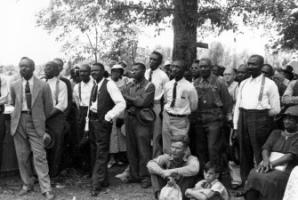 Southern farm workers joined in solidarity during the great depression.


