by Mark P. Fancher
Washington’s military tentacles daily tighten their grip on Africa, in ever deepening collusion with France. “Allowing the U.S., France and others to essentially take charge of Africa’s militaries creates or maintains an almost childlike dependence on imperialist forces.”
Africa Beware of Imperialism’s Fatherly Advice
by Mark P. Fancher
“The U.S. must remain committed to the militarization of Africa in order to preserve its empire.”
Throughout Africa, supposedly sovereign, independent countries are teeming with western military personnel who claim to be friends, advisors or partners with Africans. In truth, they create paternalistic relationships that lock a continent into submissive, subordinate facilitation of its own domination and exploitation.
Perhaps no entity flings “partnership” rhetoric with greater frequency and abandon than U.S. Africa Command (AFRICOM). An AFRICOM statement says: “AFRICOM’s Theater Security Cooperation programs (TSCP) remain the cornerstone of our sustained security engagement with African partners, are focused on building operational and institutional capacity and developing human capital, and provide a framework within which the command engages with regional partners in cooperative military activities and development.”
Nevertheless, it is France and not AFRICOM that is the undisputed master of paternalism in Africa. During the colonial era, a French government official boasted of a strategy to transform “the best indigenous [African] elements into complete Frenchmen.” Even during the period of decolonization France presented itself as a benevolent guardian and attempted to strong-arm its colonies into a continuing master-servant relationship. At the time, only the people of Guinea had the pride and character to sever ties with the colonizer. In recent years France has maintained an active military presence in Africa, particularly in places like Mali and Libya. It is therefore troubling that through AFRICOM the U.S. is now formally making common cause with France, which unlike the U.S. makes no efforts to disguise its troops in Africa as advisors.
“It is France and not AFRICOM that is the undisputed master of paternalism in Africa.”
A French Special Forces officer said: “The Americans want to get involved in Africa. That’s good for us. We know that with the Americans it will be more efficient. We use American logistics – that’s what we are missing. On the other hand, we provide the local knowledge.” With respect to support the U.S. is supplying France, Reuters reported: “The United States fast-tracked the sale of 12 Reaper drones to France last year, the first two of which started operating in Niger in January alongside U.S. drones already there.”
In return for U.S. support, France takes on the large, sustained military operations in Africa that are off-limits to the U.S. because of military budget cuts and a U.S. public that is increasingly war weary. The U.S. military is left to lurk in Africa’s shadows training and manipulating African armies and staging occasional quick-hit raids on alleged terrorists.
Although the U.S. must remain committed to the militarization of Africa in order to preserve its empire, the situation is nevertheless awkward. Congressman Frank A. LoBiondo said: “It’s a balancing act. Many of these [African] countries consider the U.S. a partner and strong ally, but they have serious concerns about what our footprint looks like.”
Africa’s concern should extend beyond what the U.S. footprint “looks like.” At issue is the continent’s dignity. Horrific, devastating attacks such as the recent murders of dozens of children at a Nigerian boarding school by the group Boko Haram, make it easier for western countries to persuade African governments that they lack the expertise and resources to counter terrorism. But allowing the U.S., France and others to essentially take charge of Africa’s militaries creates or maintains an almost childlike dependence on imperialist forces. Africa should have enough pride to engage in an independent analysis of its own circumstances. In some cases it is likely the solutions won’t require a military approach at all.
“African leadership has the capacity to address the root causes of the Boko Haram crisis without inviting western military involvement.”
Human Rights Watch researcher Eric Guttschuss told a UN news service the “root causes” of support for Boko Haram are “poverty and unemployment, driven by poor governance and corruption.” Guttschuss added that one of the group’s former leaders rallied support “by speaking out against police and political corruption [on behalf of Nigeria’s] vast numbers of unemployed youth.”
Abdulkarim Mohammed, another Boko Haram researcher, noted: “Boko Haram is essentially the fallout of frustration with corruption and the attendant social malaise of poverty and unemployment…The young generation sees how [the nation’s resources] are squandered by a small bunch of self-serving elite which breeds animosity and frustration, and such anger is ultimately translated into violent outbursts.”
Thus, African leadership has the capacity to address the root causes of the Boko Haram crisis without inviting western military involvement. A regional, if not continental focus on the needs of the most desperate elements of African societies would do much to eliminate the pool of recruits for groups engaged in violent attacks on civilians. Long-term, the solution is certainly the elimination of neo-colonial governments and a continent-wide, unified approach to the mass control and use of Africa’s natural resources. However, when Africa begins to walk down that path it will almost certainly find that its current western military “partners” will become fierce military adversaries.

 The convict labor system was once notorious in Mississippi – and it still is, under the guise of debt restitution.
 Black Self-Defense is Important, But Ideology is Paramount
 The US became deeply involved in global counterinsurgency after World War Two, said Stuart Schrader, a sociologist at Johns Hopkins University and author of “Badges Without Bo
 On January 31 activists plan to confront New York City cops in protests over high transit fares and police brutality, under the banner “F.T.P,” according to Shannon Jones, of
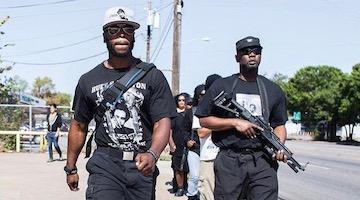 Yafeuh Balogun, a leader of the Dallas-based Huey P Newton Gun Club, which advocates armed Black self-defense, said the club was inspired by the “founding of the Black Panther



