by Wangui Kimari
Recent police excessive force against mass demonstrations in Brazil should not overshadow institutional state violence directed against the nation’s poor Blacks. “Many Black communities in Brazil are living in a state of siege” – levels of mass-produced death that can justifiably be called genocide.”
March Against the Genocide of Black People in Brazil
by Wangui Kimari
Photo by Lunae Parracho.
“These communities are asserting their right to survive and live free of state violence.”
“React or be Dead” is a campaign initiated by many Black communities and movements in Salvador, Bahia, and that has been taken up nationally, with the objective of organizing to fight against the police brutality, prison industrial complex and genocidal state of affairs in their communities. Essentially, these communities are asserting their right to survive and live free of state violence and its machineries such as the police, paid death squads, militias and extermination groups that seek to defend the status quo.
This campaign began in 2005 in an environment of unrelenting domination by the same political groupings that for decades control finances, means of production and also inevitably the systems of (in) justice and communication that predictably have racism as a key ingredient of this power -- an important instrument of which is the penal system. The deaths of thousands of Black youth nationally, whether by violent action or inaction, confirm this politics of genocide by those in political control.
These murders were more than enough to provoke the campaign “React or be Dead” which began as an articulation of Afro-Brazilian community and social movements in the struggle to politicize these deaths; an organizing that builds upon resistance by Afrikans in Brazil. Nonetheless, these homicides have not ceased in the eight years since the inception of the campaign, and in fact have increased even in spite of the activism of the Black movement in both national and international spheres, an activism that has seen them deliver reports and demands to both the United Nations and the Organization of America States. In contrast, homicides in Brazil are more than those in Iraq, a country that is at/in a “war” provoked by violent imperialist occupation. In light of this situation, it is not a stretch to declare that many Black communities in Brazil are living in a state of siege.
“Homicides are the principal cause of death for Black males between the ages of 15 and 29.”
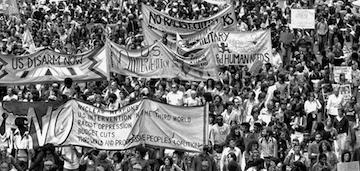
In recognition of this, and coupled with other organizing on different fronts, the “React or be Dead” campaign planned marches in at least three different cities in Brazil. This demonstration is referred to as the “March Against the Genocide of Black People.”
While the life expectancy of Afro-Brazilians is lower than other groups, and homicides are the principal cause of death for Black males between the ages of 15 and 29 years and who, often, live in poor urban settlements, it is important that the discontent with this state of affairs is shown in the streets. Furthermore, even the Ministry of Health documented in 2010 that over 53.3% of the roughly fifty thousand homicide deaths in Brazil are youths and from these 76.6% are Black Brazilians and 91.3% are young men. This is coupled with poverty and lack of access to services such as health care and education -- all wide spread manifestations of the white supremacy that is pervasive in the lives Black Brazil and which mark Afro Brazilians as “enemies to be combated” by the Police and injustice systems.
This is indeed a genocide.
In addition, the gendered implications of this situation are evident in many aspects. Black women, mothers, grandmothers, sisters, aunties are often left to deal, emotionally and materially, with the repercussions of the death, imprisonment or injury of one of their own. Moreover, it is often women who are tasked with looking for the bodies, often mutilated, of those who have been killed. Furthermore, it is women who wait for the news of the disappeared and dedicate themselves to implementing the healing(s) that their communities require in the face of this violence. Therefore we note that “the suffering of black women is not only perpetuated but is catalyzed by the state.”
The normalization of the genocide of young, black and poor males and their families, facilitated by the powers that be, must stop and it is for this reasons that Black communities and movements nationally have organized this “March Against the Genocide of Black People.” It is indeed “React or be Dead” since the color of homicides is indeed telling of the situation of many Black communities in Brazil.
From Oscar Grant, to Trayvon Martin to Zoltan Hyacinth and to all those many Black bodies that are murdered in the poor urban communities in Brazil, and wherever Black communities exist; these should no longer be our stories and survival should no longer be so consistently imperilled for Afrikan peoples.
As Afrikans, as allies and comrades please lend your critical solidarity to this initiative.
Wangui Kimari is a member of Network for Pan-Afrikan Solidarity (NPAS) Toronto and Bunge La Mwananchi/ The People’s Parliament in Nairobi, Kenya.

 “I have come to you tonite not just for the stoppage of nuclear proliferation, nuclear plants, nuclear bombs, nuclear waste, but to stop the proliferation of nuclear minds….”
 The state and vigilante lynchings of Black men and boys in the U.S. are not merely an aberration or a momentary relapse on the nation’s path to racial equality. They are part of the toolbox of…
 Similar to a predator realizing it is losing a fight and is reaching its end, the U.S. is lashing out and attempting to deepen its claws into subjugated nations like Syria, which just experienced a…
 For the first time since his departure from Syria, Bashir Al Assad shared a statement detailing the series of events which led to US backed regime change against his country.
 Journalist Krys Cerisier attended the COP29 climate conference, where they reported and conducted interviews with activists from around the world demanding funding for climate solutions from the…


