Contrary to Congressman John Lewis’ revision of history, “the notion that the Civil Rights movement was exclusively nonviolent is a popular mythology.” In fact, “Some members of Lewis’s Student Nonviolent Coordinating Committee picked up weapons and worked with community people to defend their lives against white terrorists.”
“Gun control for Black activists must be an issue of self-determination, self-reliance and self-defense.”
The recent debate concerning gun control is complex, particularly as it relates to African descendants in the United States. As almost every other issue in the US, the race dimensions of gun control cannot be dismissed. Slave-holding society fought to prevent enslaved Africans access to weapons to resist and increase potential for insurrection. After emancipation, Blacks sought arms not only to hunt, but to protect themselves from white supremacist terror. Gun ownership was associated with citizenship and liberty and as a means to protect those principles. The segregationists continued slave-holding society’s practice of attempting to disarm Blacks. Ultimately, Blacks utilized armed self-defense to protect activist leadership and their communities from white terrorist violence. It was a rite of passage for rural Black families taught children to use arms as a means of survival; for food and for protection. Black female youth were trained to shoot for defense from white rapists.
I have the utmost respect for Congressman John Lewis due to the sacrifice he made during the Civil Rights movement in the Deep South. In responding to those opposing President Obama’s gun control proposal’s Congressman Lewis offers that he and his colleagues in the Civil Rights movement, “… believed the only way to achieve peaceful ends was through peaceful means. We took a stand against an unjust system, and we decided to use this faith as our shield and the power of compassion as our defense.”
“Blacks utilized armed self-defense to protect activist leadership and their communities from white terrorist violence.”
The notion that the Civil Rights movement was exclusively nonviolent is a popular mythology. In dozens of Southern communities Black people picked up arms to defend themselves. In particular, Black people relied on armed self-defense in communities where Federal government officials failed to safeguard Movement activists and supporters from the violence of racists and segregationists, who were often supported by local law enforcement. Congressman Lewis statement is true for a small number of committed activists who engaged in civil disobedience and voter registration in Mississippi, Alabama, and Georgia. These activists were often protected by grassroots Black people armed with shotguns and rifles. Some members of Lewis’s Student Nonviolent Coordinating Committee picked up weapons and worked with community people to defend their lives against white terrorists.
The post-Civil Rights and Black Power era brought a new dimension of this issue for Black communities. A crisis in Black families resulted from welfare policy and increased individualism and the decline of the manufacturing economy that employed significant numbers of Black males. The federal, state, and local “Cointelpro” assault on activist Black leaders, organizations, and institutions weakened solidarity and Black political consciousness in the 1970s. Black communities experienced a growth in gang activity and an influx of drugs in this period. The access to automatic weapons and assault rifles paralleled the crisis in Black communities. Increased access of weapons to the most criminalized and unstable elements of the Black community only accelerated the crisis. Unlike generations of youth who were trained by their elders to protect their families and communities from emancipation through the Civil Rights and Black Powers era, large numbers of Black youth were supplied weapons in the underground economy.
“Black people will never disarm in a political and social environment where Black life is still challenged and not valued.”
As a youth growing up in Compton, California in the early 1970s, I heard a plethora of rumors of elements external to the Black community providing caches of military weapons that contributed to the fratricidal war between the Crips and the Bloods in Compton, Watts, and South Central LA. While this sounds like a wild conspiracy theory, it has been well documented that the FBI and local police agencies utilized “divide and conquer” tactics to incite fratricidal conflict between the Black Panther Party and the Us Organization in the same streets that the Crips and Bloods would inhabit a few years later. The dilemma of the criminal use of guns still poses a challenge in several urban and rural places today. This situation has motivated support for gun control in our communities.
Other politically and socially conscious elements challenge the gun control position based on the history of white supremacy in the US and the desire of racists to disarm Black communities. The growth of white supremacist and right-wing paramilitary formations and militias since the 2008 election of Barack Obama and the fatal shooting of young Trayvon Martin by a white civilian has done nothing to decrease the fear of white violence in the Black community. Several elements of the Black community recant the lyric of the late popular artist Gil Scott Heron, “when other folks give up theirs, I’ll give up mine.”
Gun control for Black activists must be an issue of self-determination, self-reliance and self-defense. Black people will never disarm in a political and social environment wherJohne Black life is still challenged and not valued. The Black community must advocate for policies that take weapons out of the hands of unstable elements (e.g. checks for mental illness), but be vigilant to make sure these policies do are not utilized in a manner to weaken the capacity of our community to defend itself from white supremacists. At the same time, more solidarity and grassroots organization of Black communities is needed to gain control and socialization of unstable elements of our community. Cooperative economic projects to provide alternatives to those trapped in the drug economy. The fight for the decriminalization of drugs and quality and culturally relevant education for our youth is another pillar in the fight to bring community integrity and solidarity and a safer community back.
Akinyele Umoja is an Associate Professor and Chair of the Department of African-American Studies at Georgia State University. He is the author of We Will Shoot Back: Armed Resistance in the Mississippi Freedom Movement (forthcoming by New York University Press, April 2013)

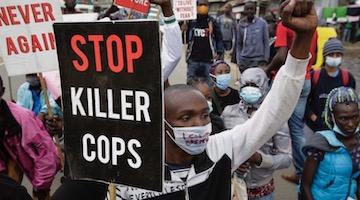 The Black judge listed the injustices of “qualified immunity,” which allows police and other government officials to escape liability for their law breaking.
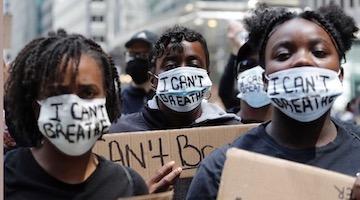 Some coronavirus deaths, especially early on, were mistakenly attributed to other causes.
 The same corporate media that shamelessly boosted Biden’s candidacy, even when his popularity plummeted, never question his sudden comeback at the polls.
 Harris’ identity as a woman of color has been propped up to cover for her decades-long loyalty to the ruling class, locking up working-class and poor people and deporting migrants.
 “Voluntourists” in Africa are actually jihadists for the West who defecate all over the continent in every way that defecation is possible.


