US in Military Misstep Over African Oil
by Antonia Juhasz
This article originally appeared in Foreign Policy in Focus.
"Africa is an area of
increasing activity for both Big Oil and the US military."

The number of Americans who believe that the war in Iraq
was a mistake has surpassed the number who felt the same way about Vietnam
during that war. At the same time, a much quieter US military build-up is
underway on another continent. The ultimate objective of the two efforts is the
same: securing Big Oil's access to the regions' oil. The impact in Africa will
likely be the same as in Iraq: perpetual occupation, instability, and growing
anti-Americanism.
In recognition of "the emerging strategic importance of Africa," President
George W Bush in February 2007 ordered the creation of AFRICOM, the US Africa
Command.
AFRICOM centralizes all authority for the US military operating in the African
region under one command structure. It also transfers many duties that previously
belonged to nonmilitary US agencies - such as building schools and digging
wells - to the jurisdiction of the Department of Defense. While fighting
terrorism in Africa is the primary reason given for the establishment of
AFRICOM, oil appears to be the more pressing motivator.
"A key mission for US forces [in Africa] would be to insure that Nigeria's
oilfields, which in the future could account for as much as 25% of all US oil
imports, are secure," explains General Charles Wald, deputy commander of US
forces in Europe in an interview with Wall Street Journal writer Greg Jaffe.
"A much quieter US
military build-up is underway on another continent."
To secure and maintain access to oil, if not for the nation, then most
certainly for our oil companies, the Bush administration has increasingly
turned toward the US military. Author Kevin Phillips coined the term
"petrol-imperialism" to describe the Bush administration's policies
in this regard, "the key aspect of which is the US military's
transformation into a global oil protection force". Under the rubric of
the Global War on Terror, the Bush administration has implemented the greatest
realignment of US forces since the end of the Cold War. With a map of Big Oil's
overseas operations, the world's remaining oil reserves, and oil transport
routes, one can now track the realignment and predict future deployments of the
US military.
Africa, with almost 10% of the world's remaining oil, is an area of increasing
activity for both Big Oil and the US military. Between 2000 and 2007, US
imports of oil from Africa increased by 65%, from 1.6 million to 2.7 million
barrels a day, according to the US Department of Energy. These imports, in
turn, accounted for a growing percentage of all US oil imports: increasing from
14.5% in 2000 to 20% in 2007. Both trends are expected to accelerate in the
future.
Oil Giants Increase Presence
Not only is the United States importing more African oil,
but US oil companies are also increasing their African reserves and their presence
on the continent. According to SEC tax filings, in 2000, ExxonMobil operated in
just three African nations - Angola, Equatorial Guinea, and Nigeria - and its
production there was negligible relative to the rest of the world. Today,
ExxonMobil also operates in Cameroon and Chad and is set to begin work in
Libya. Its African holdings account for nearly 17% of the company's global oil
reserves.
According to 2008 SEC Tax Filings, Chevron, ConocoPhillips and Marathon, among
other US oil companies, are also increasing their presence, with each operating
in three or more of the following countries: Algeria, Angola, Cameroon, Chad,
the Republic of Congo, the Democratic Republic of Congo, Equatorial Guinea,
Gabon, Libya, and Nigeria. According to US Energy Secretary Samuel Bodman, US
companies hope to expand their operations further, with Madagascar, Benin, Sao
Tome and Principe, and Guinea-Bissau among potential future targets.
"US companies hope to
expand their operations further in Africa."
Shell and BP, both with large US affiliates that are active in both US
political campaigns and domestic lobbying efforts, are also expanding their
already sizeable African operations.
The Bush administration has increasingly turned to the Department of Defense to
ensure more stable governments in Africa that are supportive of both the US
government and US (and US-affiliated) oil corporations and to guarantee an
amenable (some would argue, subdued) populace.
The Administration has increased the provision both of arms and direct military
services and training to Africa, such that today Angola, Algeria, Botswana,
Chad, Cote d'Iviore, the Republic of the Congo, Equatorial Guinea, Eritrea,
Ethiopia, Gabon, Kenya, Mali, Mauritania, Niger, Nigeria, Sudan, and Uganda are
all direct recipients of such assistance. General James Jones, EUCOM (European
Command) Commander, announced that US Navy carrier battle groups would shorten
future visits to the Mediterranean and "spend half the time going down the
west coast to Africa." The former French Foreign Legion base, Camp
Lemonier in Djibouti, became home to the US military's Combined Joint Task
Force - Horn of Africa in 2003.
"Of course it's
about oil, we can't really deny that."
US oil companies have long used African military and security forces to protect
their oil interests. Perhaps it is more honest for the US military to take more
direct oversight over these operations, but the risks far outweigh any
potential benefit. The United States is already engaged in one war for oil in
Iraq and the US military knows this. General John Abizaid, retired head of US
Central Command and military operations in Iraq, said of the war, "Of course
it's about oil, we can't really deny that." The concern is that, as it has
in Iraq, a larger US military presence in Africa will strain an already
overburdened military while increasing internal hostilities, regional
instability, and anger at the United States.
The answer to our nation's oil addiction is not to secure new and diverse
suppliers. We need to kick the habit and just say no, beginning with AFRICOM.
Antonia Juhasz is a Foreign Policy In Focus Policy Analyst. She is an
Associate Fellow with the Institute for Policy Studies and a Fellow with Oil
Change International. Her new book, The Tyranny of Oil: the World's Most
Powerful Industry, and What We Must Do To Stop It, will be released in
October by HarperCollins Publishers.

 Over a year in advance, the Black Misleadership Class has kicked their efforts to corral Black people into the Democratic party, despite the Dems’ apathy toward Black politics or the concerns of…
 The US empire is continuing its psychological warfare campaign by conducting a mass mobilization of resources and waging a propaganda offensive to protect its interests in the Middle East.
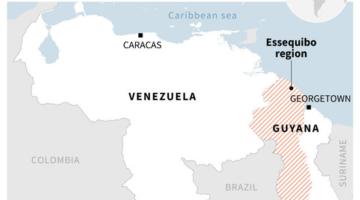 Despite the reality of US intervention causing inhumane conditions in the region, Venezuela’s push for the annexation of Guyana’s Essequibo region prioritizes its own political objectives,…
 Survivors open up about struggles with lingering post-traumatic stress disorder 18 years after the storm
 The high court in Nairobi will issue a ruling on a legal challenge to the deployment of 1,000 Kenyan police forces to Haiti as part of a “multinational force.” The US and UN-backed mission has been…


